Tag Archives: self-publishing

Awesome writing resource: Diversity Cross Check

I first heard about Diversity Cross Check on the Writing Excuses podcast (another amazing writing resource in itself).

So what is Diversity Cross Check? I’ll let them explain it for you….

Simple premise: You’re a writer interested in diversifying your characters, but you don’t share those experiences and you don’t want to offend anyone. A good resource is always those who understand firsthand what it’s like to live as such. So you visit the appropriate tag, find someone you’d like to work with, and contact them via whatever method they’ve provided.

How cool is that?

Often people lament about how little diversity there is in books. It seems an obvious thing to solve – write more diverse characters! Make them the protagonist! Avoid negative stereotypes!

It is easy, until you go to the next level down and start fleshing out said characters. Then you discover you have no idea what an Orthodox Jew would be doing at a certain point in their festive calendar – if you even know what that calendar is in the first place. Or the conflict a second generation immigrant from a specific nation in a certain city would be experiencing as they balance their new life against old world traditions and customs. Wikipedia can only go so far in answering these questions. It just provides more broad brush strokes for you to work with. The detail comes from those who live it.

The fear of accidental offence stops people from branching out from what they know. It’s limiting when it doesn’t need to be. Diversity Cross Check might be the best place to address an issue with a character you secretly want to write. Or it might ignite an interest in a minority waiting for someone brave enough to step forward and give them a main character voice.

Writing Goals 2015

This post is about writing goals, but it really can (and should) apply to any area of your life.

We’re a week into 2015 which means, according to the stats, that as many as 75% of you are still on track. Awesome. However, the stats also say that the number of us still sticking to those resolutions by the end of the month is going to nosedive like lemmings off a cliff. Less awesome.

My writing goals, along with my goals in other life areas, were not randomly plucked out of the air on New Years Day. I spent some quality time in December looking back over what I’ve achieved in the past year and where I went horribly derailed despite my best intentions. Live and learn people, live and learn.

Achieving goals is something I’ve come to realise is largely down to habits. Good habits specifically, like getting up at 6am to write, which I’ve been doing for about four years now. Understanding the bigger picture in working your way towards success takes more than just an hour of ‘I wish’. It also requires being brave. So, putting my big girl pants on, my goals are:

  • Submit, submit, submit, even when the rejections become demoralising
  • Self-publish 2 novels as my alter-ego
  • Finish writing the novel I’m halfway through
  • Write 2 new full length stories
  • Finish NaNoWriMo in a week (doing it in 3 days this year was astounding, but it damn near finished me off)
  • Keep this blog going for another year

There, that’s my caring and sharing done. It seems a lot, seeing it written there for all the world to see, but possible. Not easy, but all research indicates that goals should stretch you a little, even if that means they scare you a little too.

I’ve broken them down into monthly and weekly goals, so I can take baby steps. The monthly goals are written on an index card and blue-tacked above my desk, where they shout at my face all day long to remind me. At the end of the month, I’ll be able to see in black and white whether or not I’m on track.

So, without further ado, I’d better head off now and make some progress on one of them.

Perhaps after another cup of coffee…

When you get up in the morning, choose YOU

When you get up in the morning, choose YOU

NaNoWriMo – Head Down, Keep Going

For a lot of people still chugging away at NanoWrimo, this is the hard part. So I just wanted to write a very quick post of encouragement for those who are starting to believe the finish line will never arrive.

For those of you who have only written a thousand words every day – you are awesome. You have taken the time to write consistently and that is something that most people really struggle to do. Even if by the end of Nano that means you’ve only written 30,000 words, then who cares? You’ve still achieved and that is a great thing, even if November 30th appears and you’re still slogging away.

Or as Douglas Adams puts it:

I love deadlines. I like the whooshing sound they make as they fly by.

nanowrimo-logo

There will be some people who did great in the beginning then had a few rough days and now want to give up. That is completely understandable. Bad days can knock your motivation, enthusiasm and self-belief. Now is the time to stand up, try on your superhero pose and start again. Take anything, a line, a scene, an interesting character, and start writing. The beauty of Nano is that it doesn’t have to be perfect. Or even averagely good. It just needs to be written down and out of your brain.

For everyone else at all stages in between, the advice is the same. Keep going. The sense of satisfaction at seeing that progress bar hit the 50k for the first time is quite memorable. You might even find that you want to keep going when it is done. There are an increasing number of published novels out there that were NanoWrimo monsters to begin with, which is something to keep in mind.

Remember:

If you can tell stories, create characters, devise incidents, and have sincerity and passion, it doesn’t matter a damn how you write.
– Somerset Maugham

Now, go do it!


Why join a writing group?

I’ve been to several writing groups over the years, starting with my very first one when I was still at college. My dad, for a while, helped out with some adult learning and spotted a flyer for it at the local library and encouraged me to go. Over the years there has been quite a mixed bag and I’ve encountered all of the ones I talk about below.

My least favourite writing group is one full of pretentious arty farty types – think middle aged men in cravats –  who think they are qualified to give scathing literary critiques are required because they actually believe their eye is as good as a booker prize judge. They once had a letter printed in the back of the local newspaper and can crush the fledgling writer in their very palm. Which is good, because they haven’t got anywhere and they don’t want anyone else to yet either.

The other side of that coin comes in the group that is too friendly. Great for building up confidence and self-esteem, but if all the feedback is positive then you never really improve. It might be less likely to make you cry, but it’s really no more beneficial than the one above.

All too common is the giant writing group, where you only have two minutes and forty seven seconds to read 800 words and get a whopping 2 minutes of feedback. One of those minutes is usually wasted on deciding on who goes first. Not exactly useful.

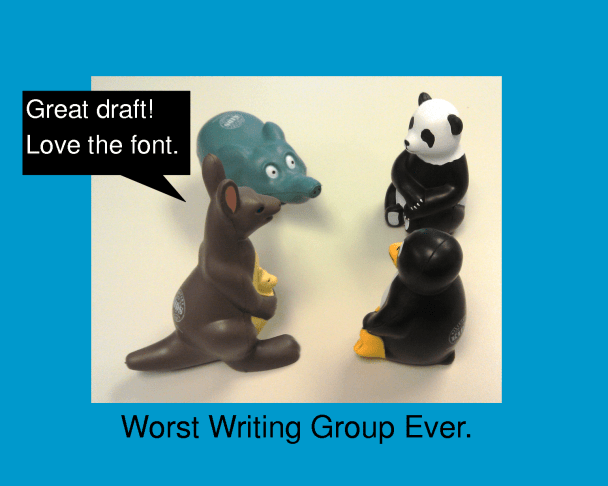
Found on the interwebz, contact me for credit

Found on the interwebz, contact me for credit


So, having run that psychological gauntlet, is it worth being part of a writing group? The answer is most definitely. But there are a couple of factors that have to be, like Goldilock’s porridge, just right.

The Right People

So you all love writing. Great. You have the sum total of one thing in common and you don’t even agree on that. It takes more than being a writer, but doesn’t automatically mean you need to have a heap of other similar interest either. What you do need is a group of people you like enough to trust. Sharing your WIP when it is a new thing, all yours, is an scary experience. If you fear getting shot down, or being given meaningless praise, then you’ll share the stuff that doesn’t matter most to you. You want encouragement, but also suggestions and help that is genuine. Trust will grow over time, but that means having the right people in the mix.

Genre

Make sure you’re not all writing in the same genre. This may sound counter-intuitive, but trust me, it’s not. Not because you might see the people in your group as competition – success can and should happen to everyone there if they deserve it – but because it dramatically reduces the group’s perspective. If you write literary fiction, being able to persuade someone who writes YA or SciFi will mean you have done more than just write for those who are already going to like it. That forces you to notice craft and really kick it up a level.

Experience

There is great value in having experience which spans from beginner to already published. A group of writers who have one or two rejections between them, have never networked, will by design have a limited perspective. Conversely, a group of published writers are also coming from the same perspective. A writing group comprised of people at all stages means that point of view can be handed up as well as down. No one there has an invalid opinion. Even if you are working on your first draft, you have the perspective that the rest of the group may have forgotten. Sometimes, this can be a handy reminder of why everyone is doing it in the first place. This mix, in my mind, is the most useful element you can have in your group.

Get these things correct and it’ll be smooth sailing. Of course, you might not get it straight away. Every group will evolve naturally over time regardless. But it stops writing from being a solitary experience, where the only people who understand are the people in your head. It will open your eyes to new worlds and perspectives.

My writing group now is a mix of all of the above and it is one of the most inspiring and motivation things I have ever been a part of. When I left for my spell in New Zealand, I felt its loss more than I probably should have done.

Anyone else had a similar experience? Do you know that annoying man in the cravat? Let me know in the comments!

So, what does it mean to Write Foxy?

On Sunday I was fortunate enough to attend Miranda Dickinson’s Write Foxy event, which was jam packed with some amazing guest speakers.

So what does it mean to Write Foxy? It does not mean you are limiting yourself to the topic of elusive woodland creatures. And although all of the speakers were female and Miranda is well known as a Romantic Comedy author, this was not a day exclusively for those who want to write ‘chicklit’. The whole day was genre unspecific and for those at any level of writing experience. To Write Foxy is to take back the passion of writing and do what you really love. A day legitimately and wholly devoted to the writing experience.

WriteFoxy


For me, there were several highlights and key moments in the day. The first was being completely vindicated by Hannah Beckerman (The Dead Wife’s Handbook) when it comes to planning. People always seem a bit suspicious of my level of planning, as though it somehow equates to a lack of creativity. Hannah was great at explaining how developing a strong structure in advance can actually create a sense of freedom when it comes to writing. There are no moments of panic when you feel like you are fumbling in a blind alley towards your ending. No sitting, staring at the blank screen waiting for the muse to appear. But nor is it so set in stone that there is no choice but to follow your original plan relentlessly. I couldn’t have completed NaNoWriMo in 3 days without a plan, that’s for sure.

Dead Wife

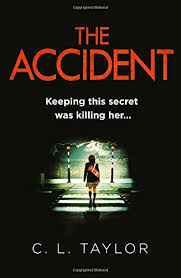
The aha! moment for the day came from Cally Taylor (Home For ChristmasThe Accident) who tackled the topic of editing. Or, as I like to call it, my nemesis. I realised that although I am meticulous in my planning, and my life in general, I have no such approach when it comes to editing. Instead, I get out a red pen and plod through the thankless task. No wonder I always get distracted by writing something new and shiny instead. Cally showed us a way of approaching editing that has given me a whole new perspective on getting from that first draft to a polished manuscript, without it feeling like pulling teeth. As my goal for 2015 is to actually do something with this fort of stories I’ve been building around myself, I feel like I now have a framework to help me learn to enjoy the task as a part of the writing process itself.

The Accident

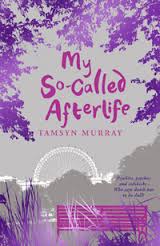
The unexpected laugh out loud moments came courtesy of Tamsyn Murray (Stunt Bunny, My So-Called Afterlife), who explained the three act structure to us in a way that was better than any of my English teachers ever did. Or maybe her choice of a well known children’s book as an example was just aiming it at my mental level… Now I’m re-reading this and wondering if I’ve managed to do it with this post (the piece of training documentation I wrote for work the other day though is something Aristotle himself would be proud of. Isn’t that what people mean by work-life balance?)

so called afterlife

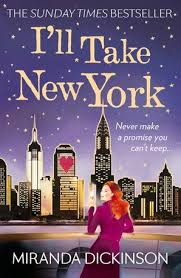
To round off the day, Miranda Dickinson (Take A Look At Me Now, and the soon to be published I’ll Take New York) gave everyone a timely reminder that for everyone there, no matter what they wrote, where they wrote, or how much they wrote, the whole point was still to have fun. To really love what you write and, more importantly, to give yourself the freedom to do so without guilt. Writing is a solitary process to begin with and hard to explain to friends and family without sounding like, well, a bit of a nutter really. I’m lucky that everyone I know has just accepted that I’m a nutter anyway and the whole writing thing is now quite incidental to that fact. But, despite the fact I don’t have anything traditionally published yet, I do now call myself a writer and say it like I mean it. For that, I will be forever grateful to Miranda for being a champion of the generosity mindset and always extending a hand down to help those on the way up.

It is something I hope to be in a position to do myself one day.

Take New York

There are still tickets available for the February Write Foxy day, so if you’re free and want to start taking your writing seriously (or if you already do and want access to a whole load of additional tips and tricks) then you should check it out here. Plus, if I haven’t sold it to you, there will also be free goodies and oodles of cake. Writing events should always be this well catered….

WriteFoxy

5 Reasons why I’ll be using Scrivener for NanoWrimo

Earlier this week, I read the bravely titled Why I Will Never Use Microsoft Word Again by the mighty Jeff Goins. People I know say that phrase all the time out loud, but few people in positions of influence in the writing world would commit it so defiantly to screen. Yet, as soon as I read the title I was nodding, partially because I already suspected what the solution would be.

The world at large has not yet moved on from Microsoft Word and I suspect it won’t for a while yet. Submissions, anything for the day job – Microsoft Word is the only accepted choice. Even with the huge increase in popularity of Apple products there has been very little give, with an emphasis instead on better conversion technology.

But when it comes to my writing, Scrivener is my tool of choice. For those of you doing NanoWrimo this year who have never tried it, there is a free trial on their website, available for both windows and mac.

But Scrivener is not just for fiction. I think that is a common misconception. Any piece of writing that requires more than a couple of sides of A4 plain text will benefit from it’s functionality. With that in mind, here’s why I’ll be using it for NanoWrimo.

Planning Tools

You can’t write a word of your novel itself before midnight, but there are no rules about pre-writing for Nano. In fact, I would positively encourage anyone trying it for the first time to do as much pre-writing as possible. Scrivener has the best outlining tool I’ve ever come across, and the cork board allows you to visually play with concepts, themes and characters in a way that is impossible on a  piece of simple word processing software.
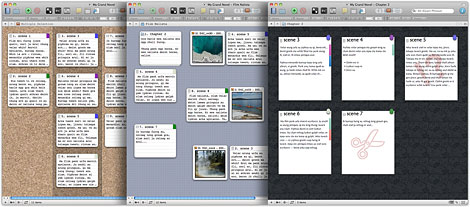
feature-corkboard

Name Generator

This is almost an afterthought for some people, but it has saved my bacon at 6am more than once. It’s amazing for those times when an incidental character turns up. You know the sort, the ones where you need them for a plot point but they don’t come with a back story or enough of a personality in your brain to instinctively know they are called Bob. The name generator tool can do either first names or both, with cultural, gender and language options if you need to narrow it down to something more specific. Don’t let trying to work it out derail your writing flow any longer.

Templates

Again, another key pre-writing feature that it just awesome. Scrivener comes with pre-developed templates for characters and settings, so you can keep track of the key details (nothing like your protagonist changing eye colour halfway through the book is there?). You can attach images and web content in Scrivener too, so keeping it all in one place is easy. What’s more, you can customise it so you can create your own templates. I’m trying my hand at an epic fantasy for Nano this year, so I have a template for my magic systems to make sure they balance each other out and the complicated details don’t get lost. One click and I can easily reference back, rather than having to search through an entire document to find a tiny but suddenly important detail.

Formatting and Fonts

Let’s face it, Word has become more and more complex. Whilst powerful functionality is good, it gets lost in amongst the everyday, and for most people, they never use any of it anyway. When writing a long document (again, regardless of fact or fiction), the key is to get quality content in place, not to be able to provide fourteen different types of shadowing to your title. I like the fact that Scrivener places the basic, everyday options up front and centre, with much of the formatting and additional functionality happening in the background. Instead the screen is taken up with the elements you need to keep your eye on, such as the binder on the left so you can see where you are in the grand scheme of things, and the synopsis notes on the right so you can drill down into the specifics of your current chapter. I love that my screen isn’t mainly wasted space.
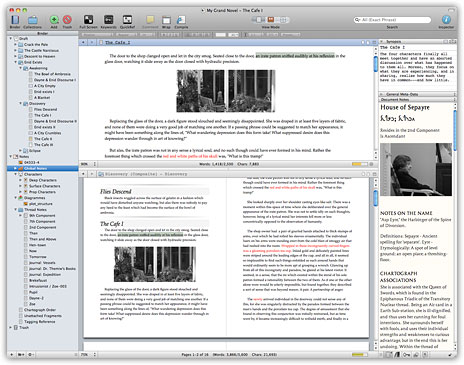
write_structure_revise

Project Targets

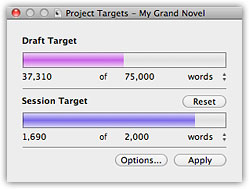
Again, a relatively small tool, but the one thing I love the most. The project target box sits happily in the corner of the screen, allowing me to see my daily word target, as well as the overall progress based on my estimates of the total length, and the countdown to deadline. The target can even dynamically change if the deadline is the key element, so if you have a day off, Scrivener reminds you that you have to put in the extra words over the life of the project. Simple, but oh so effective at 6am when you’re trying to do 1000 words before the rest of the world wakes up.

feature-statistics

Having started this whole thing by saying that everyone still uses Microsoft Word, it would be foolish of me to push something that then had no application in the real world. I’ve written 6 full length novels in Scrivener now and exported them all successfully to either Word, ePub or Kindle formats. Likewise, if you’ve already done some of your project in a different format, you can import into Scrivener if you want to give it a go.

So that’s why I always use – and will continue to use – Scrivener for all my writing projects, not just for NanoWrimo. Check it out and let me know what you think.

All images courtesy of literatureandlatte

My favourite things about New York

A quick Throwback Thursday to one of my favourite cities in the world.

I’m lucky enough to have been to New York three times. The first time was filled with relatively unhappy memories as it was in the wake of my father’s death and I was taking his place. That still feels like a painful tug at the heart, but I’m happy I got to see New York when the twin towers were still there.

New York is the setting for at least three of the stories I’ve written and I suspect it will be in many more. It has everything you need as a backdrop.

I’ve done New York in the winter and it was the perfect place for Christmas shopping. I have to say, it was probably the one time where something was as romantic as it is portrayed in the movies. Christmas trees, the displays in Macy’s, skating in central park. Not to mention my favourite picture taken from there, a winter sunset from the Empire State Building:

Sunset in New York

For me, that photo really captures what is special about New York. It is standing there, proud on the river, no matter what, and I can’t wait to go back again.

Book Review: Brilliant Freelancer

On a recent trip to my local library, I picked up Brilliant Freelancer by Leif Kendall. I wasn’t looking for anything in particular, but being British, things such as marketing myself have never sat that comfortably with me.

Nevertheless, it seemed like an interesting book to give me a bit of an overview and I have to say I was pleasantly surprised. Whilst there were the standard ‘of course you can do it’ messages – no one wants to push failure and inadequacy after all – it was refreshingly realistic. It posed the simple message that if you tried it and it didn’t work out then it wouldn’t be the end of the world. Even if you tried it, were hugely successful at it but didn’t enjoy it, then that was okay too.

Brilliant Freelancer

The book itself is divided up into sensible chapters and sub-grouped into key areas. It is all pretty high level stuff, but I think that is actually a strength. When you are first dipping your toes into the water with this kind of thing, having everything laid out before you in excruciating detail is more likely to simply induce fear and lead to trying absolutely nothing. Instead, chapters on how to find the most profitable and manageable work sat comfortably alongside how to motivate yourself and get stuff done. Being a self-employed writer is a road I am only just beginning to walk down, so I am happy with the baby steps for now.

Whilst this book wouldn’t serve as your only guide to freelancing ever, it was certainly a handy reference point to begin. If you are thinking about a strategy or just whether or not it is feasible to even do any self-employed work, this book will give you just enough information to hold the fear at bay so you can begin.


New Job and Writing

Next week I will begin the tricky balancing act of starting a new job with that of being a writer.

Essentially, it is starting a new full time role in addition to becoming self-employed and starting a business. Many people would not think of being an author as also being an entrepreneur, but in a lot of respects it definitely is.

There is the act of content creation and development, marketing, accounts and finance, as well as any legal elements that might be included. Depending on how much available time there is after a full day at work, this might eat into virtually all of what would traditionally be considered ‘free’ time.

clock

Of course, actual number of available hours is only a part of it. Time is only valuable if you have the mental energy to use it effectively. That is why some times you can get more done in a single hour than you can get done in an entire day. It becomes about leveraging that mental energy to make the best use of your time to get things done effectively. It may also be having the courage to admit that you are doing a job poorly and it is worth stopping now before you make a bad thing even worse.

This is what I will try to remind myself of over the next few weeks, when I feel as though my writing is not progressing as fast as I would like. I always commit myself 100% to an employer, something I believe to be vital if you want to be credible and trustworthy as a human being. Obvious caveats apply if your employer is treating you unfairly, of course. But my free time is the the time where the hardest fought battles will take place, because honestly, watching TV is just easier than locking myself away and editing.

I guess the hardest fought battles are the ones most worth winning.

I Hate Titles

As I’ll be moving on from New Zealand shortly, I have a few weeks where I can be completely devoted to writing.  This has led me to the realisation of how much I hate coming up with book titles.

Sometimes, I know from the beginning, which is great. When I don’t, I come up with a placeholder, because every file needs a name, right? Then I get to the point where I need a title and nothing seems to work. Nothing seems to fit. Worse, the more I think about it, the more ridiculous my brain gets until I just feel frustrated. In the end, everything sounds like a bad porn movie.

This past week, I have had to come up with two new titles for books in very different genres. The first is one I am submitting to agents to try to take down the traditional publishing route. I know that if I am lucky enough for it to go somewhere, then the title will no doubt get changed anyway. But I still need something a little catchy to begin with if I want to grab attention.

The second is for the first book in a series I am intending to self-publish under a pseudonym. That means there will be no team of professional title-makers to come up with one for me. Annoyingly, the second and third books have had their titles from the start, but this has been stuck with it’s placeholder for nearly a decade. That’s made it hard to shake in my own mind. I finally had the breakthrough last night, which means I can finally think about getting the cover art done. Yay.

Titles. I hate ’em (apart from when I love them).

So, in the spirit of the writing focus and the coffee I have ploughed through to keep going:

IMG_5474