Tag Archives: personal development

Best planner 2021?

Whilst most people consider getting a planner for the new year, serious planner nerds know that the time to start thinking about this in September. Some of the most popular planners in the world go on sale around then and sometimes they (or their accessories) are sold out long before January rolls around.

Kikki.K has fallen victim to the global economic crisis, so there are no UK stores anymore. This means I won’t be using the Dream Life Planner again next year. So what to use instead? My first thought was trying out the Hobonichi Techo Cousin, but it’s so expensive, especially if you also buy a cover and then get whacked with a customs fee when it enters the UK.

So what to do? Come up with something potentially even more expensive, of course!

Over the past few years, a new planner niche has appeared: the 90 day planner. This gives people the space to do serious planning with nice tools requiring thicker paper (i.e. fountain pens and other wet inks), without it being the approximate thickness and weight of a house brick. The other advantage is that every quarter, you get to try something new and get the feeling of a fresh start, which reduces boredom and keeps you more engaged with the planner you are using to actually get work done.

I think I’ve come up with four options I’m interested in, but I’m also very open to suggestions of any alternatives (90 days or otherwise) for 2021.

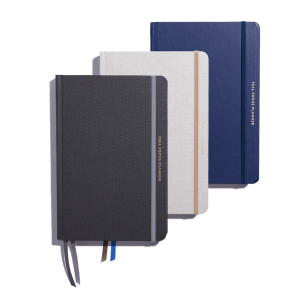
The Full Focus Planner is an obvious choice. It was one of the original 90 day planners on the market and is very productivity and goal focused. My planning is all about functionality rather than stickers and washi tape, so I can see how this would be a really good fit for me.

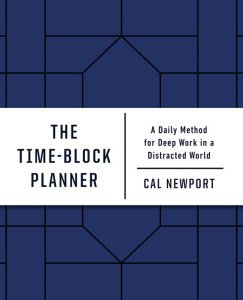
My second choice is a little bit more of a risk in that it’s not actually out yet, so there are no reviews or evidence of its success. I’m a fan of Cal Newport and some of the ways he approaches his day – no one can argue that he gets a lot done. So his Time Block Planner coming out later this year has already caught my attention.

Best Self Co. do a range of planners and again, productivity and personal improvement is at the heart of the process, rather than just tracking meetings and organising a to do list. The book that’s classed a planner is for 6 months, so I’d probably go with the ‘journal’ which is a 13 week goal book.

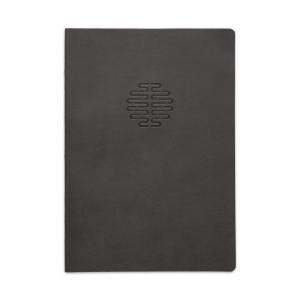
The final choice is significantly less structured than the others: the Theme System Journal from Myke and Grey over at Cortex. I’ve always found their podcast discussions on systems for working interesting, so I’m naturally intrigued. Plus Myke is a pen guy, so I know that I’ll be able to use my favourite fountain pens without worry.

Anyone else thinking of doing the same thing next year? Or, perhaps more importantly, has anyone already tried it and either had amazing success or found it to be an expensive crash and burn? Let me know in the comments before I go any deeper down the planning rabbit holes and spend the equivalent of a mortgage payment on notebooks…

A case for reading (and especially libraries) in a crisis

This week there has been a slow tip on a personal level towards things getting back to whatever ‘normal’ might be now. I’ve returned to work, albeit not on a full time basis, which has allowed me to get a sense of how I can finally plan this quarter and the summer season successfully. Not knowing when/if I would be going back led to a lot of procrastination and uncertainty. True, if things stay on track it will change again in October, but I’m happy with that marker as I’ve since realised it lines up nicely with planning out the final quarter of the year.

Side note: I can’t even begin to imagine how my yearly review is going to look at the end of December!

The other thing was that for the first time since the beginning of March, I had an email to say that I had a reservation to collect from the library. It seems like a whole lifetime ago when I placed the order (The Body by Bill Bryson, if you’re interested). As someone who still isn’t really embracing the ‘freedoms’ of post-lockdown, the thought of actually going into a library feels funny, but what doesn’t these days?

I have not read as much as many people during lockdown, but I have managed to stay on track with my two books a month goal I set for myself at the beginning of the year. When scrolling leads to nothing but anxiety and uncertainty, a good book is a solid reminder that this is but a snapshot in human history and suffering.

But more than that, I have always argued that the public library is one of the greatest democratising forces we have. Even if you don’t meet the requirements for borrowing in a specific library, you can go in there for free, sit in the warm, dry chairs and absorb whatever you feel like reading. It is easy to forget that in our current internet age and it is true that there is an entire generation who have not been taught to appreciate the library system. Under threat before, I wonder how many will fail to survive once this pandemic is over?

It’s also no surprise that despite their value, they opened after pubs and were prioritised less, which tells us something damning about our society I think.

I guess I am contemplating this more because it intersects with the current book I am reading, Digital Minimalism, by Cal Newport. I’m in a phase of seeking a more intentional life, one akin to the pre-child years, although I realise that will never entirely be the case again. Reading hard books and being able to lay my hands on them without having to worry about the financial outlay right now is a part of that. Academic texts are not exactly known for having a low price tag.

In fun stuff, I have identical format Moleskine and Leuchtturm pocket notebooks turning up next week. It’s been a while since I’ve tried the Moleskine one and now seems like a good time to do a direct comparison. I’ll be using them as my idea books (different to my daily carry list and notes book, which is usually a Field Notes, or my writing ideas and long form notebooks, which I prefer to be A5). Hopefully there will be enough differences that I’ll be able to write something about them here that could be helpful to people wondering which one is best for them.

Here’s to a happy and productive week!

Preparation and Planning

So, after several months at home, I am gearing up to return to the world of work. I’m not going to lie, it feels strange.

I’ve been very fortunate in that I live in the UK and have been furloughed. This has allowed us as a family to tick along from a financial perspective and for me to take on a significant role in childcare so my partner (who works in healthcare) can work as and when has been needed.

With that all about to change, it’s time to think about how to plan and prepare for a return to work. I did take a moment this morning just to sit outside with my coffee as the sun came up and most normal people were still in bed to quietly think about how to do this.

Coffee in silence

Schedules

We still have reduced childcare for the foreseeable future, so planning out our hours and time-blocking means we will hopefully manage the logistics of work without sacrificing too much combined family time. In the early stages of lockdown it felt like we were tag-team parenting which is not sustainable or healthy in the long term. I’ve been listening to Cal Newport’s podcast to get ideas from a fresh perspective.

Meal Planning

I’ve been doing this on a more ad-hoc basis during lockdown, simply because I enjoy cooking and the kitchen has been more accessible than when I was working full time out of the house. It’s time to think about batch cooking and quick and easy healthy meals – more of a challenge than it should be when you have a toddler under dietician supervision.

Downtime

I’ve struggled with relaxation the most over the past few months. We don’t have a large house, so there is a sense you’re never far away from other people or lego blocks. I have a lengthy commute to the office (usually an hour each way) so I am planning audio content so that it feels like there is some greater pleasure and purpose than simply getting from A to B. I also need to make sure to schedule and protect that alone time without feeling guilty (easier said than done).

Habits and Routines

I live my life by my habits and routines, but it’s worth noting that any significant change is an opportunity to review what you currently do and question whether or not it is still fit for purpose or if it could be done better. I’m thinking of moving things around to make it more likely that writing will get done. It’s likely that something will have to be sacrificed to make room for that, but I’d like to make it a conscious choice rather than anything else.

As more of us return to work, it’s clear that there will be a new normal for much longer than many politicians are willing to admit. It’s how we adapt to these changes without damaging our physical, social and mental health that will determine our success in the long term.

Getting out is harder than getting in

Here in the UK, or should I say specifically England (yay government unity… *massive eyeroll*), we’re definitely moving into the latter stages of re-opening our economy. From the 1st August even higher risk businesses will be allowed. Not soft play though, which is confusing given that everyone in government keeps banging on about the lower risk in the younger ages. Not that I’ll be going anywhere near one for quite some time.

So with that in mind, all I can keep thinking about is Jurassic Park. Just because you can do something, it doesn’t necessarily mean that you should.

The daily act of risk assessment is exhausting. As is the constant battle over the perceptions of others. Are you being too cautious and wasting your precious hours on earth? Are you being too complacent and therefore recklessly risking yourself, your loved ones and the whole of society? It’s far too easy to just swing from extreme to extreme, especially when you’re sleep deprived and a small child wants the door both open and closed and is having a meltdown until you manage to defy the laws of physics for them.

So… I am going to try a few things. They are all things that I was doing perfectly well before this happened, so I know that it’s possible.

  1. Keep writing. I actually completed what could be considered a beta version of a manuscript this week, done in small pockets of time during naps and before 5am. It felt good.
  2. Stop looking at the news. I hadn’t looked at the news for a very long time before this happened and now I’m always doom scrolling. It’s not good for my mental health and definitely pushes me towards the take no risks or we’ll all die! side of the spectrum.
  3. Avoid social media. Again, something I had mostly done, but somehow Twitter scrolling (if not posting) has snuck back in. I’d like to keep Instagram, but I have to make sure I only look at my following feed, rather than hit the explore button and have the algorithm feed me endlessly scrolling horror.
  4. Get outside more. The weather hasn’t been great here and it only takes a vaguely cloudy day for me to talk myself out of exercise. But then the autumn will be here before I know it and I’ll be kicking myself.
  5. Read more. I’m getting better at this again. If you’re taking bad habits out of your life, then you have to be proactive about what you replace them with. Nature abhors a vacuum. Reading is becoming my default replacement.

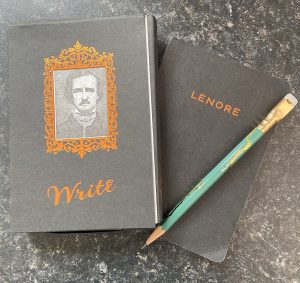
In keeping with my attempts at more control and optimism, I’ve finished yet another notebook that is mean and moody

and I’ll be replacing it with something more bright, optimistic and with a reminder that there is a world out there:

Have a good weekend everyone. Stay safe, stay healthy and stay sane!

Pandemic Planning Mindset

Everyone who knows me or reads this site knows that I’m a planner. One of the most relaxing things I can do is sit down with my physical planner, some nice pens and a coffee, and work through what’s coming up and what I want to achieve. This most recent quarterly review really made me consider mindset and much as actions.

I’d actually blocked a time aside in my calendar at the end of June and arranged to not be in charge of the small, loud tornado that is my toddler. I was looking forward to it, but when the day actually arrived I was feeling nothing short of meh. Instead of ploughing on with it, I decided to reschedule. Not once, but twice.

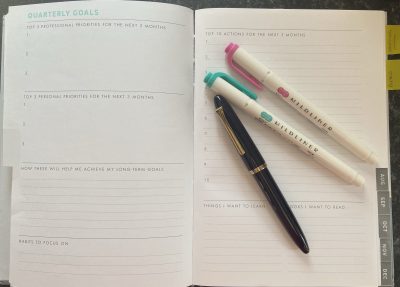
kikki.k planner

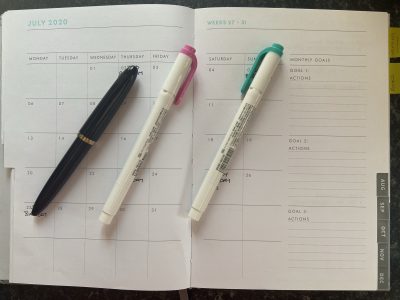
Current planner and essential mildliners

This isn’t like me, but given the current situation, it seemed like the most logical choice. It’s so hard to plan and dream when there are so many unknowns. Sure, the UK is coming out of lockdown, but so was Florida and Texas. Coming out of lockdown basically requires people to be sensible and thoughtful of others. I don’t have much faith in other humans at the best of times, but throw alcohol and new-found freedom into the mix and I can’t help but be prepared for a bumpy ride. Going into a planning and dreaming session with such a negative mindset is a recipe for disaster.

Add into the fact I was coming off a month of sleepless nights (my own fault for mentioning that a certain child had started sleeping through at last, thus causing some slapback from the universe), and I was struggling with the reviewing part, let alone the planning for the future.

Just grateful for coffee I guess

Quite simply, mindset matters, much more than the day of the week. It’s easy when you have a perfectionist, upholder streak to do the review at the set time and place because that’s the best way and what you always do. In reality, it won’t matter if your quarterly review isn’t complete until a week into the new quarter (I finally finished the detail of mine this morning). What matters is that you’ve set some goals and plans that you feel enthusiastic about and hopeful for and that are within your control. This isn’t the time for massive stretch goals, not unless you have no family responsibilities and a higher than average autonomy over your surroundings. The pandemic planning mindset is about incremental progress forwards and celebrating the small wins. We’re in this for the long haul.

Work with what you have right now

Anyone who wants a good framework on how to do effective reviews should sign up for Sarah Hart-Unger’s email list and get her free planner download. It’s pretty much exactly what I’ve done for years (although she uses a very interesting quintiles system rather than quarters), but her template looks much nicer than anything I have right now! Her blog is always worth a read, especially her current pandemic blogging streak.

And talking of email lists, it came to my attention that mine had been disabled for a week or so. It should all be sorted now (thanks to mail chimp for the speedy customer service), so if you’ve tried to download a template and it failed, then please try again. If you still have problems, feel free to get in touch and I’ll take a look as soon as I can.

GTD: Getting Started – Quickly

This post is part of my series about mastering productivity from the perspective of a full time working mom of a toddler with a side business. That’s me with the side business, not the toddler. 

There is something of a cult around Getting Things Done and that cult is desperate to set the methodology in stone. This ignores that David Allen admits straight away that there is all out or casual implementation. Which is good, given that his ‘Getting Started’ chapter suggests giving yourself two full consecutive days to start the process. Two full days.

In my dim and distant memory, I gave myself most of day when I first decided to give this whole getting organised thing a go. Now, I re-read the recommendation and part of me finds it hysterical to think that I could have anything more than a solid two hours without an interruption. So the first of the so-called golden rules I’m going to outright say you can ignore is that you need two days free in your calendar to even bother trying.
The key isn’t the amount of time, it’s the quality. If you have two hours of focused time, then you can move the needle more than if you have a luxurious day of unfocused, leisurely busywork. So if you have a single room, project or problem that needs dealing with, choose that and give it the attention it deserves. If you haven’t cleaned out your attic for the last ten years and you could go another ten before you actually care enough for it to bother you, then there is nothing to be gained by climbing up there and losing a day to sorting when there are more important things you could be working through.

Another pro-tip: if that attic seems super appealing to you, despite there being no obvious gain in wading through dust and old boxes, then stop and work out what other, genuinely important thing it is you’re procrastinating on that needs to be addressed.

If for some enviable reason you actually have the ability to go through your entire life in one sitting, then there is something very Marie Kondo in this approach. Where she deals with primarily physical things, David Allen associates those physical things with actions and tasks. Both are drains on the psyche when left unmanaged, but having recently read The Life Changing Magic of Tidying, the two books seemed to echo off each other in an unexpected way.

So, the ‘Getting Started’ chapter is all about setting yourself up to begin. Time is clearly one facet and I would argue that it is a factor we feel we have increasingly less of. Space is another – you obviously need to be in a location conducive to collecting and managing things. A dedicated space to sit, think and make decisions doesn’t need to be fancy, but it does need to exist. Even the most technology-savvy people cannot put their entire life in the cloud.

Much of the stress and input we deal with in daily life doesn’t come from our own processes and delivery mechanisms, but those of others. So until the entire world is virtual, then a physical inbox is a lifesaver. Never make the mistake of thinking this is a ‘paperwork tray’. Anything that serves as a physical reminder of something you need to do can get thrown in there. The majority might be cards and papers, but batteries, broken watch straps and cables, they can all go in there until you’ve captured the associated task into your system.

The final piece of the puzzle is the tools you need to begin the process. Here is where another of the golden rules can be broken – you do not need to have all of these items in place to begin.
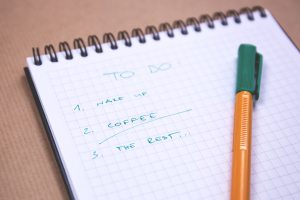
The original book was clearly written in the days prior to ubiquitous technology. With less paper in our lives, the requirement for a labeller and a filing cabinet with the correct type of hanging files seems quaintly retro. But don’t dismiss analogue altogether. Still keep a small notebook with tear off pages to hand – the act of writing down a quick thought is much easier to manage in the beginning than trying to digitally capture it.

I’ve also managed to do a successful large-scale implementation without the need for rubber bands, binder clips, scotch tape or the required minimum of three paper holding trays. The later version of the book retains all the previously listed tools, but includes any other tools already being used for data capture – a nod to the fact that anyone reading the book most likely has a phone with built-in task management and email – the ‘PDA’ is no longer the preserve of a handful of senior executives as it was in the original.

This overly prescriptive list can act as a barrier to getting started, regardless of whether you’re going for a work, home, or all-out implementation. Don’t let it.
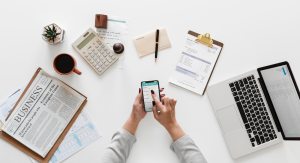
In both editions, the question of an organiser also comes up here. Yes, the question – do you actually need one if all you’re doing is list management? I’m going to go ahead and say yes you do. It doesn’t have to be high-tech, but you definitely need one. If you’re doing this, you already know if you have a digital or analogue preference, or if your workplace is locked down to a certain system. But make the decision now. It’s not necessarily the tool that you’ll stick with forever. You can change it once you’ve played around with it for a few weeks, but don’t gather all your ‘stuff’ into one place, panic when you realise how much there is and then realise you’ve got nowhere to put it.

GTD Golden Rule to break – you don’t need to have a single system that covers work and personal. I use Microsoft Outlook Tasks for work but Toodledo for personal and it has worked fine for years. I don’t want the constraints of either set of circumstances to force themselves on the other. I’ve got a slightly workaholic personality, so if I always have access to work, I’d never stop thinking about it. Having a clean break can actually be better for your mental health than the psychological effort of maintaining two systems.

After a brief argument for the start up items he’s listed, in the 2011 edition there is an extensive argument for the importance of good filing. This is all around the physical mechanics of storing paper where it is easily accessible. A few of the principles apply to the world we live in now, but in most businesses and households, this level of attention to paper storage is simply no longer required.

One thing I would take away from this is that physical paper forces something that digital seldom does: the requirement to purge before you simply run out of space. You can upgrade your virtual storage space at the click of a button, leaving most people with an amorphous blob of badly tagged ‘stuff’ with multiple providers. A yearly purge of data can be invaluable. What we do now is the digital equivalent of storing things in the shed in case it comes in handy later, then repeatedly buying bigger sheds until the tin of paint you want is buried so deep inside that when the time finally comes for it to be useful, you just buy a new one anyway.

In summary, getting started with something as complex as GTD should be as simple as possible.

  1. Assess the amount of time you can realistically give your total focus to and find the problem that fits. 
  2. Get yourself a place to physically sort things, preferably where you can repeatedly do a smaller version of this (the weekly or daily review). If you live a mobile lifestyle, then this can be achieved simply by the consistency of your bag set up and storage. It doesn’t need to be complicated. 
  3. Finally, get the basics of pen, paper, post it notes, a physical inbox and your list management tool of choice.

That’s it. You’re good to go.

Rhodia notepad – my best analogue capture device

Sometimes the best things come to us in life entirely by mistake. That’s exactly what happened to me with the Rhodia no 12 pad and it has turned out to be one of the most useful analogue tools I use.

Unlike my digital task management systems (which are separate for work and personal), this can be used for everything. A story or character idea? Check. A task I need to complete for a client? Check. Topping up the coolant levels in my car? Check. I just write the thought down, tear off the sheet and throw it in my inbox to be processed at a more convenient time.

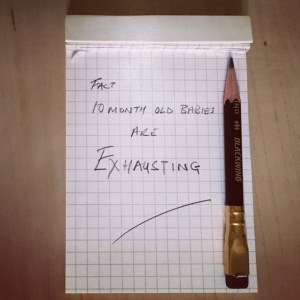
A frequent thought right now

I didn’t realise how small this was when I brought it. I’d heard people talk about how fountain pen friendly the paper used by Rhodia was and saw it at a reasonable price. Thanks to the one click simplicity of the internet, I’d paid for it and it was being delivered before I really looked any further. Initially I was disappointed, but at 85 by 120mm, it sat unobtrusively on my desk and was always at hand when a rogue thought popped into my head.

As part of the Getting Things Done methodology, David Allen talks about the benefits of writing down a single thought on a full size sheet of paper. Despite the recycling options now available, that feels wasteful to me. Post it notes don’t work out either, because although they are a similar, more convenient size, they stick to everything else in your inbox and inevitably get lost on the back of a letter that you filed.

The tear off perforations on the pad are sturdy but easy to rip. I’ve never had a sheet come loose, but nor have I ever had a ragged half-piece of paper where it got stuck and wouldn’t cleanly come free.

I never have to worry about what writing implement is already in my hand when the bolt of lightning strikes either. I’ve had a felt tip, a gel pen, a pencil and a nice juicy stub-nibbed fountain pen and none of them have bled through to the sheet below or smeared. When it comes to getting ideas out of your head so you can get back to what you’re meant to be doing, silly frictions like having to swap to a ballpoint will stop you from writing it down at all. I’m super lazy like that and, if you’re being honest, I bet you are too.

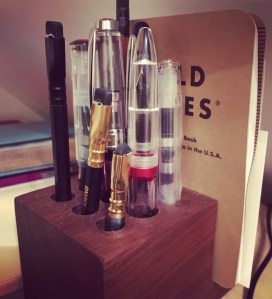
It’s even small enough to hide behind a Field Notes

So, for the perfect little desk or pocket notepad, it ticks all the boxes. I usually try to do a pros and cons list when I write about physical tools, but for this little buddy I can’t think of any cons. And with such high quality for such a low cost, it’s worth giving a go, no matter how high or low tech your system is.

GTD – Mastering Workflow, Mastering Life

This post is the first in my series about mastering productivity from the perspective of a full time working mom of a toddler with a side business. That’s me with the side business, not the toddler. 

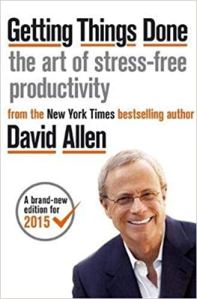
If you’re looking to be more productive, more effective and grow as a person, then there is a bewildering world of self-help business books out there to choose from. Some are fashionable for a year, others stand the test of time. David Allen’s Getting Things Done has been successful enough to warrant a brand new edition in 2015.

It’s always the book I recommend that people start out with. Not because it is a literary masterpiece, but because the methodology he describes allows you to sort out the little things so you then have the mental clarity and space to then deal with the bigger life questions. Books such as The 7 Habits of Highly Effective People start with life purpose and other lofty aspirations. I really don’t recommend that as a starter for anyone. Ever.

Despite saying the GTD method is for everyone (and it really is), the book is nevertheless aimed at business executives, with the secondary motivator of selling consulting services. I’ve never had to worry about forgetting to get flowers for my secretary’s birthday (although in the 2015 version I noted that’s been changed to a less culturally charged ‘assistant’). With that in mind, I want to show you over this series of posts how I’ve implemented it in my work, personal life and side business as a writer, without the requirement for a corner office.

Since 2009, I’ve probably read Getting Things Done at least once a year. That’s what I’ve always believed anyway. When I decided to write this series, it forced me not to just choose the bits I was most interested in, or needed a refresher on, but really read what he was saying like it was the first time I’d come across it. I’m not going to lie: the chapter on Mastering Workflow took effort.

I’ve heard so many people say they found the material ‘dry’ and ‘hard-going’. I’d never really thought that to be the case, but re-reading a chapter like this, so early on, I can see why people got stuck here. In a single chapter, he gives you the entire methodology. The remainder of the book is the detailed ‘how to’. I’m a fan of the big picture, but this is intense stuff.

Luckily, it can all be summed up in a handy flowchart. Get a copy. Put it where you’ll see it. It will be more helpful than constantly going back to this chapter while you’re starting out.

© David Allen

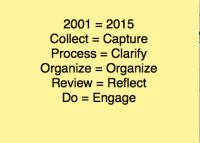
I find it interesting that the flowchart remains unchanged, but the titles for the stages have been updated between the two books.

What next?

“Every decision to act is an intuitive one. The challenge is to migrate from hoping it’s the right choice to trusting it’s the right choice.” – David Allen, 2001 Edition

Instead of being overwhelmed by this chapter, I’d suggest doing a quick assessment of where you are now. Some simple things to consider:

  1. Do you already have an existing tech or analogue system you need to use? There are some great ones out there that are designed with GTD specifically in mind, but learning the methodology can be hard enough without being distracted by a new tool as well.
  2. Are there some things you can do straight away? The 2 minute rule (see flowchart) is easy and doesn’t require any further support structures.
  3. Which area of your life is causing you the most stress? Ignore the work-life balance for now. If you’ve got a single project causing you problems, then decide if you could implement a GTD strategy just for that. If it works, you’ll find the momentum to expand out into other areas.
  4. If you’re like me, you don’t naturally trust other people to do what they’re supposed to. As a result, doing work that isn’t technically yours to complete can be the source of many feelings of overwhelm. Make a master list of things you are waiting for and then hand off those tasks. The list will allow you to control what you’ve delegated and you can check back in with people at any time.

“Basically, everything potentially meaningful to you is already being collected, in the larger sense. If it’s not being directly managed in a trusted external system of yours, then it’s resident somewhere in your mental space.” – David Allen, 2015 Edition

David Allen sets us up in this chapter for doing hard work. Getting through it separates the wheat from the chaff. He wants you to go all in on the method and promises a life of ‘stress free productivity’ and ‘mind like water’ as the end result. He’s also been quoted as expecting it to take the average person two years to really master the system. That’s a lot to ask of anyone, but I believe you can implement an effective enough strategy in a few months or even weeks. If you want to take it further then that solid foundation is one you can build on when you’re ready.

Evolution of the bullet journal

Evolution is, perhaps, the wrong way to describe it. The phenomenon that is the bullet journal method is slowly coming full circle, leading us all right back to where it started.

As I’ve discussed before, I was a relatively early adopter of the system. I know I was using it at a job that ended in December 2013. Given that Ryder Carrol launched the Bullet Journal website in August 2013, I must’ve been one of the first people climbing aboard that waggon. Plus, it led me to the Pen Addict podcast, which allowed me to rekindle my love affair with all things analogue.

Above all, I found it because it was a productivity tool. A system to better manage my To Do list. Although I’d been using a digital task manager for my personal life and a GTD style spreadsheet for my work tasks, when the proverbial hit the fan, I always grabbed a pen and made a paper list. Five years later, things are still the same. A handwritten list allows me to focus on what is truly important, rather than scrolling through lists of next actions throughout the day and wearing myself down with decision fatigue.

Then, at some point, bullet journaling and Instagram collided. The emphasis on actual productivity became muddied. Yes, there were things to do on people’s lists, but no growth once things got under control. People who had come to the system because they needed to manage their overwhelm had everything in one place at last, but the twins of effectiveness and efficiency were nowhere to be seen. This is, of course, a gross simplification and uses broad brush strokes, but when your productivity system becomes an art portfolio with token tasks, then it’s missing the point (unless you’re an actual artist). Underneath the bujo hashtag is a mind-blowing array of beautiful images.

No one’s bujo looked like mine. Four things to do each day and space for a beautiful sketch? You’re living the dream then. A day with only four things for me to do is a lazy weekend day. And with it the bitter, mostly envious thought of well if you spent less time drawing perfect layouts, you’d actually get more done. This is not necessarily true, but the images of weekly spreads across the various social media sites made it difficult for anyone new who didn’t want that element to feel like they could do it. It can be demoralising as much as it can be inspiring.

Not to mention that all those pretty accounts led to a wrongly perceived gendering of ‘how’ to bullet journal. I couldn’t imagine someone going into a boardroom meeting with all those pastel shades and flowers and being taken seriously. The culture we live in would, sadly, make one of two assumptions. Firstly, if it was a man, he would be mocked endlessly for his girliness. If it was a women, then she clearly isn’t as focused and capable as a man. I’m not saying it’s right, but it’s the world we live in until we make progress in making it better.

Yet the system is perfect for that environment. Writing by hand removes the perception that you’re secretly checking your email, which happens when you take notes on a laptop. A well-organised and maintained system allows you to easily flip through to previous meetings and related collections. Your actions and waiting fors are captured quickly so nothing gets lost. The act of capturing the notes themselves stops you from zoning out when that powerpoint presentation hits slide twenty.

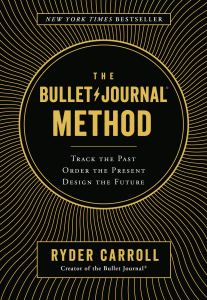
So the bullet journal is at a point of reckoning. Ryder is an astute businessman and creative, so was prepared for this moment already. His book, The Bullet Journal Method, takes it gently back to where it began – a productivity tool. The emphasis is what made it attractive in the first place: it’s not about getting more in your system, it’s about focus on what matters.

So, the bullet journal breaks down to this:

  • As long as your notebook is something you want to engage with, it doesn’t need to be a work of art
  • A notebook that comes with an Index and numbered pages does half the work for you
  • You don’t need to do everything – keep the parts of the system that work for you
  • You can use a bullet journal in conjunction with digital tools – it’s not sacrilege to use an online calendar
  • The bullet journal is a methodology that plays well with others – you don’t have to abandon GTD or personal Kanban to use it
  • You don’t need an expensive notebook and pen (although I prefer them)
  • It doesn’t have to be a specific, larger size format that you see most often depicted – I apply the same principles to my pocket notebooks

What got you here won’t get you there

As I move deeper into a year focused on doing what matters, the saying ‘what got you here won’t get you there‘ (made popular by Marshall Goldsmith) has begun to resonate more and more. When life changes in some fundamental way, then you have to change too. This applies to career, family and everything that gets wrapped up in those banner labels.

What has got me here, certainly won’t get me there. Why? Because of that other buzz phrase right now, the one about doing things for ‘the season you’re in‘. Now that one resonates even more.

When you have a child in your forties – your first child especially – you suddenly enter a whole new season. The real problem isn’t that you have to adjust, it’s that, if you think about it, your seasons are now out of order. Another spring has followed summer and now it looks like your autumn and winter are probably going to be rolled into one.

I’m fortunate to have done so many amazing things in my life. I’ve lived in several countries and traveled to many more. I’ve had a few fulfilling jobs (and a few less-fulfilling ones). I’ve been employed, self-employed and consciously unemployed. I’ve written a book that received a best-seller tag from Amazon and plenty more that should never see the light of day. I implemented a successful morning routine and got my health in order.

Now I stumble into the bright lights of the office each morning and need to double-check that I really have got dressed. My morning boot up sequence has been cut from an hour to a maximum of fifteen minutes. Journaling has kept me sane – I refuse to sacrifice that. As for my health, I frequently fall into the spiral of no sleep = poor decisions + low energy. I am officially a different person to the one I was a year ago. A person whose spring is just starting and those seeds I’ve planted have yet to sprout into life.

What got me here won’t get me there. It will again one day, but not just yet. Those seeds will become flowers again at some point, but until then, I have to keep moving forwards.

But how?

I need to ask better questions. Create new routines, not just abandon old ones and let chaos reign.

It’s not as hard as it sounds. It’s also not a quick fix, super-easy solution. With my morning routine, there are some things which are sacred and others which were luxurious habit (see my previous post on streamlining my morning using the MD Paper diary notebook). Reading isn’t happening right now, but it will be again. I know that writing 1000 words each morning can be curtailed by sudden wailing, but I’ve become less fixated on the number and more on at least writing something. 400 words might not be as good as 1000, but it’s better than zero because I’m worried the baby might wake up.

This new season – I have to learn to go back to small wins. Small habits. What are the building blocks I used last time to build the castle. Which ones can I re-use? Which ones are the foundation stones.

I don’t have the luxury now of an hour to exercise in the evenings if I want. Not without compromising other things that now suddenly matter more. The lack of sleep means that I tend towards inertia at every moment of calm. The only way out of that is to remove anything that causes friction between myself and an activity. I’ve always advocated for that, but now I need to recognise just how small those barriers might be. I need to monitor and measure things that I’ve long since taken for granted.

So here’s my simple five step plan. I’m doing it and sharing it so that no matter what season of life you’re in, if it’s flowing along nicely or a momentous change has suddenly derailed you, it’s possible to make a change.

Make a conscious choice. Then make changes.

  1. What are the cornerstones you already have?
  2. What are the unconscious habits you need to let go of or change?
  3. What are the small changes – the tweaks – you can make that will have disproportionate results?
  4. What are the friction points stopping you from getting started each day?
  5. What are the goals, dreams and plans that you need to let go of, even if it’s just for now?