Tag Archives: hustle

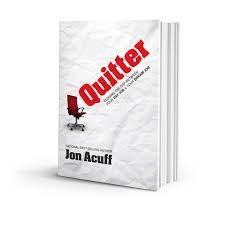
It’s quitting time: How Jon Acuff’s Quitter changed my life

I first read Jon Acuff’s Quitter 3 years ago on vacation. I even wrote a review on it.

I loved the book. It had many useful insights. So, did I come home from that sunny beachside view, walk into the office and hand in my notice?

pexels-photo-104750

No, I did not.

Why? Not because I didn’t want to. At the end of the book, when you feel the glimmering possibility of quitting your day job for your dream job, there is a pop quiz. One that gives you an idea of whether or not you’d make it in the real world.

I answered the questions and, despite knowing doing so wouldn’t give me the answer I wanted, I answered them honestly. The result? I was putting in some work, but not in enough areas to enable me to quit. I was annoyed with the outcome, but only because it was telling me what I already knew. It wasn’t giving me a quick out. It wasn’t giving me any kind of false hope.

The false hope is a common flaw of many business / self-help books. Their purpose is to sell you a concept. The promise that the book will change your life forever if you just follow their new approach or idea. Life isn’t that simple. Especially when it comes to quitting a stable, good job in a tough economy.

So I went back to work, but I also looked seriously at my side projects. My passion projects. Instead of keeping them as hobbies, I made them into real, practical things. Hobbies are great, but they don’t come with obligations and deadlines. You don’t hustle on a hobby. Writing for fun is the best thing ever, but I had to understand the difference between that and writing things that would allow me to follow my dreams.

pexels-photo-62471

Every year since that first experience, during my two weeks looking out over the ocean, I read the book and took the quiz again. Each year, my score got a little higher. It was slow, but it was progress.

Then one day, without that sunny view, I could feel the change in the air. It was a normal Tuesday morning, but something tickled the back of my mind. I grabbed the book and before work, I took the survey. I got a score of 65. That seemed pretty good. Higher than ever before. I flicked to the scorecard to double check.

The answer: it’s quitting time.

Still, felt like I had some work commitments and loose ends to tie up. It seemed like the decent thing to do. I also see there was a little bit of fear involved with quitting. A reason to put it off for a little while longer.

Now, after so many years of wishing it was time to quit, I finally have.

In four weeks, it will be my last day with my present company before going it alone for a while. It will be tough, but it is the most exciting thing I have ever done. Persistence has paid off and Quitter gave me the framework to create my best chance of success, rather than an impulsive leap into the unknown.

Thanks Jon!

You can find my original Jon Acuff’s Quitter review here.

4 reasons why it’s not too late to start a profitable side project

Some people love having side projects. Other people love the idea of having side projects. The dream that one day, you’ll find the magic bullet that will let you escape the 9-5 grind.

With the internet’s ability to peer into the carefully curated lives of others, we get a false sense of what success is and how young you need to be to achieve it. There is a sense that if you haven’t changed the world by the time you are twenty-five, you probably never will.

Which is, for the record, bullshit.

Billion dollar tech startups created in some fourteen year old whizz kid’s bedroom are always going to make you feel inferior. Yet most people don’t really make something of themselves until their late thirties or forties. You don’t really know who you are when you are a teenager. You may have some technical skills, advanced ones at that, but you haven’t lived yet.

You don’t have a multitude of people and experiences to shape you. These come later in life. Much of the dissatisfaction we experience is because we’re expected to set a course in our mid-teens and then stay on that hard earned (and often still paying for with student loans) trajectory.

man-coffee-cup-pen

So let’s bust some myths about why it’s not too late. These are all from my personal experience too, so I’m not just spinning someone else’s yarn here.

1. It won’t take as long as you think

It will probably feel like it, but it won’t. For most entrepreneurs, the skills that make them successful and competitive are not ones they learned through formal education. Yet for most people who think about changing income sources, the education route is the only way they know. It takes a lot of cash and time to retrain when you have existing responsibilities, like a job, a family and a mortgage. For most people, that scenario feels impossible.

But the three years of expensive qualifications and then on the job training won’t be the route for many successful side projects.

2. You can use the Pareto Principle to speed things up

The Pareto Principle is broadly that 80% of the results come from 20% of the tasks/effort. Once you can establish this as a defining life principle, you can really make things move. In life, work and all the grey areas in between, we see it in action all of the time.

Let’s apply the Pareto Principle to the time/cost retraining fear above. 80% is a high enough level of competency to succeed at most things. If our three year degree course teaches us 80% of the skills during just 20% of the time, then by working out what those key skills are and ignoring the rest, then three years quickly becomes less than one.

If we can find out what those things are, we probably won’t even need to pay for the course anyway.

There are obviously exceptions of course, but I’m assuming your side project isn’t to become an astronaut or a brain surgeon.

3. If you’re reading this, you probably already have the skills you need

Again, see the caveats about brain surgeons and astronauts. If you’re poking around in my skull then I expect you to have more than an ability to use google effectively. For anyone else, then if you’ve found me, you’re already on the right track. Even if your side projects have nothing to do with the internet, in our current world, you’ll still need to master it in order to sell your products and services. Side projects can become businesses very quickly. They might not become ‘jobs’ in the traditional sense, but they can if you want them to.

Everything you need to know these days is buried on the internet somewhere. You just have to find it, learn it, be brave enough to do it. Which brings us to…

4. Consistency is more important over the next year than where you are now

This is actually the hardest step. When you’re starting out, the rewards are non-existent at worst, infrequent at best. There is nothing so dispiriting as a first iteration flop, whether it’s a book, product or YouTube video. Casey Neistat makes it look so easy, right?

You burn bright with enthusiasm at first, but then it all fizzles out. The excuses come thick and fast. Before you know it, a month has rolled by before you remember your side project and dust it off.

The lesson here is that you don’t just pick up where you left off. The clock resets to zero, or close enough. You’re rusty. Those three strangers who actually found your new YouTube channel have moved on, forgotten about you. Frustration and overwhelm sets in.

The good news? If you can be consistent and you have something of value, in a year you can experience exponential change. It can take as little as six months to grow your idea into a sustainable, life changing source of income. Not a billion dollar startup, but enough to quit the 9-5 and focus on it full time.

pexels-photo-297755

Your side project can work for you at home or secretly inside your laptop, even if you are on a sun-drenched beach in Bali or walking around the streets of New York. It can do it if you are turning 30, or 40, or 50.

Location independence matters to me. So does having the time to prioritise my health. So does having time to spend with my friends and family. If you’re reading this, then I suspect they might matter to you too.

So stop reading. Start doing.

Now.