Tag Archives: Health

No juice for babies – the significance behind the shift

The American Academy of Pediatrics made the news recently when it updated its guidelines to advise that babies under 12 months should not be given juice. Previously, it had made this suggestion only for babies under 6 months.

Unfortunately, it is easy to assume that this means fruit juice is absolutely fine and should be encouraged for babies over 12 months old. In fact, the underlying reasoning for the change contains some findings that can apply to us all.

Fruit juice is promoted as a healthy and diet-conscious option. Yet research continues to show that it can actually be detrimental to controlling weight. From the article behind the headlines comes this snippet:

“High sugar content in juice contributes to increased calorie consumption and the risk of dental caries. In addition, the lack of protein and fiber in juice can predispose to inappropriate weight gain (too much or too little)”

One of the reasons I have become so vocal about the benefits of a sugar-free lifestyle is that it runs counter to food marketing, with its billions of dollars of advertising to blind and confuse the masses. For parents trying to do the right thing, when juice is promoted as an equivalent of whole fruit (which it really isn’t), it seems an easy way to get some nutrients into your kid. Yet, once they start loving and drinking it, the reverse becomes true:

“Malnutrition and short stature in children have been associated with excessive consumption of juice”

And of course, we’re encouraged to keep our children hydrated. Getting them to drink enough can be a problem, so we make it easy for them. But unless the fluid in that sippy cup is water or milk, you’d better hope that your kid enjoys going to the dentist:

“The practice of allowing children to carry a bottle, easily transportable covered cup, open cup, or box of juice around throughout the day leads to excessive exposure of the teeth to carbohydrate, which promotes the development of dental caries”

Although these issues are accentuated in children, it is easy to see that they can translate to adults as well. Fruit is amazing. It has fibre, nutrients and energy. Juice is sugar and water. I wonder how many parents would be horrified at their babies drinking a can of cola, but wouldn’t think twice about a nice healthy juice? This article is a great first step in educating ourselves away from ways of eating that simply aren’t beneficial, just easy.

For the actual article rather than the headline grabbing summaries, you can find it on the American Academy of Pediatrics Publications page. If you don’t want to read all of it, skip to the conclusions section to see the specific dangers and concerns.
 

If you’re interested in cutting down or completely removing sugar from your life, then check out The Realist’s Guide To Sugar Free. It’s full of tips, tricks and information to help you live a healthier lifestyle.

Beyond the bikini body – be healthy for life, not just for summer

It’s been coming for a month or so. The magazines aimed at women (and a handful aimed at men, too) have been screaming that we need to slim down for summer. The bikini body. The ‘lose ten pounds in two weeks’ diet. The juice cleanse. And goodness knows what else.

Many countries have a long weekend right about now. It holds the promise of summer. The evenings are longer. The temperatures are warm enough that the long sleeves and baggy jumpers that hide the sins of winter have to go.

For many people, panic sets in. Hence the crash diet and the crazy food choices. Most of them do work, but only in the short term. Some of the more extreme ones actually do more harm than good.

“In reality, the healthy approach is simple. Not easy, but simple”

In reality, the healthy approach is simple. Not easy, but simple. You don’t need cabbage soup. You don’t need a low fat, low flavour, low calorie diet. Just cut out processed sugars. Simple as that. Go cold turkey for thirty days and by the time the summer really kicks in, you’ll discover it’s not about looking thin, it’s about being truly healthy.

And your health? Worth more than dropping ten pounds in two weeks, no matter what the media tries to sell you.

Don’t know where to start? My realistic guide to navigating the sugar free lifestyle is available in ebook for only 0.99 until June.

Deeply addictive, sugar is everywhere. Even added to the most unlikely foods, the majority of us exceed the recommended daily intake without even realising it. Instead of teaching you how to cook fake cake, or pretending that quinoa really is an exciting grain that will revolutionise your view on salads, this book guides you through the myths about sugar in our food and through the realities of addiction. The 9 step action plan then helps you make the change and really stick to it.
Even if you’re not quite ready to eliminate all sugar from your life, this book contains practical tips to help you shop wisely, create good habits and sustain better lifestyle choices.

The paperback edition includes blank pages and examples to help you analyse your behaviours and face up to your bad habits, allowing you to document your journey to a sugar-free lifestyle.

Available on amazon.com and amazon.co.uk

Kelly Clarkson, Nutella and calling people out on the internet

I’ve been avoiding distractions for the past few weeks, but someone sent me the following story of Kelly Clarkson giving her daughter Nutella for the first time.

Now you may think that as someone who has written a book about living sugar-free, I’d be firmly on the side of the commenters who are chastising the singer for giving a young child such a thing.

Well, I am and I’m not. Why? Primarily because I don’t think it’s the right thing to do to shame individuals about the food choices they make. Educating is good, shaming is not. The vast majority of critics were hitting out mainly because they wanted to blast a celeb. Welcome to the internet.

Nutella is essentially chocolate. It’s had some clever branding, but at 13% hazelnuts, let’s not pretend it’s a healthy nut-based spread. Interestingly, due to its sugar and fat combination, it actually has a lower glycemic index than most breakfast cereals. For that reason, I’ve seen it touted as a better alternative, as it doesn’t cause the sugar spike and mid-morning slump. I’m not saying I believe that it is, but you can frame most things in a positive spin if you try hard enough.

I don’t think feeding children a diet that is high in processed foods, especially processed sugars, is a good thing to do. In fact, it is a terrible thing to do and causes long-term damage. But to pretend that a child is never going to consume chocolate and that for Clarkson to do what 99.9% of all mothers do is ‘child abuse’ is just ridiculous and inflammatory for the sake of it.

So of course I think it’s a bad thing to give your child Nutella every day. But there’s very little difference between that or a fruit chew bar and a glass of juice as a mid-morning snack. Live healthy and clean the rest of the time and educate on the difference of treats. Make treats occasional, not daily. Don’t make unhealthy foods exciting and taboo.

And sure as hell don’t try to shame someone like you’ve never eaten a sweet treat in your life.

Not The 4-Hour Workweek: lessons in scheduling, time tracking and an abundance of hours

This is the first full work week completely under my own control. I set the tasks, the hours, the goals and overall strategy. Anyone who knows me will agree I love to have that kind of control. It has been a steep learning curve, but years of practicing in my free time outside of the 9-5, as well as the lessons in project management I’ve learned over the years working in companies, has made it much easier than it could have been.

Towards the end of 2016, I listened to The 4-Hour Workweek by Tim Ferris. For anyone who has ever considered location independent living or being a digital nomad, then this is often the springboard book. Besides, with a title like that, who wouldn’t want to work just four hours?

Of course, is that really what the book is saying? ‘Do nothing and get rich’ is the answer a lot of people hope to get from it. But at it’s heart, it’s about doing the things that matter in the most effective way possible. It is a bible for lifestyle design. People who can automate their business to the point that they only spend four hours on them are the kinds of people who don’t then retire. They start another business. The ‘be effective’ and commitment to living big is the message they take away, not do as little as you can.

Four hours sounds nice on the surface. But if you work doing the things you enjoy, which I suspect most of Ferris’ disciples do, then four hours is never the goal.

Time tracking

As you can guess from the title, this has not been a four hour work week. My life hasn’t been fully automated with a bunch of virtual assistants running businesses for me while I sip cocktails in Bali. How do I know this? For the first time in years, I did proper time tracking.

I didn’t spend hours looking at all the different options for doing this. Instead I picked toggl, as Mike and Grey were talking about it so much on the recent episodes of Cortex. Have I gone all in? Nope, I won’t be taking advantage of that extensive API to play with. I just want to know how much time I am spending on the key areas that now constitute my day.

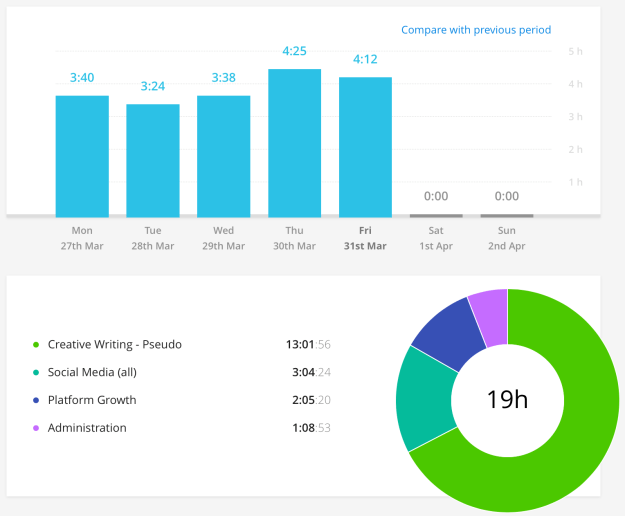
The results? I might not be working a four hour week, but I’m not doing a forty hour one either:

This is actual work. This is not ‘killing time’ work. This is not timesheet submission busy-work. When the tasks for the day are done, then I am done. I focus on them completely and make them as efficient as they can be. This is just the first week of data, but it is fascinating. I’ve always believed that quality of work is more important than hours spent and this is re-enforcing that in a big way.

Time scheduling – a combination of digital and analogue

In a less time efficient move, I have lost countless hours since January looking at digital project and time management tools. None of them seem to be just what I was looking for. Many were far too time intensive to set up projects and tasks for my small, single-person projects. Secondly, I’m still reliant on the GTD way of thinking, meaning that many have critical pieces missing. Thirdly, none would emphasise calendaring in a way that works for me. I’m a deadline driven person, so without a ‘real’ due date, my default action will be to happily defer.

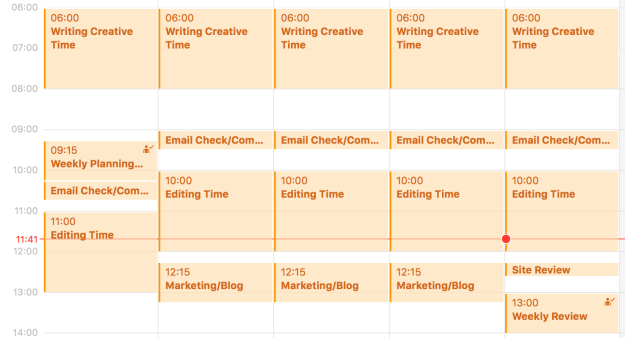
Rather than continuing this frustration, right now I am managing things in an analog and digital combo. The first is a paper planner (the Moleskine Weekly Planner that I reviewed here) and a separate ‘work’ calendar that chunks times of the day into very high level categories (for example, editing time vs ‘line edit of x book’).

Putting the two together has allowed me to focus on the bigger picture, whilst still getting into the detail of the day. Whether it will continue to work in the long term remains to be seen, but for this first focused week, just about everything went according to plan, with enough flexibility to allow for one or two unscheduled events.

Free time and the sensation of guilt (‘I should be doing…’)

I’ve been sticking to my usual routine of starting my workday at 6am. Doing around 4 hours means I have a lot of day left at the end of my day. Whilst this sounds like a dream – and it is – the thing that I have noticed at times is an overwhelming sense of guilt. Even on the day I used all my brainpower writing 7,500 words, it was an obvious nagging sensation at the back of my brain. The quest for something ‘productive’ to do. It has made me realise how much we are compelled to fill our hours with work, when sometimes the thing to do is just relax.

I hope this is something that disappears quickly. It feels like a hangover from the 9-5 life and it serves no purpose as far as I can tell.

Walking and thinking is a valid use of time

Conclusion – scary, at times overwhelming, but eye-opening and utterly rewarding

Would I class this first proper full time writing week as a success? Yes, I would. I’ve eaten well, I’ve rested well and I’ve spent time creating new products and learning new things.

Has it been difficult and crazy ass scary at times? Of course it has. Any big change always does (and anyone who tells you otherwise has got caught up in their own lies and bravado). But I’ve also loved the freedom and the self-reliance. I’ve loved a semi-traditional work week, with all of the benefits and very few downsides.

I already can’t wait to see what next week brings when reality sets in.

Death of a salesman: The (not so) sweet truth about hotel breakfasts

Hopefully today was my last hotel breakfast for a long time. For nearly three years, I have spent at least one night each week in a hotel. I’ve stayed in some good places and some bad places. I have tried a lot of hotel breakfasts and at some point I might look forward to one again, but right now that seems impossible.

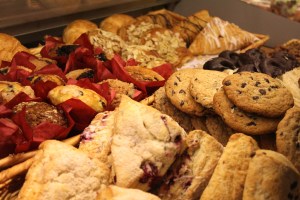
This kind of temptation each week? Exhausting!

So how do you stay healthy while traveling? It’s not easy at all. In unfamiliar surroundings, the default setting is to take the easiest option. Sticking to a healthy lifestyle – food or exercise – is a challenge of monumental proportions.

Most UK hotels offer a simple choice: cooked or continental. Cooked is usually more expensive as you have to pay for the privilege of someone heating your bacon until it is at least tepid (or the other option, so black and crispy you’re waiting for a CSI unit to come in and identify it). However, if you’re keeping your unhealthy fats low during the rest of the week, it is a low sugar option if you forgo the beans and ketchup. The same cannot be said for the continental option, with it’s all-you-can-eat high sugar cereal options, pastries and jams in every variety.

So, if you are trying to be healthy and wholesome, why not forgo the temptation and get a healthy breakfast to go instead? It’s quick, it’s easy, it has limited portions and it is marketed as a great start to your busy work day.

Quick, easy and healthy marketing? Alarm bells are ringing…

So, what do these packs typically contain and how much sugar does that translate into? I’ve researched a couple and below is a pretty accurate representation:

Cereal and milk (19g) OR fruit yoghurt (15g)
Muffin (25g)
Breakfast bar (12g)
Juice (20g)

This equals between 70-75g of sugar before you even start your day (that’s more than double the NHS recommended daily intake of 30g!). When you’ve got an early meeting, this can seem like a sensible choice, but it isn’t. Not to mention that it virtually guarantees a mid-morning slump that will have you reaching for another quick pick me up.

This persistent set of poor options is one of the reasons why I’ve decided to transition into a lifestyle where I can have more control not only of my work, but also my health. Research shows that health is one of the consistently de-prioritised areas of modern life, despite us understanding more than ever about exercise and nutrition benefits.

The healthy ‘to go’ breakfast, whether at a hotel or your favourite coffee chain, is just another marketing trap, so heed the warning and don’t be fooled!

therealistsguidetosugarfree-2

The Realist’s Guide To Sugar Free is available at Amazon (UK) and Amazon (US) in both ebook and paperback.

Love the book? Then please leave a review on Amazon. Reviews help keep the book visible, which means I can help more people make the change to a happier and healthier life.

Still struggling to lose excess holiday weight? A workbook to help cut dangerous sugars from your diet

When I first published The Realist’s Guide To Sugar Free, lots of people asked for a paperback version of the book. I resisted for a while, as only offering the the book in electronic form meant I could keep the price low and get the message out there.

Over time, the requests for a paperback version have continued to grow. So I decided to take the plunge and create one.

food-dinner-grilled-shashlik

The physical copy of the book not only contains the important tips, tricks and psychology of the ebook version, but also contains a greater degree of interactivity. The Realist’s Guide To Sugar Free is not a cookbook. It is not a diet book. It is about serious lifestyle change and kicking a powerful addiction. I’ve built the paperback version to contain space for you to make notes and answer the questions I ask you in real time.

sugar free workbook

Countless studies have shown that the act of writing down your goals vastly improves your chances of reaching them. The same goes for your habits and routines. It empowers people to take conscious, positive decisions rather than make unhelpful unconscious choices.

This has turned the guide into a workbook of sorts. It can be your personal journal on the road to eliminating processed sugars from your life for good. The 9 step action plan includes the space you need to analyse your behaviour, face up to your bad habits and document your journey to a sugar-free lifestyle.

I know how difficult it can be to rely on willpower alone, so there is real value to be found in writing down your motivations and weaknesses. When the craving for a sugary snack strikes, having a tangible reminder of why you’re changing your life helps you to resist. I know I struggled to stay sugar free over the holidays and then had to kick the addiction again, so I’ve returned to this basic guide to get myself back on track. If it works for me, then it can work for you.

therealistsguidetosugarfree-2

The Realist’s Guide To Sugar Free is available at Amazon (UK) and Amazon (US) in both formats.

Love the book? Then please leave a review on Amazon. Reviews help keep the book visible, which means I can help more people make the change to a happier and healthier life.


4 reasons why it’s not too late to start a profitable side project

Some people love having side projects. Other people love the idea of having side projects. The dream that one day, you’ll find the magic bullet that will let you escape the 9-5 grind.

With the internet’s ability to peer into the carefully curated lives of others, we get a false sense of what success is and how young you need to be to achieve it. There is a sense that if you haven’t changed the world by the time you are twenty-five, you probably never will.

Which is, for the record, bullshit.

Billion dollar tech startups created in some fourteen year old whizz kid’s bedroom are always going to make you feel inferior. Yet most people don’t really make something of themselves until their late thirties or forties. You don’t really know who you are when you are a teenager. You may have some technical skills, advanced ones at that, but you haven’t lived yet.

You don’t have a multitude of people and experiences to shape you. These come later in life. Much of the dissatisfaction we experience is because we’re expected to set a course in our mid-teens and then stay on that hard earned (and often still paying for with student loans) trajectory.

man-coffee-cup-pen

So let’s bust some myths about why it’s not too late. These are all from my personal experience too, so I’m not just spinning someone else’s yarn here.

1. It won’t take as long as you think

It will probably feel like it, but it won’t. For most entrepreneurs, the skills that make them successful and competitive are not ones they learned through formal education. Yet for most people who think about changing income sources, the education route is the only way they know. It takes a lot of cash and time to retrain when you have existing responsibilities, like a job, a family and a mortgage. For most people, that scenario feels impossible.

But the three years of expensive qualifications and then on the job training won’t be the route for many successful side projects.

2. You can use the Pareto Principle to speed things up

The Pareto Principle is broadly that 80% of the results come from 20% of the tasks/effort. Once you can establish this as a defining life principle, you can really make things move. In life, work and all the grey areas in between, we see it in action all of the time.

Let’s apply the Pareto Principle to the time/cost retraining fear above. 80% is a high enough level of competency to succeed at most things. If our three year degree course teaches us 80% of the skills during just 20% of the time, then by working out what those key skills are and ignoring the rest, then three years quickly becomes less than one.

If we can find out what those things are, we probably won’t even need to pay for the course anyway.

There are obviously exceptions of course, but I’m assuming your side project isn’t to become an astronaut or a brain surgeon.

3. If you’re reading this, you probably already have the skills you need

Again, see the caveats about brain surgeons and astronauts. If you’re poking around in my skull then I expect you to have more than an ability to use google effectively. For anyone else, then if you’ve found me, you’re already on the right track. Even if your side projects have nothing to do with the internet, in our current world, you’ll still need to master it in order to sell your products and services. Side projects can become businesses very quickly. They might not become ‘jobs’ in the traditional sense, but they can if you want them to.

Everything you need to know these days is buried on the internet somewhere. You just have to find it, learn it, be brave enough to do it. Which brings us to…

4. Consistency is more important over the next year than where you are now

This is actually the hardest step. When you’re starting out, the rewards are non-existent at worst, infrequent at best. There is nothing so dispiriting as a first iteration flop, whether it’s a book, product or YouTube video. Casey Neistat makes it look so easy, right?

You burn bright with enthusiasm at first, but then it all fizzles out. The excuses come thick and fast. Before you know it, a month has rolled by before you remember your side project and dust it off.

The lesson here is that you don’t just pick up where you left off. The clock resets to zero, or close enough. You’re rusty. Those three strangers who actually found your new YouTube channel have moved on, forgotten about you. Frustration and overwhelm sets in.

The good news? If you can be consistent and you have something of value, in a year you can experience exponential change. It can take as little as six months to grow your idea into a sustainable, life changing source of income. Not a billion dollar startup, but enough to quit the 9-5 and focus on it full time.

pexels-photo-297755

Your side project can work for you at home or secretly inside your laptop, even if you are on a sun-drenched beach in Bali or walking around the streets of New York. It can do it if you are turning 30, or 40, or 50.

Location independence matters to me. So does having the time to prioritise my health. So does having time to spend with my friends and family. If you’re reading this, then I suspect they might matter to you too.

So stop reading. Start doing.

Now.

Sugar Free Farm: A noble but flawed attempt at mixing entertainment with a serious message

I’m not usually a fan of reality TV. As a genre it is filled with vacuous, fame hungry idiots and adds no real meaning or value to my life, or to that of many others.

sugar_free_farm

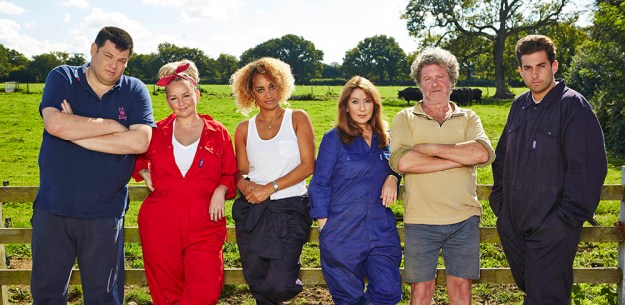
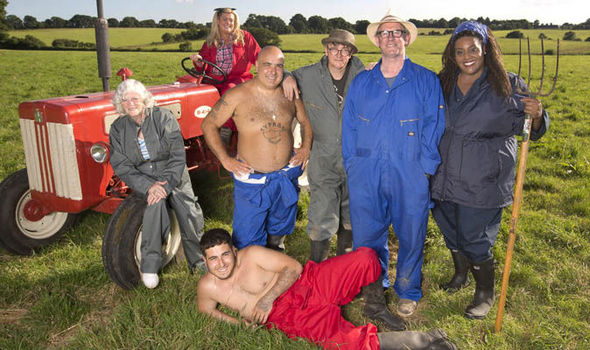
The cast from season one. At least they look clean.

However, I watched the first series of Sugar Free Farm (Tuesday, ITV) with interest.  I have developed an interest in living a sugar-free lifestyle over the past year and half. One of the problems with this is that the media is only now coming to terms with questioning historically inaccurate scientific research. As a result the information about sugar is entering the ‘mixed messages’ phase.

As with any change and any new way of thinking, education is key.  Unfortunately, statistics show that highest incidences of obesity tend to occur in areas where income and education are the lowest.

So how do we reach this particular demographic? Quite simply, it is through the medium with which they are often most comfortable: entertainment. People like Tony Robbins have used this  effectively over the years by creating an almost rock concert-like atmosphere in which he is able to get his message across.

Reviews of the show have not been overwhelmingly positive. Despite its good intentions, when trying to put an educational message across, it needs to be either shocking or completely hidden behind something more engaging. Failure to do that results in something that isn’t very entertaining and, dare I say it, just a little bit preachy.

The quality of the celebs is a huge factor as well. The fact I only know the one who used to be a politician says more about me than it does about the intended audience, but even I can realise a Z-list when I see one. Sorry, old Dr. Who, but it’s the truth.

sugar-free-farm-cast

But most importantly, the message gets lost because it is simply not relatable. I realise the show needs a central concept (getting back to the land and living unprocessed lives) but who has time to grind their own flour? Or shake up their own butter?

No one, that’s who.

I live a sugar-free life already and I rolled my eyes and switched off. It would be far better to provide the contestants with a store cupboard that was limited but contained readily available items. That way people could begin to imagine how it would look in their own homes. Instead, the message becomes that to quit sugar you need to quit life and never have fun again.

Watching a few random other people lose a bit of weight and play with pigs isn’t going to motivate you to those extremes.

I mean, does this make you want to change your life?

sugar_free_farm


Want to quit sugar anyway? Buy the book that’s more about making it work in real life than baking fake cake. 

therealistsguidetosugarfree-2

2017: New Year, New Goals, New Dreams

I’m not going to lie. During November and December I fell off so many wagons I couldn’t work out which one I wanted to get back on first. So I drank another glass of wine, enough cheese and crackers to sink a small boat and opened a box of chocolates instead.

But now that has all changed! By the mystical power of the calendar year flicking over, my willpower has returned and I am wholesome and virtuous again!

I wish.

I’m not sure I’ve ever been wholesome and virtuous. But I have begun to steadily correct course this week to get back on track. But where did it all go wrong in the first place?

I suspect much of it came down to illness and exhaustion. I failed to achieve a lot of things in 2016 because I felt worn out or ill most of the time. Listening to the Creative Penn podcast, it was great to hear another writer making health a priority in 2017. It is very easy to set ‘business’ type goals only. We’re taught how to focus on finance and career, but not necessarily spiritual or health goals. Last year was a harsh reminder of how if I don’t sleep and maintain a healthy lifestyle, eventually I’ll fail in other areas as well. I had two (because I’m a slow learner) fairly serious burnouts last year. I’m determined not to make the same mistakes again.

I’m tracking my sleep on my Fitbit and have once again begun the process of detoxing from sugar. I got a huge morale boost from seeing my book, The Realist’s Guide To Sugar Free at #2 in the kindle personal health charts in the first days of January. Hopefully I’ve been able to help a few people on their journey towards making the change too. Throw in a daily journaling and gratitudes practice and I can keep moving towards a physically and emotionally better me.

I’ve also challenged myself to read a book a week in 2017. With an English degree, I find it easy to read quickly, so the only excuse I have for not doing it is that I simply haven’t made it a priority. I have to hold myself accountable for that.

Mainly, I want to work on more exciting and challenging writing projects in 2017. I won’t give the numbers, but I have set myself a pretty hardcore stretch goal for increasing my writing income compared to 2016. Like health and reading, it will come down to prioritising and commitment. I’m good with that. When the 6am alarm sounded each day this week, I got up, got coffee and did the work. That’s how you achieve anything, right?

So those are some of my goals and plans for 2017. I want to get into a more consistent blogging schedule as well, to hold myself accountable to these things as much as anything. It also means I’ll get to share some tips and tricks I find along the way.

2016 was a terrible year generally, but with some major personal highs. I want 2017 to be the year to give back. To use my voice to make a change in the world when I can. That sounds lofty and ambitious. But if you haven’t been happy with the way things went politically in 2016 then you have to raise your voice. You have to do something. As Shonda Rhimes said, a hashtag is not a movement. Do something.

Subtle discomforts

I haven’t posted here for a while. As well as being very busy, there was a strange discomfort that I couldn’t quite put my finger on.

This morning, I realised what it was. I’d probably known all along, but I finally acknowledged it.

When I published my Sugar Free book, I decided to give Facebook a go, despite disliking it as a concept for years. Obviously, if you’re going to use it for marketing purposes, then it made sense to link my blogposts to it.

I still hated it. More importantly, its open door policy and spooky algorithm meant that everyone I may have ever known was being suggested to me in other places, such as my Instagram. Even people who I don’t want to be part of my life. It was like a sledgehammer of suggestions that kept poking sore spots.

So this morning I deleted my Facebook account. I’m under no illusions that it will make all the problems instantly go away. But I realised I don’t want the downsides it brings, no matter what the upsides might be.

It feels good. If something bothers you, then get rid of it, even if other people tell you it’s a ‘must have’ item. Trust your own instincts. They’re probably right about things more times than you realise.