Tag Archives: happiness

Floating: why it is beneficial to my physical and mental health

Everyone who knows me understands that I inhabit a strange place between logical efficiency and unconstrained creativity. Essentially, this:

venn

In reality, I try to be efficient so I can get the things I must do out of the way as quickly as possible, so that I can enjoy the things I want to do. Like a lot of people, I frequently seem to slide down the slippery slope towards getting more done, rather than getting the right things done.

Luckily for me, just under a year ago, Time To Float opened up nearby. Before, I had travelled to London to float, but for anyone in the centre of the England, this is infinitely more convenient. So, why did I try it and why do I keep doing it?

1. Sleep

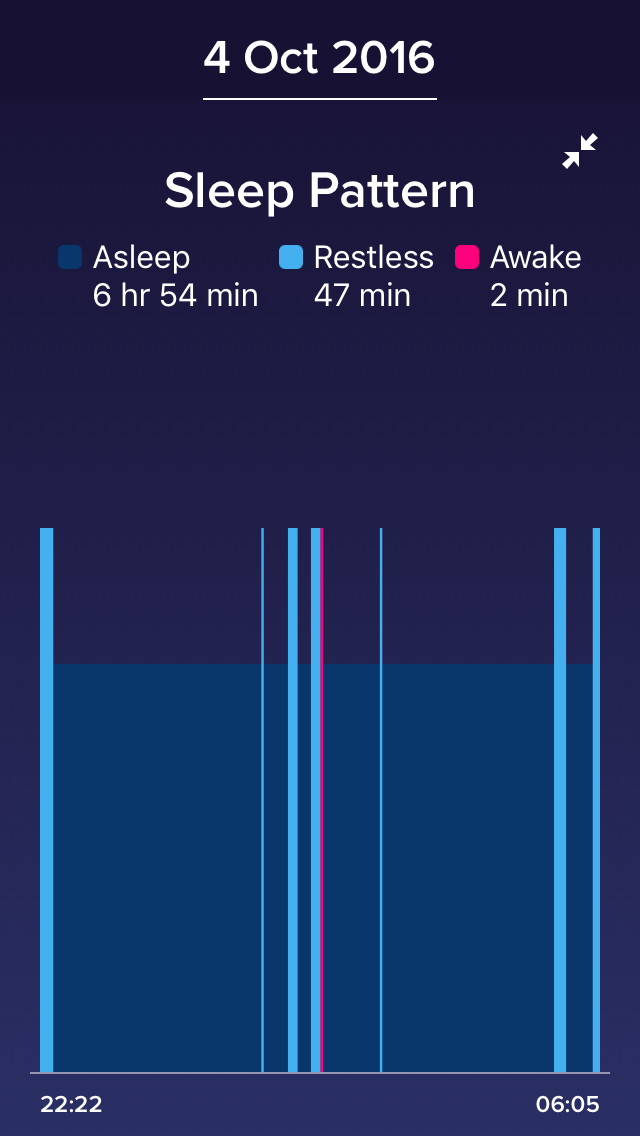
I’ve put this first, because it is the one I can actively measure. I’ve always ‘felt’ like I slept better after floating, but having recently started wearing a fitbit, I was interested to see if my gut feel actually resembled reality.

Apparently, it does:
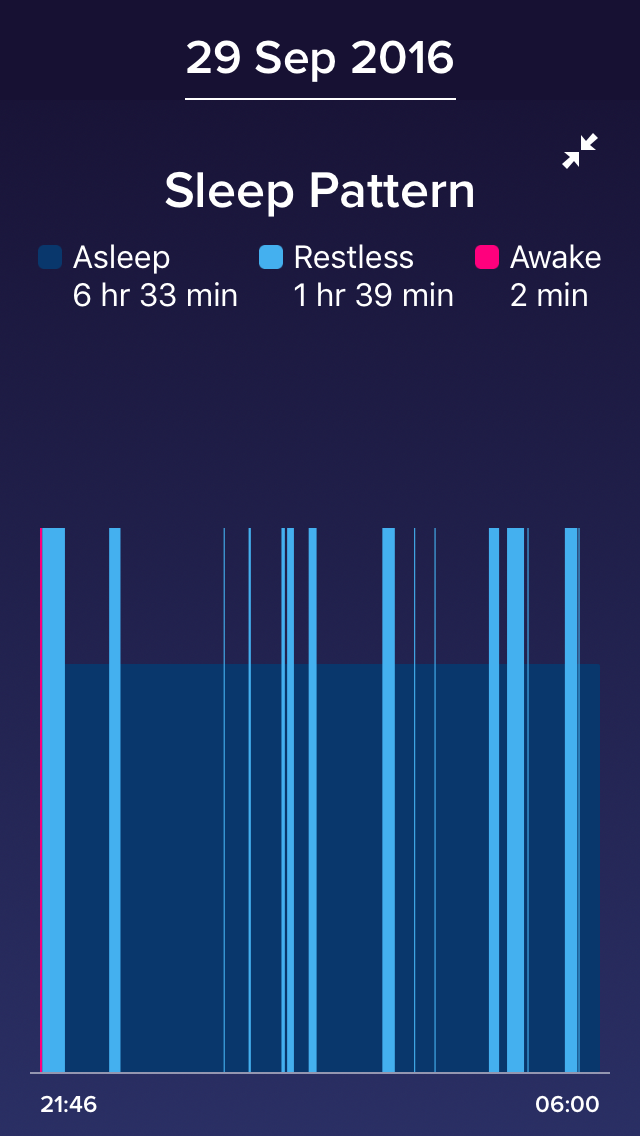
img_1531  img_1530
I selected two nights, one from the week before floating and the second from the week after. Both had a similar amount of ‘total’ sleep. But you can see the quality of that sleep was markedly different. After floating I had prolonged periods of sleep without restlessness (the light blue bars that make the first picture look more like a barcode). This was really interesting to see and I’m glad it’s not just all in my head.

2. Physical Relaxation

The physical effect of floating is a strange one. At first, I find that it is like lying down on a really comfortable bed. Then I start to become aware of areas such as my neck and shoulders relaxing, letting go of a tension that I’ve simply become used to feeling. I try to use a standing desk at home, because prolonged periods of sitting during my workday makes the problem so much worse. Even doing that, I still find my shoulders tensing in response to any stressful scenario. Feeling that tension disappear is amazing.

Finally, when the session is over, trying to stand is almost hilarious. My body gets used to being weightless very quickly, so when my feet get back on the earth it feels like my limbs are made of lead. For a few moments you are aware of gravity in a way that can be achieved by little else. I tend to be a little zoned out for a while after and have to take advantage of the chill out area.

3. Creative/Strategic Thinking

Unlike sleep, this can’t be quantified with a chart. But I notice it every time, depending on what phase of life I am in. If I’ve been juggling multiple projects and can feel the beginnings of burnout and poor decision making, then floating allows me the clarity to get to the higher levels. Most people don’t apply strategic thinking to their daily lives, but I have no intention of getting to 80 and wondering how I ended up in a place I never wanted to be. The sensory deprivation may be a part of it. But it certainly works.

Alternatively, there are times when I just want to come up with new ideas. They may be for my writing, or they may be for other side projects. Sometimes I go into the session with a problem already in mind, giving myself a chance to really think about it in the silence. The aha! moment usually comes a few hours later, seemingly out of nowhere, but really from the freed up depths of my subconscious. Other times I am open to whatever my brain comes up with when it is allowed to do nothing but think. I’ve recently been reading Greg McKeown’s Essentialism and I can see how floating provides me with a fast track to getting that clarity. Although it is easy to understand the physical effects, the psychological ones are as profound.

So those are the key benefits of floating for me. There are many more that are important for other people, but these are the ones that have had a positive impact on my own life. If you think that could work for you, then definitely check it out.

 

How I Did It: The Realist’s Guide to Sugar Free

After almost a year of being sugar-free, I’ve finally written a book about it. You see, despite being stubborn and competitive (mostly with myself), living a life without sugar was hard. Really hard. Despite understanding all the associated health risks, I still struggled to give it up and then remain virtuous in the face of temptation.

Let me tell you something about myself: I don’t like failing.

Every self help book will tell you failure is necessary. Trying and failing is how you learn what works and what does’t. That doesn’t mean I have to like it. So despite several epic failures that resulted in a large tub of ice and a spoon, I have been determined to find a way to remove sugar from my diet, yet still live in the real world. Along the way I’ve been keeping track and it is the results of my journey that I’ve put into this book.

therealistsguidetosugarfree-2

This is not a cook book. It is not a detox plan. It is a step by step programme of strategies to help you eliminate sugar in the face of the temptations life will throw at you. Knowing how to cook a delicious four course sugar-free meal won’t help you at all if you don’t actually find the motivation to do it on a daily basis. Most people I know are too busy working or chasing after small children to be able to put that kind of time into planning and prepping a meal. It’s a nice idea, but it just doesn’t work for most of us.

So if you want a humorous and honest guide to eliminating sugar from your life, then this is the book for you. Even if you’re not sure you want to quit sugar completely, the easy to understand information will still help you make better choices when faced with the temptation and sweet food marketing you’ll encounter every day.

Blurb:

A humorous and honest guide to eliminating sugar from your diet. For good.

Quitting sugar in the real world is hard. Sugar is everywhere and your friends think you’re mad for not eating cake. You’ve done the 8 week detox plan and part of you still craves chocolate so much that you develop a mild twitch when you see a brightly coloured wrapper on the shelves in front of you.

Deeply addictive, sugar is everywhere. Even added to the most unlikely foods, the majority of us exceed the recommended daily intake without even realising it. Instead of teaching you how to cook fake cake, or pretending that quinoa really is an exciting grain that will revolutionise your view on salads, this book guides you through the myths about sugar in our food and through the realities of addiction. The 9 step action plan then helps you make the change and really stick to it.
Even if you’re not quite ready to eliminate all sugar from your life, this book contains practical tips to help you shop wisely, create good habits and sustain better lifestyle choices.

Available at amazon.com and amazon.co.uk

Life hacking my year

I set myself some pretty big goals in 2015 and intend to make 2016 my most successful year ever. Of course, we’re still in January, so making bold statements like that before the grudging reality of the daily grind kicks in is still possible. Even so, I picked up a few life hacks last year that I’m going to carry over into this year. They apply to daily life, so they cover off all my goal types: writing, financial, spiritual, physical etc.

Top tip number 1 – the standing desk.

Several personal development pros I follow have recommended this, but the biggest influencers for me were Jeff Sanders and Michael Hyatt’s blogpost and podcasts on the topic:

7 Amazing Benefits of a Standing Desk

4 Reasons you should buy a standup desk – right now

Previously I would spend 6-8am sitting writing, 9-6 sitting for my job, then often 7-9 sitting doing more writing. That is a lot of sitting. Now I still do the writing stints sitting down, but the day is spent standing, unless I physically need to be at head office. That persistent twinge in my left shoulder has gone, along with general back pain. I’ve recently added a balance plate to keep myself moving too, rather than just standing still.

Top tip number 2 – a really good morning routine.

I’ve had a morning writing routine for at least 5 years now. Time flies, so I can’t really be sure. Over 2015 I really upped my game on this. My morning routine now includes more than just knocking out 1000 words on my latest writing project each day. It includes affirmations and journalling (my form of meditative practice). It all felt very American at first, but once I got over being all British and reserved, it’s had huge benefits. It’s a real mental health compliment to the physical health tip above. For an idea of how to start setting it up, Hal Elrod’s Miracle Morning is a great place to start (he has a pretty full on personal story to check out too).

Top tip number 3 – carry a notebook and pen EVERYWHERE

The more I did the above top tips, the more my brain seemed to become able to throw out ideas and see potential everywhere. As I wrote in my last post, I made a habit of capturing them straight away, rather than lose them or have to waste a ton of mental energy trying to remember them for later. It could be that sudden strategic insight that you needed to get a result on that big project, or it could be that you need to add cheese to the weekly shopping list – it doesn’t matter. Getting it down on paper means that your brain can then carry on being the awesome beast that it was designed to be. Field Notes have become my pocket notebook of choice, but it’s all personal preference.

Top tip number 4 – track it

Digital or analogue, tracking what you’re doing is the easiest way of making sure you’re doing what you need to do. I use coach.me and have a few habits that I’ve done so many days in a row that I will now go out of my way to complete them so that I don’t break my streak. I’ve done 10 pushups (upgraded to 20 nearly a year ago) each morning now for over 500 consecutive days. There is no way I’d do that without the app.

These all work for me, but if anyone else has any suggestions then feel free to comment. I’m always looking for ways to up my game…

Capturing ideas wherever, whenever

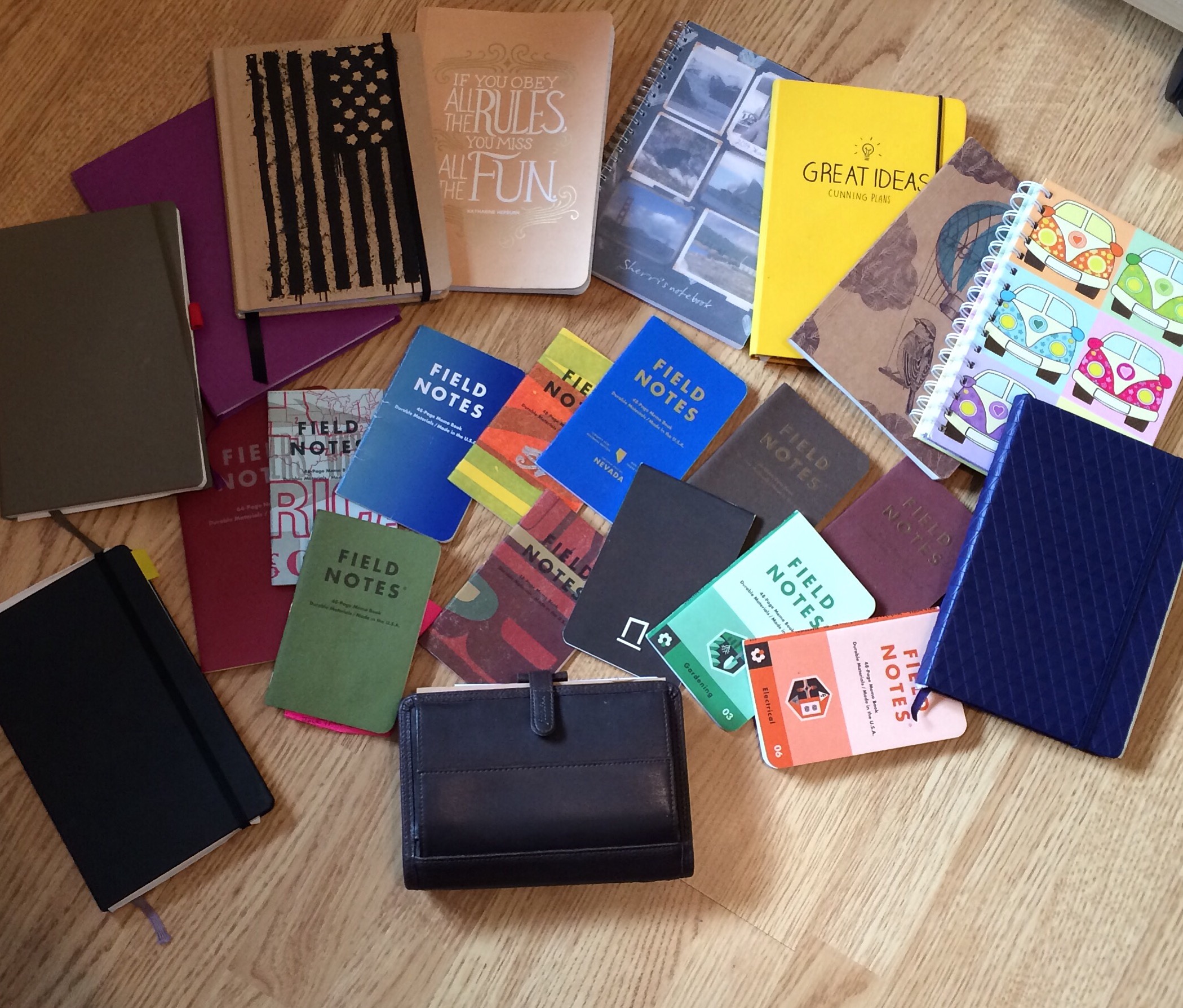
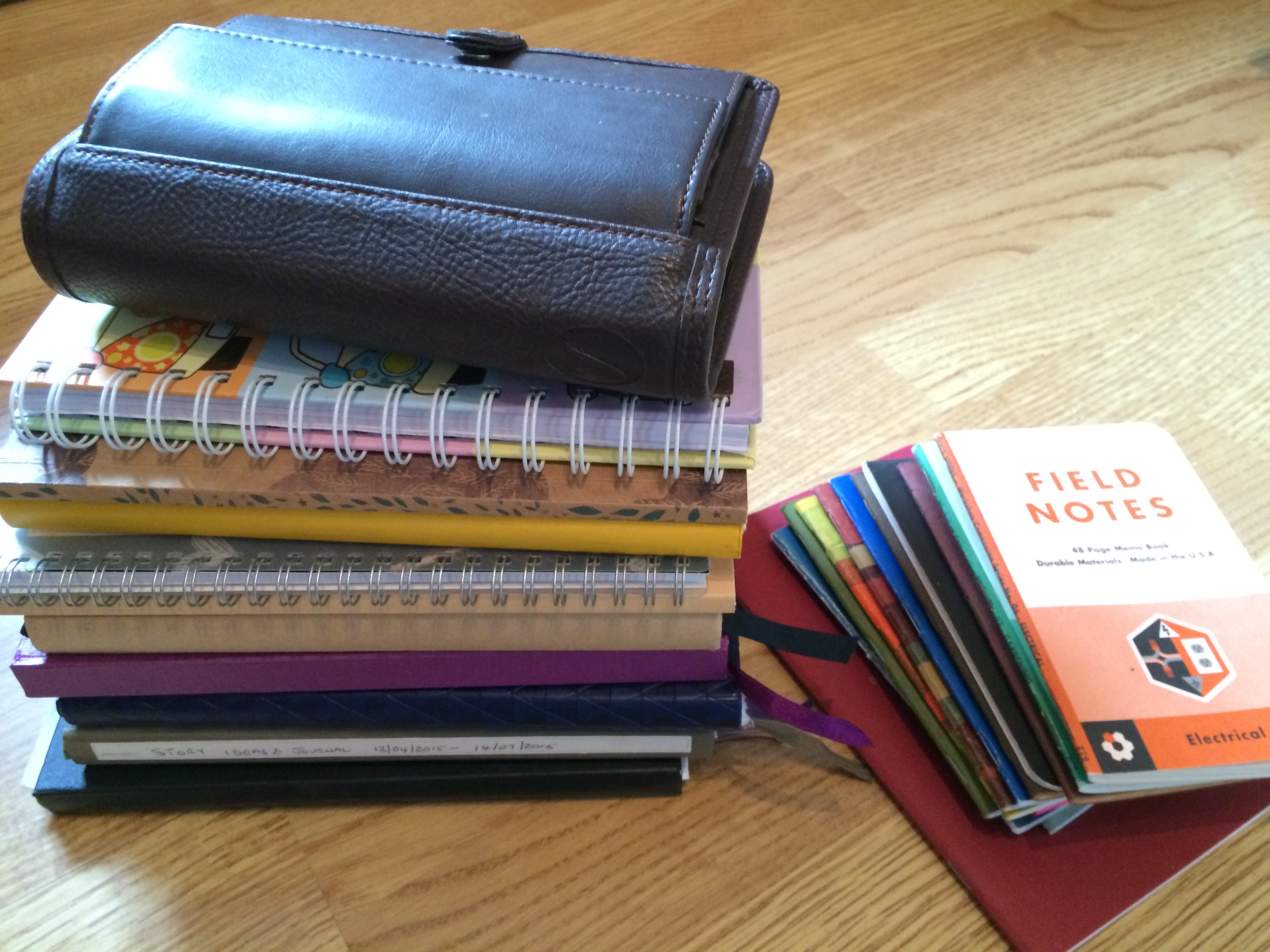
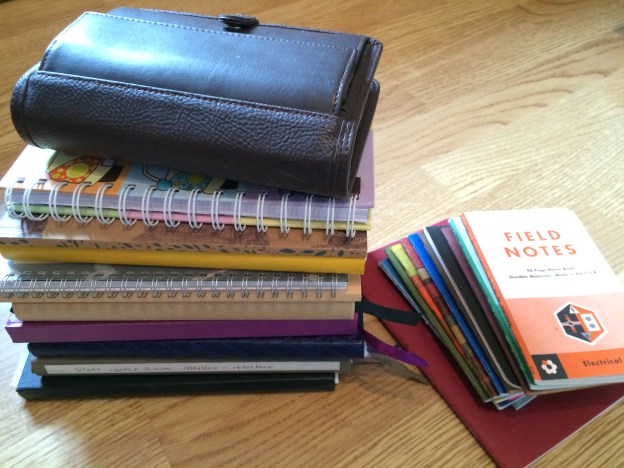
Intuitively I felt like I was capturing so many more thoughts and ideas as I moved through 2015. So at the end of the year I collected together all the notebooks I had completed into one place to confirm the theory. Yep, I had indeed had a lot of thoughts:

2015 notebook stack

Because I’m a bit of a GTD fan, I was in the habit of capturing things to do the moment I thought of them, but story ideas and general everyday thoughts and feelings, not so much. I made much more of an effort to do that and it shows. I have a whole treasure chest of ideas for stories I can now return to, as well as all the highs and lows of the year that I’ve recorded for posterity.

Broken down into three notebook types:

  1. The filofax was my daily log book for 2015. For 2016 I’ll be moving over to a Hobonichi which is already proving to be an amazing experience.
  2. The large, hardback notebooks were for novel plotting and extended meditative journalling, including daily gratitudes to set my days up right.
  3. Pocket notebooks (especially Field Notes) were always in my jeans or handbag for keeping track of what I had to do each day, but also for those random confluences of inspiration that happen when I’m out and about. Now I can capture them immediately (I’m guaranteed to forget them if I put it off until I get home).

2015 Notebook collection

I made leaps forward in my writing processes and achievements in 2015 and I fully intend to keep building on the momentum in 2016. More than ever I believe the best way to succeed at anything is to just write it down!

The importance of finding peace

Saying things have been crazy lately is an understatement. I know everyone in today’s world feels overwhelmingly busy most of the time. I’ve spent years putting systems in place to allow me to manage multiple products and still be uber-productive, but even I have had several moments of complete overload. I already know my yearly review of 2015 will be quite something.

Even my morning journalling, a time solely dedicated for quiet reflection, has been interrupted by a compulsion to check my phone, having random ideas that need capturing elsewhere and, quite frankly, the fidgetiness of a five year old.

It kind of defeats the point.

But the absence of peace and stillness has made me realise how important it has become to me. Not to sound like some hippy white person trying to be an eastern self-styled guru, but there is so much to be said for the practices of mindfulness and gratitude. Of just being in the moment and being part of the world around you. Of being able to appreciate an autumn sunset, rather than just whizzing past it on your way to somewhere else.

Lake Windermere

It has been manic, and there is more to come. Nanowrimo is coming up and I have six days to complete it in. This is not one of my crazy, self-imposed deadlines and I’m certainly not going to try and beat last year’s three day completion, but I won’t actually have access to my computer from day seven. So it’s either type or fail and I’m not the kind of person who relishes failure.

But it seems to me that in order to keep moving forwards, one needs to be intentional about standing still. About appreciating where you are and where you are going rather than just charging forward blindly. Life is about progress, but not necessarily about speed.

It will be over before you want it to be anyway, so don’t rush to a final location that may not really be where you ever dreamed you would go.

The white sandy beaches of Fraser Island

Last night I had a dreams with three apparently memorable components. One was about bunking off work to go to a sixth form reunion, another was something very messy involving mashed potatoes and gravy and the last one was being back on Fraser Island.

I suspect it is in part a hankering for the sunshine as the autumn begins to encroach. I don’t feel like we had a particularly amazing summer weather-wise and as much as I find the changing of the leaves a beautiful sight, I don’t like that damp chill in the air when I get up to write at 6am. I want blue skies and warm sunshine and white sand. And peace. So it’s no wonder really that in my dreams I would go back to a place like this:

Lake Mackenzie Fraser Island

Now forgive the picture quality, because this was taken with my first ever digital camera, given to me as a parting gift from a dear friend before I set off to adventure around the world. This was back when 2megapixels didn’t mean anything to anyone but it was about the best you could get for under five hundred quid. Now you can get a burner phone with better. How quickly the world has changed in a decade.

I’m so lucky to have travelled to so many places and god willing I hope to travel to many, many more. For these are the places that are the source of my inspiration and the memories that I can keep returning to on the mundane, cold days to remind me of just how privileged I really am.

So this is a Throwback Thursday to sunshine, but a present day moment of gratitude.

Putting the wheels back on the wagon

This isn’t my first blog about Getting Things Done (GTD for short) and it probably won’t be the last. Also, I always want to spell waggon with those two gs, but apparently that’s been classed as archaic now for a century. Clearly I really might be as old as I feel some days.

Anyway, I’ve had my GTD system set up for so long now that I’ve forgotten how to live without it. Or, at least, I thought I had. Then it became abundantly clear that I’ve been slowly sliding towards chaos in both work and personal areas. Luckily for me, my version of chaos is most people’s version of normal, so nothing slipped or became a problem. The only problem as such was in the way I felt. Like I was always on the edge of forgetting something important. It was horrible.

So on Friday I completely got things sorted on the work front: projects identified, next actions defined, emails and tasks list all up to date. It gave me a wonderful sense of freedom. One which was also, unfortunately, a false sense of security in how easy it was.

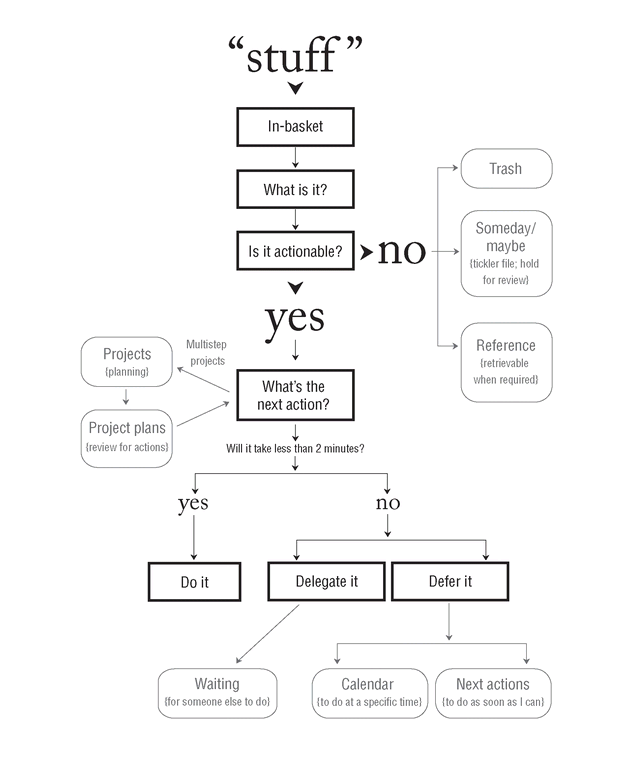
On Sunday, I then spent my day working through this:

GTD+workflow+diagram

By the end of the day, you know where I was at?

Step 1: Stuff to in (or collect, for those of you who prefer the term).

All of those things that had been lying around, pieces of paperwork, random receipts, half held thoughts in my head, were actually at least captured all in one place. For most people who pick up Getting Things Done, I think they fall at this hurdle. Don’t get me wrong, it is massively overwhelming. I burst into tears at one point and I am not a person prone to random crying. Well, not at this stuff anyway.

So why keep going? Because I do know what it feels like at the other end. To be able to be mysteriously more productive and still have time for creative thinking. Having this system will essentially allow me to have two jobs: employee and writer. The bills still need paying and without a system, the one I love the most would be the one I have to sacrifice.

That’s how you put the wheels back on. You remember that the two days of 100% overwhelm will be followed by many more days when you know exactly what has to be done and how you are going to do it. I’d rather do that than run through every day at 25% stress and go to bed each night kicking myself for making progress on everything other than the things that matter to me most.

Holiday Guilt (don’t worry, I don’t have any)

Anyone who knows me, or has read this blog fairly often will know holidays are pretty much my favourite thing. Coffee probably just about pips them to the post, but it’s a close run contest.

So why do many people feel holiday guilt? I’m not setting that up as a question I’m going to answer by delving into the depths of the human psyche. It is a genuine question on my part. Why do people look forward to, plan for, then go on holiday and take with them all the things they’ve been talking about escaping from?

I guarantee there are people here who’ve made a work call today, despite saying they weren’t going to. Or checked their emails, despite promising their significant others that this time they really wouldn’t.

I’m not talking people who own their own businesses and are the last say when it comes to making an emergency decision that could make or break the company. I’m not talking about people who are doing their dream job (such as writers or artists or crazy code writers) for whom a holiday is just a different way of experiencing the thing they love. I’m talking about middle management and mainly routine emails and calls.

My rule has always been that I will not take my work phone with me. From the moment my out of office goes on, all communication with my day job ceases. For the past 7 years, since the concept of being available 24 hours a day became something of a thing, it has been the one compromise I refuse to make. When I say that my employers can’t pay me enough, I mean it. The value of that time away is beyond monetary value for me.

So, no guilt. The world will go on without you. The job will actually be better if you return refreshed and capable, rather than only marginally less worn out, but with a tan. Research shows that taking a break will be of benefit in just about every way.

Ask yourself, if you can’t let go of the phone, what is really making you check your emails. Micro-management? Lack of faith in other people? Lack of faith that you’ve done what you were supposed to before you left and a ball has dropped? Or are you just addicted to the rush of getting email notifications, which is some bizarre chemical response the human brain has for some reason. Evolution needs to fix that one pretty damn quickly.

Whatever it is, give it up. Look around you. Take into account the things that matter most. Your family. Your friends. Your health, both physical and mental.

And for those of you getting all judgemental on me for taking the time out of my break to write this post, of course I scheduled it. Fingers crossed I’m actually lying in the sun now having a cocktail, watching the world go by.

Life, Death and Achieving Goals

So, I have once again committed the cardinal sin of the aspiring author. Neglecting my platform building yadda, yadda, yadda. But now, as the crazy months of summer begin to fade, I thought it would be a good time to return. Because this week has been about reflecting on life, acknowledging death and celebrating achieving goals.

It is important, for this first time in my life, I am seeing these things and being grateful for them in a context where it’s not all about me. Yes, the past few months have been crazy, but that is because I have spent so much time helping other people do what they can to live out the best life they can offer themselves. My own dreams and aspirations certainly haven’t been on the back burner, as I’ve actually continued to be consistent about getting up at 6am each morning and doing my 1500 words. I’ve even taken the plunge and started submitting again. But I am also starting to appreciate the joy that comes from building a close network of strong relationships where everyone is invested in giving each other a hand up when they can.

sunsetAnd this celebration of living a good life was brought to a poignant reminder this week when I attended the funeral of a friend who had finally lost a long battle with a brain tumour. It was my first humanist service and it was quite beautiful. The clear emphasis on celebrating life rather than mourning and resenting death seemed so appropriate. Never ever had I seen her complain about her lot in life or do anything other than live each day to the very best of her capabilities. People always imagine they will be tirelessly strong and positive in these kinds of life-altering scenarios, but few actually are when the chips are down. It was an inspiration to see; even though it took death to make me really aware of it.

Finally, in the spirit of appreciation, my sister has achieved a goal she has been working towards and I am so proud of her. Not just for the success, but for the completion of such an immense task in the face of odds which would make a normal person throw their hands up and walk away. The outcome is fantastic, but for me the privilege has been watching her take the journey and letting me walk with her some of the way. When she cracks open a bottle of champagne tonight, I will also raise a glass here, no doubt in the direction of the old man’s urn on the windowsill there, because I know he would have loved the chance to be as proud of her as I am.

Jack of all trades, master of some

I’ve come to a bit of a realisation. For most of us, specialism is dead.

I’m talking in a work sense here, rather than anything else, although I do wonder if the same principles apply. Sure, some roles will always be very specific. I mean, you don’t want to be operated on by someone who ‘dips in and out’ of being a surgeon. But in the fast paced world we are now living in, even those with a specific craft or skill will need to adapt quickly to ever-changing scenarios.

For the rest of us, everything is now fluid. Core skills (literacy, numeracy etc) will probably always be required at the heart of most roles. But now there are other important skills that need to be brought to the workplace: flexibility, innovation, creativity, persuasion and a learning mindset. It can be bewildering, but I also realised something great:

For those of us who have never wanted one of those very specific, narrowly defined roles, this is the best time to be in the workforce.

Because there will always be something new to jump into, if you see the opportunity and take it. I have an English degree and my masters was studying Critical Theory. Strangely, neither of them appear at all applicable to any of the jobs I have held, yet they have been the foundation of everything. Communication and appraising a scenario, seeing a problem and defining a resolution is a great thing to be able to do. And, if you’re prepared to learn a little code here, a little statistics there, then top it up with a hefty dose of project management, you can play the game in just about any industry.

Being a Jack of all trades is no longer a bad thing.