Tag Archives: gratitude

Personal Post: The Year That Was 2017

Is it a sign I’m getting older that my first thought is about how quickly the year has gone? Probably. But here we are on the cusp on 2018 and I find myself at that point in the year when I look back and see what I can learn before moving forward.

Lesson 1 – The best laid plans…

I spent the early part of 2017 setting up my life so I could become entirely location independent. Armed with a laptop, all I needed was a decent wifi connection and I was good to go. I got to spend months in the sun, living the dream and writing. Then, happily but ironically, circumstances have changed so that for the next two years I have virtually no choice but to be tied to that place called home.

Lesson 2 – Marketing makes no sense…

Never trust anyone who promises you a fool-proof system to fame or money. Whether it’s sales, platform building, advertising models or social media, no one has all the answers. In a world that is rapidly transitioning towards entrepreneurs and gig economies, there are more scammers out there than there are genuine business minds.

Lesson 3 – It’s all about helping others…

I’ve done some amazing things this year. But the thing that has given me the most satisfaction is hearing from people who have found The Realist’s Guide To Sugar Free useful. Some of the Amazon reviews have been amazing and I am so very grateful. It was because of this I wrote The Realist’s Guide To Resolutions. There are so many self-help achievement books out there that are really boring for the vast majority of readers. I happen to love them. So, once again, I studied, distilled and made a light and fun read for other people to get the benefits without having to wade through books that are, ultimately, trying to get business people to buy consulting services.

Looking forward…

I’ve come to realise that the main thing is about being happy with what matters to you. It’s not about being what other people expect you to be. If I can continue to stay true to myself in 2018, help others along the way and take it some spectacular sunsets, then I’ll be fine.

Whatever you want from 2018, I wish you every success.

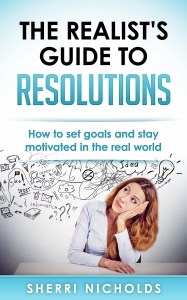
The Realist’s Guide To Resolutions – How To Set Goals and Stay Motivated In The Real World

If you want to stop smoking, lose weight, get fitter, improve your career prospects or simply finish a project that’s been hanging around on your to do list for the past ten years, this book will give you the kick up the backside you’ve been looking for.

Top 5 podcasts for writers of 2017

Over 2017, podcasts remained one of my favourite forms of entertainment and education. Thinking about this post, I couldn’t help but wonder if there would be any changes from my Top 5 of 2016. Or – even more impressively – if any from my Top 5 of 2014 would make it back onto the list.

To kick us off, returning for the second year: Cortexbroadcast_artwork_cortex_artwork

“CGP Grey and Myke Hurley are both independent content creators. Each episode, they discuss the methods and tools they employ to be productive and creative.”

Despite the not-a-schedule schedule being even more erratic this year, I’ve still looked forward to getting the alert that a new episode has arrived. For independent creatives in any field, Cortex is a conversation between friends about productivity, efficiency and a new way of working. Plus, someone gave me a knowing look and a ‘nice Cortex T-shirt’ comment at a hotel breakfast buffet this year and it made my day. Honestly, it’s not as creepy as it sounds. Monkey brain wins every time.

*

The only podcast to have featured on all previous lists is the amazing Writing Excuses.

wx-wordpressbanner-wdtrophy2016

“Fifteen minutes long, because you’re in a hurry, and we’re not that smart.”

Although the number of writing podcasts on my app of choice (Overcast, if you’re interested) has increased this year, this is still the best one out there dedicated to craft. This year there have been a number of co-hosts who bring new perspectives. Although I miss hearing from the main hosts sometimes, I would much rather that than have no weekly podcast at all. Whether you’re still working on your first draft or if you’re a seasoned professional, there really is something in here for everyone.

*

Sticking with a writing theme, Creative Penn podcast has been a great resource and a show I’ve consistently listened to over the course of the year.

“Interviews, inspiration and information on writing and creativity, publishing options, book marketing and creative entrepreneurship”

It is much less craft-focused than Writing Excuses, but still manages to stand out in a tough field of shows that want to teach you how you can make a living with your writing. I’ve discovered that most of them are seriously geared towards getting you to buy the premium course that shows you how. This is less pushy (maybe because it’s more British?), which I prefer, especially as there’s still lots of useful information and some very interesting guests.

*

Writing related, but in a different way, I have a brand new stationery podcast making it onto the list this year in the form of the RSVP podcast.

“A podcast about stationery and so much more!”

What started off as an April Fool’s one-off episode on the Erasable podcast (also worth checking out if you’re a fan of writing by hand, specifically with graphite – yes that is still a thing), became a podcast of its own. In a world full of default male voices, it has been fantastic to hear these three women bring a fresh spin on things. Plus, they don’t have a problem with calling out BS, drinking fine beverages and smashing the patriarchy, so what’s not to love?

*

Finally, in a very different  style, The Tim Ferriss Show is another overall favourite of 2017.

“Each episode, I deconstruct world-class performers from eclectic areas to extract the tactics, tools, and routines you can use.”

The thing I love about Tim and his products, be they books, videos or podcasts, is that nothing is off limits. As someone who loves to try new and inventive ways of life hacking, the wide range of topics always keeps me interested. Almost everything out on the internet is as niched down and specific as possible, but Tim constantly surprises me with some of the people he interviews and the experiments he’s prepared to try. I come away with something worth pondering every single episode and that’s pretty unusual.

So those are my top five podcasts of 2017. Some new ones and two old ones, but all of them worth checking out, especially if you’re a writer, creative, entrepreneur, life-hacker or simply enjoy damn fine audio.

2018: How to do more and worry less

As we hurtle towards the end of 2017, it’s inevitable that we start to look back over the year and ahead towards the new one. It’s a time of hope and dreams. It’s a shame then, that such determination and promise for the future only rolls around once a year.

I love personal improvement books. I’ve read hundreds of them by this point. But most people don’t. I can’t blame anyone for that. They’re notoriously dry and you have to dig through hundreds of pages to find the four really useful paragraphs they contain. You already know what I decided to do about it, right? Ta-dah!

The working title for this book was ‘goal setting for normal people’. It was never going to be the final name, but during the writing process I wanted to keep in mind the heart of what it should be about. Quite simply, to take the wisdom of those hundreds of books I’ve read, along with research papers, personal experiences and the behavioural lessons learned from writing The Realist’s Guide To Sugar Free. Then put it in an easy to read, useful and actionable book.

So what’s in it?

Plenty of information, without all the waffle and buzzwords. Things such as:

  • How to set the right goals for you (and not feel guilty about the ones you don’t)
  • How to plan for success (beyond the first week)
  • How to hack your brain to do this smarter not harder (great if you struggle with motivation and willpower)
  • How to track progress and level up (so you can continually dream bigger)

The Realist’s Guide To Resolutions will be published on December 28th. I wanted to make it available for those people who like to take advantage of the downtime between Christmas and New Year, or prefer to start the year with the thinking already done.

I’ve got my own yearly review day booked in for December 29th. I’ll consume several cups of very nice coffee, read the letter I wrote to myself at this time last year and write the one to open next year. I’ll look back at all the things I’ve done (fond memories of my four month sabbatical by the sea) and work out what I need to do to make next year even better. No doubt I’ll be slightly daunted by the sheer number of notebooks I’ve filled over the course of the year. My guess is upwards of twenty. Gulp.

If you’d rather wait until the festivities are out of the way and 2018 has arrived, then the pre-order will be delivered to your device for when you’re ready to start.

Like Sugar-Free, it’s a quick and easy read, with a dash of humour thrown in. It’s also reasonably priced (only 0.99 in most regions!) so you can get the most bang for your (literal) buck.

Here’s to a fantastic 2018, whatever that means for you.

The Realist’s Guide To Resolutions is available for Pre-order at Amazon.co.uk (or go to Amazon.com to jump to other regions)

Upcoming Offer

For those in the US, the kindle version of The Realist’s Guide To Sugar Free  will be discounted to 99c for New Year (December 29-January 4).

Top 5 blogs of 2017 for creatives

I’ve got a few ‘top 5’ posts coming up to round off what has been an unusual and exciting year. One of the first subjects that came to mind was this one, the 5 blogs I have found most useful during 2017.

It was only as I started really thinking about what they were that I realised that actually, I’ve moved away from blogs as a resource. I’m not sure if this is a trend, or whether I’ve just had a change in circumstances. Instead of having favourite sites I return to time and time again, I’ve instead been more likely to search by subject and consume a variety of blogs I find. The chances of me returning to any specific site are slim.

Perhaps, unfortunately, it has something to do with how fake news (actual fake news, which is generally the polar opposite of what is being branded fake news) has got me second guessing everything. Instead of taking any one person or comapany’s view as truth anymore, I find myself always verifying sources. I suspect that 2018 will contain more of the same.

However, I did manage to find 5 blogs that I have returned to more than others. Unsurprisingly, these cover my main interests of writing, travel and how to stay productive and healthy.


The Creative Penn

Joanna Penn has quite the enterprise going now. There’s a lot of really useful information on the Creative Penn website and I find myself returning to it frequently. Bridging art and commerce, Joanna’s site is future thinking and always optimistic, no matter what craziness and uncertainty exists in the world. She’s making money from people wanting to be authors, but she’s up front about expecting money in exchange for valuable insights, rather than being a ‘get rich quick on kindle’ scammer.

Goins, Writer

Jeff Goins has made a career from writing about writing. When you look at his work about work it all sort of gets a bit meta, but there’s a lot of important takeaways included. The concept that actually, in today’s world we are moving away from a single-track career progression and into a varied career of diverse options, is something that has really resonated with me this year. As I look towards 2018 this site has been great at reminding me to keep my options open, embrace opportunities and ignore the imposter syndrome.

Chris The Freelancer

Admittedly I tend to watch Chris’s videos on YouTube more frequently than I visit his blog. He’s built quite the channel about working from a laptop while he travels the world. He was one of the first resources I came across while looking at the way the world is gradually turning towards a laptop, gig based economy. Unlike many digital nomad sources, he has a professional approach, steering away from the backpacker with a side-hustle content that forms much of the information out there.

Pick The Brain

The banners at the top of this site cover off all the things near and dear to my heart: motivation, productivity, health, self-improvement. It focuses on doing the things required to move you forward to a dream life, but isn’t all about the hustle. Productivity is great, but not as a way of doing even more so you can burn yourself out. Instead, a healthy momentum is the name of the game. Even when the information isn’t new to me, it always acts as a good reminder to stop and think.

Brain Pickings

Although it has a very similar title to the one above, it’s very different. With much longer pieces, it’s not full of snappy soundbites. There are no quick wins to take away here. Instead, the posts are more critical and philosophical. More academic, if you don’t mind me using that word. The insights are numerous, but you have to work for them. Honestly, in today’s world of short attention spans and instant gratification, I don’t think that’s a bad thing.

Seasons – Planning Life Alongside Nature

For us in the northern hemisphere, there is no denying the change in the air. Summer is giving way to autumn (or fall, if you want to be all American about it). The kids are back at school. All the upcoming holidays now have an ‘end of year’ feel to them. For those in the southern hemisphere, the reverse is true. Spring is coming and summer will be here before you know it. Time to hit the beach and get outdoors.

It was whilst living in New Zealand that I realised for the first time how productivity and personal development have seasons of their own, often very much inline with nature. Perhaps it was because all my online inputs were largely presenting an experience that was the reverse of the one I was living through. What I did realise was that as the rains came (I was living in Christchurch, there was lots of rain), it became harder to stay motivated and geared up for new projects all the time.

Any productivity guru worth their salt will tell you that you don’t need to wait for the New Year to make a change. Or that every day is a fresh start. It’s all very true. I just think it becomes harder if you try to do it out of sync with the world around you.

Many people live online so much that it makes it easier, in a strange sort of way. When you never leave the house, it’s easy to forget what is going on outside. I know the temptation of the laptop as much as anyone else. Nevertheless, it can contribute to a feeling of burnout when there is no variation, just the non-stop hustle and grind of daily life.

Right now, I am taking a mini-break to plan the remainder of the year. I wanted to be somewhere different, somewhere much closer to nature, to remind myself of this idea. As the days get shorter, it will become harder to get out of bed each morning. The evenings will seem made for curling up under blankets with a good book, not hitting the gym or high intensity projects. I need to remember this so that I don’t fill my days with things I won’t achieve. I don’t like breaking promises to anyone, least of all myself.

So, over the next few weeks when you begin to see articles and blogs reminding you that ‘It’s not too late to win the year!’ and ‘make that final quarter count!’, remember that life is meant to have periods of recovery and renewal. If you’ve left it until nature begins to shut down, then it might be time to consider a different approach next year.

Of course, for those of you in the southern hemisphere, it’s time to get up and at ‘em.

How to create a successful morning routine

Why set up a morning routine?

These are a few benefits I’ve found from my own routine over the years.

For many years, a corporate job took most of my time and energy. I would come home from work and have nothing left to give for things that were important to me. I wanted to be a writer, but I never actually wrote anything. This all changed when I dedicated just an hour every morning to my writing. Having a morning routine allows you to dedicate time to the things that matter to you most.

Precious alone time. In today’s world, we are constantly bombarded with interruptions, whether in real life, social media or any other online input. A successful morning routine, one that was clearly defined, gave me a definite course of action, so I always knew what to do next. That removed ‘check twitter’ from my list of options. That space gave me time to think about what was important and also sheltered me from negative bombardment from the moment I woke up.

There are many other benefits, but those two give the biggest returns for a happier and more fulfilling life.

So how do you set up a morning routine?

It’s easier than you think.

Firstly, ask yourself what you hope to achieve from doing this. Everyone will have different objectives. Is it to make time for your creative projects? Is it to make sure you get in a good workout each day? Or perhaps it is to read or work on personal development. What matters most to you will make up the core of the routine.

Secondly, decide how much time you want to devote to this activity. Be realistic. If you want to do a thirty minute workout but have to go to the gym, then include the travel time and showering afterwards. No one will thank you if you run out of time for that. The amount of time required will impact on how early you need to get up in order to complete the routine before beginning your existing obligations.

Thirdly, don’t start too big. Habits take time to become routines and the more you add in, the more likely you are to become overwhelmed and give up. My morning routine started out with a simple, single task: write 1000 words before breakfast. Over time, that has developed into a multi-step routine, but I needed to get used to doing that single but significant task first.

Be in it for the long haul

So what does my routine look like now? It combines several elements that I have seen successful authors, businesspeople and entrepreneurs confirm as being instrumental for them.

1) Begin with a pint of water. I used to go straight to coffee, but never underestimate the power of rehydrating after 7 hours of sleeping.

2) Write 1000 words. That’s still my big goal after 6 years of doing this.

3) Morning Pages – adapted from Julia Cameron’s The Artist’s Way. You’re really supposed to do them before anything else, but for me they have actually always been more effective after my half-asleep writing session. The last page always contains three things I am grateful for that morning.

4) 20 Pushups. Really not many, but it makes me feel like I’ve at least done something physical and makes me more likely to do other activity throughout the day.

5) Affirmations and visualisations. Yes, I still feel like an idiot sometimes saying these things out loud, but they do work. I’m shy and introverted by nature, so this gives me the confidence to step outside my comfort zone when I need to.

6) Goals review. Don’t work hard to climb that ladder just to discover it’s up against the wrong tree. Work out what you want and remind yourself every day to stay focused on what matters, rather than what simply feels urgent.

7) Calendar review. It doesn’t matter what grand goals you have for that day if your calendar says you have back-to-back meetings. Again, be realistic.

8) Task list review. By the time I’ve reviewed what matters (goals) and what’s immovable (calendar), it makes it much easier to delete, delegate or defer tasks on my list. What remains still needs to get done, but this way I don’t waste my energy on unnecessary tasks before I get to them.

The power of a morning routine means that these tasks take less time as you repeat them. The whole process above now takes somewhere between 90 minutes and 2 hours. That’s from 6-8am at the latest. That gives me a whole hour to have breakfast, get showered and be at my desk by 9am.

I’ve already achieved things that matter to me and mentally prepared for my day by the point most people are just thinking about booting up the laptop.

None of this will work unless…

A meticulously planned morning routine with all the best intentions and activities will still fail unless you actively set yourself up for success the night before. Unless you have the luxury of being beholden to no-one, you’re going to have to sacrifice some morning sleep to get this done.

A successful morning routine means ensuring you go to bed early enough to get the quality sleep you need. If there are any objects/spaces that are essential to your routine, then these should be found or made clear the night before to remove as much friction as possible and ensure you can make every minute of your morning routine count.

Hopefully this has given you some ideas about how to set up a morning routine and how to grow it into something that makes a huge difference in the level of success and satisfaction you get from your day. If you have any questions or thoughts then drop them in the comments section below, or you can get in touch with me by email at realist@sherrinicholds.com.

Books for Entrepreneurs: Essentialism

Greg McKeown’s infamous book, Essentialism, has been on my reading list for a long time. I can’t even remember when or where I first heard about it, but those who mentioned it always spoke of its life changing effect.

When you read a lot of business and personal improvement books like I do, you get used to people waxing lyrical about how things will never be the same after adopting strategy x. This may turn out to be one of those rare occurrences where it happens to be true. The constant doing more, but achieving less. Never feeling satisfied or that the day was meaningful.

As I began reading, I was relieved to discover I already had quite a few essentialist habits. I discovered the underlying cause of friction I felt on many projects: my broadly essentialist approach versus the non-essentialist approach being taken.

This meant that in addition to completing the task itself, I had to work out the true intent and purpose of the project. Where some people are happy to just complete any task (usually just taking the easiest route to something approximating done), I have never accepted mediocre as the target to aim for. Instead, I would rather take longer to work out how to provide a valuable outcome.

But although I was embracing essentialism in many areas, in others I was getting woefully distracted. My personal life, especially, was in free-fall at the time of reading this book. In no small part this was due to the mental exhaustion that came with battling work tasks handed to me that were governed by non-essentialist principles.

So how has this book helped me? Largely by giving me the confidence not to accept a task without getting those in charge of the project to clarify their thinking about it first. Sometimes, the person handing out that task is me. As a freelancer or entrepreneur, understanding essentialism is vital for avoiding burnout.

It’s hard to ask difficult questions sometimes, but it gives me the boundaries to not only do good work, but also valuable work.

The best part of this is that I ultimately freed up valuable creative energy to expend into my personal life and projects. I developed a new infrastructure for 2017 that allowed me to be location independent and travel.It also gives me the framework to consider carefully my side projects and see which ones are ready to move from hobby to business and which ones simply need to be cut from my life, no matter how enjoyable they seem on the surface.

For the first time since reading David Allen’s Getting Things Done, I have experienced a fundamental shift in what I believe is achievable and what my life needs to look like to get there. The confidence comes through in the decision making process. Whilst success is never guaranteed, I am giving myself the best possible shot at living a meaningful life, rather than a purely busy and productive one.

With challenging economic and political times ahead, Essentialism is one of the books I would recommend for anyone who wants to make the most of future opportunities in the changing workforce.

Follow Up: Using A Bullet Journal For Creative Projects

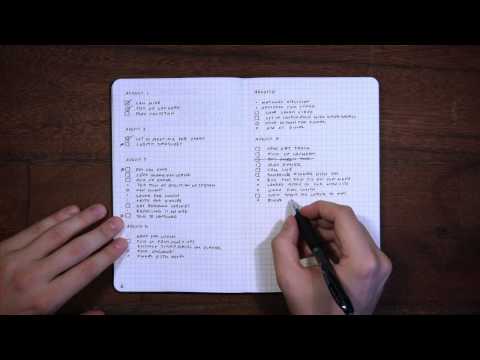
One of the most popular posts on my site is this one about how I use a Bullet Journal. The other, in case you are interested, is the one weighing up the pros and cons of using a Moleskine versus Field Notes, which also has a Bullet Journal influence to it.

Given I started using a Bullet Journal approach when it was a new thing and not the hugely popular and artistic thing it is now (check out the Instagram bujo hashtag if you want to feel inferior about your artistic skills), I thought it would be a good time to do a follow up. Specifically, how to use a Bullet Journal for creative projects.

Firstly, the thing to remember is that the bullet journal methodology is not set in stone. Right from the start, it was a system designed to be modified to meet individual needs. For me, this has resulted in two separate notebooks: one for planning and the other for creative writing projects.

A creative Bullet Journal, by definition, will have different requirements to a notebook containing everything. But why did I separate them? Quite simply, I wanted to have all my book outlines and ideas in one place. When it’s time to pick a project to move onto, this dramatically reduces the number of notebooks I have to work my way through. Because it is specifically for longer outlines, rather than aha! on-the-go snippets, I can stick to an A5 size that is just large enough.

What to remove

Because I’ve got a specific use case in mind, I can ignore any features that relate to the calendar. (Side note, because I’ve stripped out the creative writing projects, I can use an actual diary in a modified Bullet Journal approach that is just as effective. If you want to know more, I’m using a Moleskine Agenda as described here). This means the Future Log and the Monthly Log disappear for me.

What to keep

The Index is the core functionality of the Bullet Journal system that is so simple, yet life changing. This is particularly important in this instance because I want to be able to easily review the contents at a later date. I can’t help but call it Contents though, rather than Index. Sorry!

Underpinning the index is the use of page numbers. This is a feature that makes the Leuchtturm 1917 brand ideal for Bullet Journaling as they are pre-completed. I find manually numbering the pages at the start of a new notebook quite therapeutic, so don’t worry if your notebook of choice doesn’t have them.


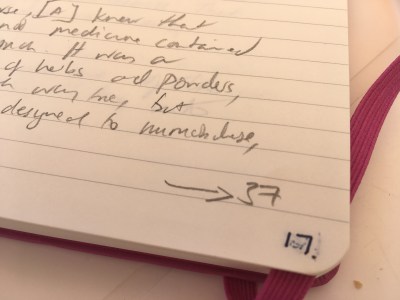
Because I might plan a story over the course of several weeks and have more than one in development at any given time, when it comes to review I don’t want to keep flicking back to the index to find the related project pieces. Instead I use a simple arrow system when linking larger blocks of related text. It is a simple thing to do before starting, but saves amazing amounts of time when reviewing:

This chapter continues on page 37

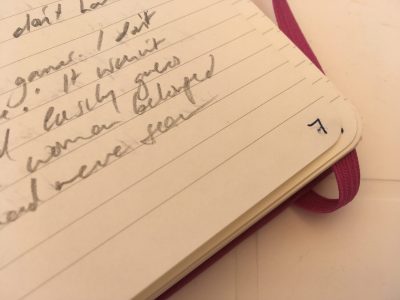
This continues from page 17

What about topics, bullets and tasks?

I still use these as a creative feature. There is much more to writing a book than plotting it out. There may be research tasks that need to be completed prior to writing and these can form topics in themselves.

Personal Opinions…

What is the best size for a Bullet Journal?

For creative projects, the A5 size works best. For ‘on the go’ notes and ideas capture, a pocket notebook is best (such as a Field Notes)

What is the best brand for a bullet journal?

Leuchtturm 1917 is the closest fit for the Bullet Journal system. Prebuilt Index and page numbers, as well as a paper quality that works for a wide range of pen types, including fountain pens

What is the best paper format for a bullet journal?

Plain paper allows for the most freedom, but I’m a huge fan of graph or dot grid. The key is that any ruling is subtle enough for it not to be limiting 

You can find the official Bullet Journal site and more information from Ryder here.

Not The 4-Hour Workweek: lessons in scheduling, time tracking and an abundance of hours

This is the first full work week completely under my own control. I set the tasks, the hours, the goals and overall strategy. Anyone who knows me will agree I love to have that kind of control. It has been a steep learning curve, but years of practicing in my free time outside of the 9-5, as well as the lessons in project management I’ve learned over the years working in companies, has made it much easier than it could have been.

Towards the end of 2016, I listened to The 4-Hour Workweek by Tim Ferris. For anyone who has ever considered location independent living or being a digital nomad, then this is often the springboard book. Besides, with a title like that, who wouldn’t want to work just four hours?

Of course, is that really what the book is saying? ‘Do nothing and get rich’ is the answer a lot of people hope to get from it. But at it’s heart, it’s about doing the things that matter in the most effective way possible. It is a bible for lifestyle design. People who can automate their business to the point that they only spend four hours on them are the kinds of people who don’t then retire. They start another business. The ‘be effective’ and commitment to living big is the message they take away, not do as little as you can.

Four hours sounds nice on the surface. But if you work doing the things you enjoy, which I suspect most of Ferris’ disciples do, then four hours is never the goal.

Time tracking

As you can guess from the title, this has not been a four hour work week. My life hasn’t been fully automated with a bunch of virtual assistants running businesses for me while I sip cocktails in Bali. How do I know this? For the first time in years, I did proper time tracking.

I didn’t spend hours looking at all the different options for doing this. Instead I picked toggl, as Mike and Grey were talking about it so much on the recent episodes of Cortex. Have I gone all in? Nope, I won’t be taking advantage of that extensive API to play with. I just want to know how much time I am spending on the key areas that now constitute my day.

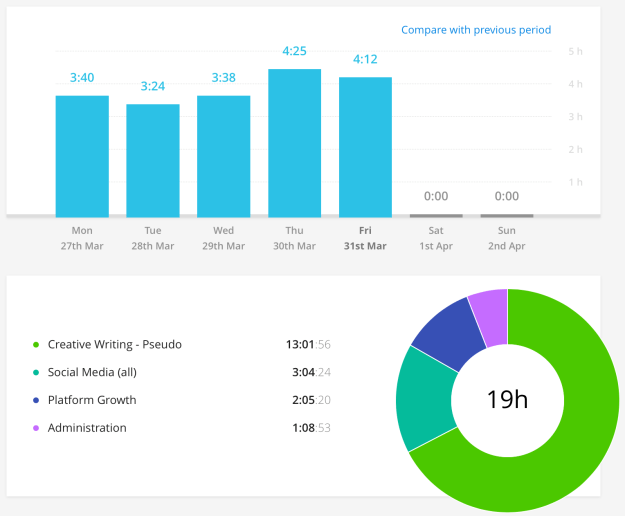
The results? I might not be working a four hour week, but I’m not doing a forty hour one either:

This is actual work. This is not ‘killing time’ work. This is not timesheet submission busy-work. When the tasks for the day are done, then I am done. I focus on them completely and make them as efficient as they can be. This is just the first week of data, but it is fascinating. I’ve always believed that quality of work is more important than hours spent and this is re-enforcing that in a big way.

Time scheduling – a combination of digital and analogue

In a less time efficient move, I have lost countless hours since January looking at digital project and time management tools. None of them seem to be just what I was looking for. Many were far too time intensive to set up projects and tasks for my small, single-person projects. Secondly, I’m still reliant on the GTD way of thinking, meaning that many have critical pieces missing. Thirdly, none would emphasise calendaring in a way that works for me. I’m a deadline driven person, so without a ‘real’ due date, my default action will be to happily defer.

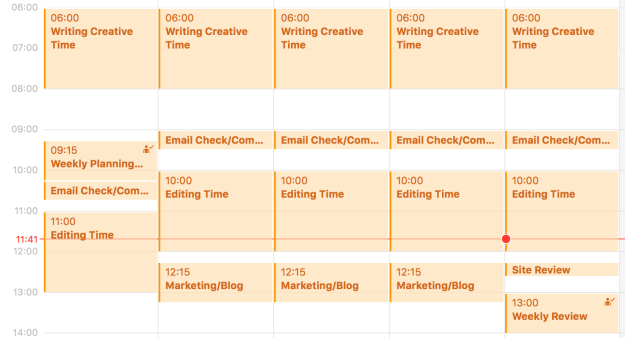
Rather than continuing this frustration, right now I am managing things in an analog and digital combo. The first is a paper planner (the Moleskine Weekly Planner that I reviewed here) and a separate ‘work’ calendar that chunks times of the day into very high level categories (for example, editing time vs ‘line edit of x book’).

Putting the two together has allowed me to focus on the bigger picture, whilst still getting into the detail of the day. Whether it will continue to work in the long term remains to be seen, but for this first focused week, just about everything went according to plan, with enough flexibility to allow for one or two unscheduled events.

Free time and the sensation of guilt (‘I should be doing…’)

I’ve been sticking to my usual routine of starting my workday at 6am. Doing around 4 hours means I have a lot of day left at the end of my day. Whilst this sounds like a dream – and it is – the thing that I have noticed at times is an overwhelming sense of guilt. Even on the day I used all my brainpower writing 7,500 words, it was an obvious nagging sensation at the back of my brain. The quest for something ‘productive’ to do. It has made me realise how much we are compelled to fill our hours with work, when sometimes the thing to do is just relax.

I hope this is something that disappears quickly. It feels like a hangover from the 9-5 life and it serves no purpose as far as I can tell.

Walking and thinking is a valid use of time

Conclusion – scary, at times overwhelming, but eye-opening and utterly rewarding

Would I class this first proper full time writing week as a success? Yes, I would. I’ve eaten well, I’ve rested well and I’ve spent time creating new products and learning new things.

Has it been difficult and crazy ass scary at times? Of course it has. Any big change always does (and anyone who tells you otherwise has got caught up in their own lies and bravado). But I’ve also loved the freedom and the self-reliance. I’ve loved a semi-traditional work week, with all of the benefits and very few downsides.

I already can’t wait to see what next week brings when reality sets in.

Still struggling to lose excess holiday weight? A workbook to help cut dangerous sugars from your diet

When I first published The Realist’s Guide To Sugar Free, lots of people asked for a paperback version of the book. I resisted for a while, as only offering the the book in electronic form meant I could keep the price low and get the message out there.

Over time, the requests for a paperback version have continued to grow. So I decided to take the plunge and create one.

food-dinner-grilled-shashlik

The physical copy of the book not only contains the important tips, tricks and psychology of the ebook version, but also contains a greater degree of interactivity. The Realist’s Guide To Sugar Free is not a cookbook. It is not a diet book. It is about serious lifestyle change and kicking a powerful addiction. I’ve built the paperback version to contain space for you to make notes and answer the questions I ask you in real time.

sugar free workbook

Countless studies have shown that the act of writing down your goals vastly improves your chances of reaching them. The same goes for your habits and routines. It empowers people to take conscious, positive decisions rather than make unhelpful unconscious choices.

This has turned the guide into a workbook of sorts. It can be your personal journal on the road to eliminating processed sugars from your life for good. The 9 step action plan includes the space you need to analyse your behaviour, face up to your bad habits and document your journey to a sugar-free lifestyle.

I know how difficult it can be to rely on willpower alone, so there is real value to be found in writing down your motivations and weaknesses. When the craving for a sugary snack strikes, having a tangible reminder of why you’re changing your life helps you to resist. I know I struggled to stay sugar free over the holidays and then had to kick the addiction again, so I’ve returned to this basic guide to get myself back on track. If it works for me, then it can work for you.

therealistsguidetosugarfree-2

The Realist’s Guide To Sugar Free is available at Amazon (UK) and Amazon (US) in both formats.

Love the book? Then please leave a review on Amazon. Reviews help keep the book visible, which means I can help more people make the change to a happier and healthier life.