Tag Archives: digital nomad

Top 5 podcasts for writers of 2017

Over 2017, podcasts remained one of my favourite forms of entertainment and education. Thinking about this post, I couldn’t help but wonder if there would be any changes from my Top 5 of 2016. Or – even more impressively – if any from my Top 5 of 2014 would make it back onto the list.

To kick us off, returning for the second year: Cortexbroadcast_artwork_cortex_artwork

“CGP Grey and Myke Hurley are both independent content creators. Each episode, they discuss the methods and tools they employ to be productive and creative.”

Despite the not-a-schedule schedule being even more erratic this year, I’ve still looked forward to getting the alert that a new episode has arrived. For independent creatives in any field, Cortex is a conversation between friends about productivity, efficiency and a new way of working. Plus, someone gave me a knowing look and a ‘nice Cortex T-shirt’ comment at a hotel breakfast buffet this year and it made my day. Honestly, it’s not as creepy as it sounds. Monkey brain wins every time.

*

The only podcast to have featured on all previous lists is the amazing Writing Excuses.

wx-wordpressbanner-wdtrophy2016

“Fifteen minutes long, because you’re in a hurry, and we’re not that smart.”

Although the number of writing podcasts on my app of choice (Overcast, if you’re interested) has increased this year, this is still the best one out there dedicated to craft. This year there have been a number of co-hosts who bring new perspectives. Although I miss hearing from the main hosts sometimes, I would much rather that than have no weekly podcast at all. Whether you’re still working on your first draft or if you’re a seasoned professional, there really is something in here for everyone.

*

Sticking with a writing theme, Creative Penn podcast has been a great resource and a show I’ve consistently listened to over the course of the year.
“Interviews, inspiration and information on writing and creativity, publishing options, book marketing and creative entrepreneurship”

It is much less craft-focused than Writing Excuses, but still manages to stand out in a tough field of shows that want to teach you how you can make a living with your writing. I’ve discovered that most of them are seriously geared towards getting you to buy the premium course that shows you how. This is less pushy (maybe because it’s more British?), which I prefer, especially as there’s still lots of useful information and some very interesting guests.

*

Writing related, but in a different way, I have a brand new stationery podcast making it onto the list this year in the form of the RSVP podcast.

“A podcast about stationery and so much more!”

What started off as an April Fool’s one-off episode on the Erasable podcast (also worth checking out if you’re a fan of writing by hand, specifically with graphite – yes that is still a thing), became a podcast of its own. In a world full of default male voices, it has been fantastic to hear these three women bring a fresh spin on things. Plus, they don’t have a problem with calling out BS, drinking fine beverages and smashing the patriarchy, so what’s not to love?

*

Finally, in a very different  style, The Tim Ferriss Show is another overall favourite of 2017.

“Each episode, I deconstruct world-class performers from eclectic areas to extract the tactics, tools, and routines you can use.”

The thing I love about Tim and his products, be they books, videos or podcasts, is that nothing is off limits. As someone who loves to try new and inventive ways of life hacking, the wide range of topics always keeps me interested. Almost everything out on the internet is as niched down and specific as possible, but Tim constantly surprises me with some of the people he interviews and the experiments he’s prepared to try. I come away with something worth pondering every single episode and that’s pretty unusual.

So those are my top five podcasts of 2017. Some new ones and two old ones, but all of them worth checking out, especially if you’re a writer, creative, entrepreneur, life-hacker or simply enjoy damn fine audio.

2018: How to do more and worry less

As we hurtle towards the end of 2017, it’s inevitable that we start to look back over the year and ahead towards the new one. It’s a time of hope and dreams. It’s a shame then, that such determination and promise for the future only rolls around once a year.

I love personal improvement books. I’ve read hundreds of them by this point. But most people don’t. I can’t blame anyone for that. They’re notoriously dry and you have to dig through hundreds of pages to find the four really useful paragraphs they contain. You already know what I decided to do about it, right? Ta-dah!

The working title for this book was ‘goal setting for normal people’. It was never going to be the final name, but during the writing process I wanted to keep in mind the heart of what it should be about. Quite simply, to take the wisdom of those hundreds of books I’ve read, along with research papers, personal experiences and the behavioural lessons learned from writing The Realist’s Guide To Sugar Free. Then put it in an easy to read, useful and actionable book.

So what’s in it?

Plenty of information, without all the waffle and buzzwords. Things such as:

  • How to set the right goals for you (and not feel guilty about the ones you don’t)
  • How to plan for success (beyond the first week)
  • How to hack your brain to do this smarter not harder (great if you struggle with motivation and willpower)
  • How to track progress and level up (so you can continually dream bigger)

The Realist’s Guide To Resolutions will be published on December 28th. I wanted to make it available for those people who like to take advantage of the downtime between Christmas and New Year, or prefer to start the year with the thinking already done.

I’ve got my own yearly review day booked in for December 29th. I’ll consume several cups of very nice coffee, read the letter I wrote to myself at this time last year and write the one to open next year. I’ll look back at all the things I’ve done (fond memories of my four month sabbatical by the sea) and work out what I need to do to make next year even better. No doubt I’ll be slightly daunted by the sheer number of notebooks I’ve filled over the course of the year. My guess is upwards of twenty. Gulp.

If you’d rather wait until the festivities are out of the way and 2018 has arrived, then the pre-order will be delivered to your device for when you’re ready to start.

Like Sugar-Free, it’s a quick and easy read, with a dash of humour thrown in. It’s also reasonably priced (only 0.99 in most regions!) so you can get the most bang for your (literal) buck.

Here’s to a fantastic 2018, whatever that means for you.

The Realist’s Guide To Resolutions is available for Pre-order at Amazon.co.uk (or go to Amazon.com to jump to other regions)

Upcoming Offer

For those in the US, the kindle version of The Realist’s Guide To Sugar Free  will be discounted to 99c for New Year (December 29-January 4).

Top 5 blogs of 2017 for creatives

I’ve got a few ‘top 5’ posts coming up to round off what has been an unusual and exciting year. One of the first subjects that came to mind was this one, the 5 blogs I have found most useful during 2017.

It was only as I started really thinking about what they were that I realised that actually, I’ve moved away from blogs as a resource. I’m not sure if this is a trend, or whether I’ve just had a change in circumstances. Instead of having favourite sites I return to time and time again, I’ve instead been more likely to search by subject and consume a variety of blogs I find. The chances of me returning to any specific site are slim.

Perhaps, unfortunately, it has something to do with how fake news (actual fake news, which is generally the polar opposite of what is being branded fake news) has got me second guessing everything. Instead of taking any one person or comapany’s view as truth anymore, I find myself always verifying sources. I suspect that 2018 will contain more of the same.

However, I did manage to find 5 blogs that I have returned to more than others. Unsurprisingly, these cover my main interests of writing, travel and how to stay productive and healthy.


The Creative Penn

Joanna Penn has quite the enterprise going now. There’s a lot of really useful information on the Creative Penn website and I find myself returning to it frequently. Bridging art and commerce, Joanna’s site is future thinking and always optimistic, no matter what craziness and uncertainty exists in the world. She’s making money from people wanting to be authors, but she’s up front about expecting money in exchange for valuable insights, rather than being a ‘get rich quick on kindle’ scammer.

Goins, Writer

Jeff Goins has made a career from writing about writing. When you look at his work about work it all sort of gets a bit meta, but there’s a lot of important takeaways included. The concept that actually, in today’s world we are moving away from a single-track career progression and into a varied career of diverse options, is something that has really resonated with me this year. As I look towards 2018 this site has been great at reminding me to keep my options open, embrace opportunities and ignore the imposter syndrome.

Chris The Freelancer

Admittedly I tend to watch Chris’s videos on YouTube more frequently than I visit his blog. He’s built quite the channel about working from a laptop while he travels the world. He was one of the first resources I came across while looking at the way the world is gradually turning towards a laptop, gig based economy. Unlike many digital nomad sources, he has a professional approach, steering away from the backpacker with a side-hustle content that forms much of the information out there.

Pick The Brain

The banners at the top of this site cover off all the things near and dear to my heart: motivation, productivity, health, self-improvement. It focuses on doing the things required to move you forward to a dream life, but isn’t all about the hustle. Productivity is great, but not as a way of doing even more so you can burn yourself out. Instead, a healthy momentum is the name of the game. Even when the information isn’t new to me, it always acts as a good reminder to stop and think.

Brain Pickings

Although it has a very similar title to the one above, it’s very different. With much longer pieces, it’s not full of snappy soundbites. There are no quick wins to take away here. Instead, the posts are more critical and philosophical. More academic, if you don’t mind me using that word. The insights are numerous, but you have to work for them. Honestly, in today’s world of short attention spans and instant gratification, I don’t think that’s a bad thing.

Tools of the trade: Field Notes Campfire Review

As a reminder, I use analogue tools for creative planning (including business strategy, idea generation and note taking). Therefore the items I use have to meet three criteria. They must be:

  • Attractive to use, so they make me want to write
  • Portable, so I can use them at my desk, office or coffee shop
  • Flexible, so they are appropriate in multiple scenarios

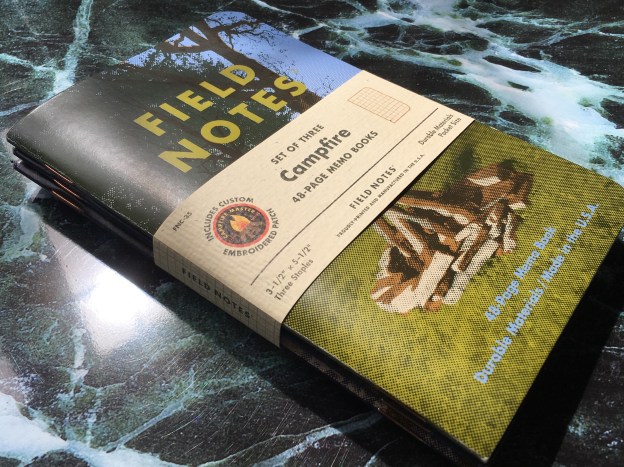
So how does the quarterly Field Notes Campfire release shape up against those requirements? Great, actually.

The different cover designs are awesome

Compared to the previous two releases (Utility and Black Ice), this edition feels like a Field Notes book. It has shades of Americana that people expect from a company like Field Notes. It is part of their brand appeal. For me, the two previous editions were innovation over functionality. They reduced the usability of a product that I want to carry with me at all times.

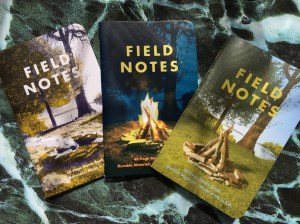
So are they attractive to use? Oh yes. A big tick in the box on that score. The three different covers add variety and they have a beautiful tactile finish on the covers. Nice additional touches include the different shade of grid lines in each book to match the key tones of their respective covers.

Attention to detail with the grid line colours

As for portability, Field Notes always have that covered. Of their 35 quarterly editions, only two have broken away from the pocket book size (Arts and Sciences and Byline). Both were great alternatives, but not as truly portable as the pocket size. Campfire Edition has the portability that we’ve come to expect from Field Notes and fits in all those standard carry cases as well as your back pocket.

Straight into my trusty Nock Co case

Finally, flexibility for use in both personal and business scenarios. Field Notes are never going to be corporate like Moleskine or Leuchtturm1917, but they’re not trying to be. At the same point, neither are they offensive or too gimmicky most of the time. If I had to pull these out in a client meeting, they’re the kind of notebooks that might attract attention, but in good ways. They don’t scream unprofessional.

As for the paper, I haven’t found it to be a problem with fountain pens, as long as I’m not using a big juicy wet nib and ink. There’s very little feathering or bleed through on the page, which means I don’t have to stop and think about the pen I’m using before beginning to write.

Very little bleed through on the page

Overall, I give this one a big thumbs up and can’t wait to see what the next quarterly release is. Fall is subscription renewal time for me, but I have a mountain of pocket notebooks still waiting to be used. It will be interesting to see if Field Notes pull something out of the bag that makes it impossible for me to resist subscribing for another year.

You can buy the Field Notes Campfire Edition here until they’re sold out.

Books for Entrepreneurs: Essentialism

Greg McKeown’s infamous book, Essentialism, has been on my reading list for a long time. I can’t even remember when or where I first heard about it, but those who mentioned it always spoke of its life changing effect.

When you read a lot of business and personal improvement books like I do, you get used to people waxing lyrical about how things will never be the same after adopting strategy x. This may turn out to be one of those rare occurrences where it happens to be true. The constant doing more, but achieving less. Never feeling satisfied or that the day was meaningful.

As I began reading, I was relieved to discover I already had quite a few essentialist habits. I discovered the underlying cause of friction I felt on many projects: my broadly essentialist approach versus the non-essentialist approach being taken.

This meant that in addition to completing the task itself, I had to work out the true intent and purpose of the project. Where some people are happy to just complete any task (usually just taking the easiest route to something approximating done), I have never accepted mediocre as the target to aim for. Instead, I would rather take longer to work out how to provide a valuable outcome.

But although I was embracing essentialism in many areas, in others I was getting woefully distracted. My personal life, especially, was in free-fall at the time of reading this book. In no small part this was due to the mental exhaustion that came with battling work tasks handed to me that were governed by non-essentialist principles.

So how has this book helped me? Largely by giving me the confidence not to accept a task without getting those in charge of the project to clarify their thinking about it first. Sometimes, the person handing out that task is me. As a freelancer or entrepreneur, understanding essentialism is vital for avoiding burnout.

It’s hard to ask difficult questions sometimes, but it gives me the boundaries to not only do good work, but also valuable work.

The best part of this is that I ultimately freed up valuable creative energy to expend into my personal life and projects. I developed a new infrastructure for 2017 that allowed me to be location independent and travel.It also gives me the framework to consider carefully my side projects and see which ones are ready to move from hobby to business and which ones simply need to be cut from my life, no matter how enjoyable they seem on the surface.

For the first time since reading David Allen’s Getting Things Done, I have experienced a fundamental shift in what I believe is achievable and what my life needs to look like to get there. The confidence comes through in the decision making process. Whilst success is never guaranteed, I am giving myself the best possible shot at living a meaningful life, rather than a purely busy and productive one.

With challenging economic and political times ahead, Essentialism is one of the books I would recommend for anyone who wants to make the most of future opportunities in the changing workforce.

Gran Canaria for Digital Nomads

After spending 3 months with Gran Canaria as my home base, I can say for certain it has been a perfect place. Although the location independent lifestyle is still in its infancy in real terms, I can see great potential for the Canary Islands as a whole to become the nomad capital of Europe. I group them together as a single entity because there is so much variety in such a small space, all of it easy to access. Tenerife and Lanzarote also have a growing digital nomad community that can be reached within an hour or two.

However, I’m also aware that I have some very specific requirements when picking out my ideal travel locations, so in the review that follows, I’ll try to be balanced towards the areas that matter to a majority of people. So how do the Canary Islands fare on the key metrics?

Costs are in US dollars, unless otherwise specified.

Cost

Compared to much of Europe, the Canary Islands aren’t that expensive. They’re not dirt cheap either, as they’re developed and off the mainland. But flights from all over Europe can be purchased for around $50 if you shop around. At this price, I was able to get a return flight to the UK for a long weekend in May for around $75 – an absolute bargain.

The cost of accommodation varies depending on season (as the islands have a strong tourist influence). A one bed apartment can cost as little as $800 per month with utilities included. For less than $900 you can have sea views and balconies, which are my personal preferences. The good news is that low season, when the prices are at their most competitive, the conditions are ideal for working.

Not a bad office view

As someone who tries to eat healthily, fresh meat and produce can be slightly more expensive than in mainland Europe. Supermarkets tend to be smaller and buying in bulk to save money is not always an option. Even so, it is still more cost efficient than eating out, especially in the tourist areas, when a main meal can set you back $15-20 per person.

You have to enjoy meat and cheese around here

The constant requirement of bottled water doesn’t sit well with my conscience either if I’m honest and adds about $2 per person, per day. That adds up over three months!

Weather

Located off the coast of Africa, approximately 28 degrees north of the equator, the Canary Islands have the best weather in the world. Hot days, balmy nights, with very little rainfall. Unlike a lot of other hot, palm tree laden places in the world, this is not subject to intense rainfall. The humidity doesn’t sap away all your energy and force you inside as a sweaty sticky mess.

There can still be variations in temperature, even on the same island, given the exposed position they have to the west. Gran Canaria is a good example of this. Las Palmas in the north has much cooler temperatures than the tourists hotspots of the south, only an hour’s drive away. Regardless, if daily temperatures of 25-35 degrees Celsius (75-95 degrees Fahrenheit) sound good to you, then this might be the place to visit.

Every day is a beach day


Internet

If you rely on the internet (and if you’re reading this post then I assume you do), the Canary Islands can be a bit patchy. Coffee shops and coworking spaces in cities have good enough internet to use in most cases. However, once you venture into tourist areas, then coffee shop wifi is more or less an afterthought.

There is a wide variety of accommodation that come with good, free internet access included, but if you want to work in public spaces more, then stick to the cities. I made the trade-off to keep the wifi in the apartment and the beach coffee shop for pleasure or analogue work. I’m still happy with that decision after 3 months, as it actually helped with a work/life separation that can be tough when you’re independent.

Community

A strong digital nomad community isn’t high on my list of needs. Much of the work I do isn’t collaborative and I’m naturally an introvert. Coffee shops with good wifi are enough for me.

Cafe Regina – with coffee like this, I don’t need people!

But I know that for many people, especially those travelling alone, a strong digital nomad community is a must. So, although I can’t speak from personal experience here, it’s clear that Nomad City are pushing things in the right direction. In April Digital Nomad Girls Las Palmas Retreat took place, again highlighting the potential for community over here.

They are all fairly positive, but in comparison to somewhere such as Chiang Mai, it will probably seem a little slow.

Transport

Travel throughout the Canary Islands is affordable and efficient. This applies not only to the bus services that connect the various parts of an island, but also to the inter-air flights that make island hopping easy. It is also fairly simple to hire a car if you prefer to drive yourself, but it is worth noting that these are volcanic islands, so confidence on steep, winding roads with a sheer drop is a must!

Culture

Puerto de Mogan is an idyllic getaway

Although the islands don’t have the same depth of history as much of Europe, there is still over five hundred years worth of culture to be absorbed here. There are some great old buildings, festivals and the food and drink is varied and tasty. You can also explore the volcanic landscapes. I recommend going over to Mount Teide on Tenerife (the highest volcano in the world base-to-peak outside of the Hawaiian Islands) and doing a Teide star-gazing trip.


Courtesy of volcanoteide.com

Safety

As a woman, safety is of high importance to me. The Canary Islands contain some of the most comfortable places I’ve found. Of course, in any location, I take a lot of sensible precautions. Outside a city such as Las Palmas, you can find sleazy tourist hotspots where it is assumed that you’re there to have a good time or a summer fling. If that’s also on your travel agenda, then great. For me, it was as simple as avoiding bars at kicking out time in these areas, just as I would anywhere in the world.

In summary, the Canary Islands have something for every digital nomad or location independent worker. The key is knowing what you need and how you want to live. For those who are starting out, bootstrapping and traveling for the first time, it might not be the best place to start if you’ve watched a lot of digital nomad YouTube videos. But for those who are more settled into the lifestyle, or want something in Europe rather than Asia, then I would recommend here so much that I already look forward to when I can return.

Interested in finding out more? Check out the resources below:

CANARY ISLANDS SEIZING THE GLOBAL GROWTH OPPORTUNITY – It’s great to see the government and locals embracing the opportunities of a global market and the digital nomads that come with it.

Places To Work – Las Palmas Co-Working spaces.

Wolfhouse Tenerife – Co-Living – I’ve not visited the Wolfhouse, but I have been to Los Gigantes several times and can say it is a great place to visit.


Tools of the trade: Lamy Petrol ink review

As anyone who follows me over on Instagram knows, despite being deeply immersed in the digital world, I use analogue tools for creative planning. This applies to both books in development and business outlining or note taking. Therefore the items I use have to meet three criteria. They must be:

  • Attractive to use, so they make me want to write
  • Portable, so I can use them at my desk, office or coffee shop
  • Flexible, so they are appropriate in multiple scenarios

Lamy seem to be making waves in the stationery world this year, both good and bad. On the side of good, the Limited Edition Lamy Petrol collection has generated a fair bit of hype.

I’ve always been a fan of deep colours, so when I popped back to England recently, I visited Paperchase on the hunch they would have some cartridges available. They did (and probably still do), so I grabbed a couple of boxes.

Although they didn’t have the limited edition Lamy Safari Petrol fountain pen available, I have inked up my Safari medium nib, as this will be roughly the same experience. After nearly a month of constant use, I thought I’d share what makes this a good ink from my perspective.

Lamy’s official description is that Petrol is a dark teal. Teal, for those wondering, is defined as a medium to dark greenish blue. Having used it in a variety of notebooks, my experience of it has been that it is a very dark colour, with few traces of blue. If anything, it is green-black.

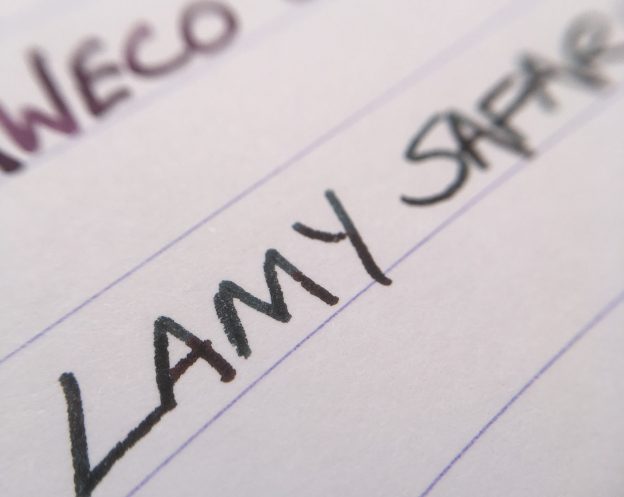
To an untrained eye in the boardroom, looking at regular writing rather than a swatch, I suspect that most people would label it as black ink:

It does have some variation and shading, but in most instances, you would need more than a medium nib, plus some good lighting, to bring it out.

Like many Lamy inks, it is quite wet, which works well for me. It means I can write long form quickly without it stuttering to keep up. As a bonus, it’s not so wet that it completely destroys a standard Moleskine page.

In summary, I really enjoy using this ink. It passes the portability test; I don’t hesitate before picking it up, no matter what notebook I have with me. It’s dark enough to switch between personal and professional use without being boring. However, if you’re more of a fan of a lighter, bluer teal, then you are quite likely to be disappointed by this.

At the time of writing, you can still buy Lamy Petrol Cartridges on Amazon but the prices are going up due to the limited stock, so shop around if you can. The Lamy Safari Petrol is still available over there too.

Essential books for entrepreneurs: The 12 Week Year

As someone who implemented David Allen’s Getting Things Done methodology back in 2009, I’m no stranger to the review process. The weekly review is the element that keeps the system running. Over the years, I moved from just a weekly review to also implementing monthly and quarterly reviews. To top it off, an end of year review and goal setting day seemed to be a significant amount of personal time given to strategic thinking and planning.

Yet somehow, I still didn’t always achieve my most important goals.

The 12 Week Year by Brian P. Moran is an interesting take on how to achieve greater success and results, rather than being purely a productivity system.

Near the beginning of the book, Moran offers up this truth: there are always more ideas than you can effectively implement. Any entrepreneur or freelancer trying to build a business will have experienced this. It is more often than not the source of that subtle source of procrastination – with so much you could do, where do you start?

“The number one problem is a lack of execution”

Moran’s answer is to begin by getting rid of the annual goal setting process. His underlying reasons for this actually make a lot of sense. With a whole year ahead, it is easy to overestimate what you will do and fill your plan with projects that will never come to fruition. Twelve months feels like a long time, whereas twelve weeks is in the foreseeable future. You can complete a major project in twelve weeks, but you are less likely to attempt three or four that then linger with the faint whiff of failure associated to them.

Instead, the twelve week year is designed to give you a tactical framework to shift your mindset. It is a system that creates accountability, deadlines and focus on key opportunities.

By working only on activities that focus you on the main goals for that twelve week sprint, rather than a longer term vision, he argues that you will achieve as much – if not more – than you would with a set of yearly goals that continually get deferred until the final quarter.

The 12 Week Year does not dismiss vision and longer term strategy entirely. It is essential to have some higher level overview to determine which projects are the vital ones for the next twelve weeks.  The subtle shift is changing the emphasis so that a failure in the current twelve week cycle can’t be ‘made up’ later on in the end of the year. Instead, daily habits and actions build momentum to achieve the ‘end of year’ success in a quarter of the time. To make sure the days are planned with tasks that are actionable and measurable, rather than drifting through towards some vague goal, is essential to staying on track. It becomes about clarity and adding value, rather than simply completing a task list.

My one major criticism of the book is that it doesn’t give enough emphasis to the potential dangers of burnout. Renewal is hugely important, especially when you are working for yourself and there is no forced cut off time at 5pm where you forget about the day. As an entrepreneur it is more likely that your projects feel more like passions, which in turn means you are more likely to push on to the point of exhaustion.

This book encourages the reader towards working frequent cycles of high intensity activity, but doesn’t address the dangers of this in a balanced way. Working consistently on a project at a high level requires more than giving yourself  ‘a weekend off’ at the end of the twelve weeks to recover.

However, I’ve used The 12 Week Year to complete a significant number of projects that have been hanging around on my yearly goals list for a while now. The techniques have been proven to produce results. For anyone starting out who needs to take charge of their own career, or for those who want to finally achieve things they’ve been dreaming of for years, I would thoroughly recommend this book.

Follow Up: Using A Bullet Journal For Creative Projects

One of the most popular posts on my site is this one about how I use a Bullet Journal. The other, in case you are interested, is the one weighing up the pros and cons of using a Moleskine versus Field Notes, which also has a Bullet Journal influence to it.

Given I started using a Bullet Journal approach when it was a new thing and not the hugely popular and artistic thing it is now (check out the Instagram bujo hashtag if you want to feel inferior about your artistic skills), I thought it would be a good time to do a follow up. Specifically, how to use a Bullet Journal for creative projects.

Firstly, the thing to remember is that the bullet journal methodology is not set in stone. Right from the start, it was a system designed to be modified to meet individual needs. For me, this has resulted in two separate notebooks: one for planning and the other for creative writing projects.

A creative Bullet Journal, by definition, will have different requirements to a notebook containing everything. But why did I separate them? Quite simply, I wanted to have all my book outlines and ideas in one place. When it’s time to pick a project to move onto, this dramatically reduces the number of notebooks I have to work my way through. Because it is specifically for longer outlines, rather than aha! on-the-go snippets, I can stick to an A5 size that is just large enough.

What to remove

Because I’ve got a specific use case in mind, I can ignore any features that relate to the calendar. (Side note, because I’ve stripped out the creative writing projects, I can use an actual diary in a modified Bullet Journal approach that is just as effective. If you want to know more, I’m using a Moleskine Agenda as described here). This means the Future Log and the Monthly Log disappear for me.

What to keep

The Index is the core functionality of the Bullet Journal system that is so simple, yet life changing. This is particularly important in this instance because I want to be able to easily review the contents at a later date. I can’t help but call it Contents though, rather than Index. Sorry!

Underpinning the index is the use of page numbers. This is a feature that makes the Leuchtturm 1917 brand ideal for Bullet Journaling as they are pre-completed. I find manually numbering the pages at the start of a new notebook quite therapeutic, so don’t worry if your notebook of choice doesn’t have them.


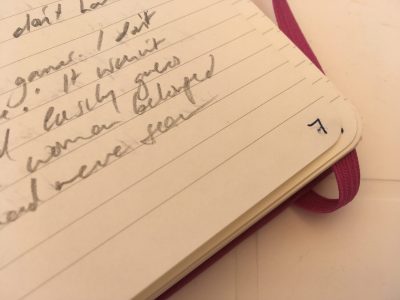
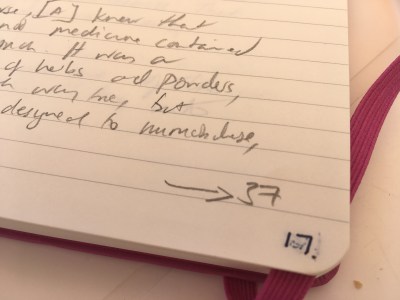
Because I might plan a story over the course of several weeks and have more than one in development at any given time, when it comes to review I don’t want to keep flicking back to the index to find the related project pieces. Instead I use a simple arrow system when linking larger blocks of related text. It is a simple thing to do before starting, but saves amazing amounts of time when reviewing:

This chapter continues on page 37

This continues from page 17

What about topics, bullets and tasks?

I still use these as a creative feature. There is much more to writing a book than plotting it out. There may be research tasks that need to be completed prior to writing and these can form topics in themselves.

Personal Opinions…

What is the best size for a Bullet Journal?

For creative projects, the A5 size works best. For ‘on the go’ notes and ideas capture, a pocket notebook is best (such as a Field Notes)

What is the best brand for a bullet journal?

Leuchtturm 1917 is the closest fit for the Bullet Journal system. Prebuilt Index and page numbers, as well as a paper quality that works for a wide range of pen types, including fountain pens

What is the best paper format for a bullet journal?

Plain paper allows for the most freedom, but I’m a huge fan of graph or dot grid. The key is that any ruling is subtle enough for it not to be limiting 

You can find the official Bullet Journal site and more information from Ryder here.

Not The 4-Hour Workweek: lessons in scheduling, time tracking and an abundance of hours

This is the first full work week completely under my own control. I set the tasks, the hours, the goals and overall strategy. Anyone who knows me will agree I love to have that kind of control. It has been a steep learning curve, but years of practicing in my free time outside of the 9-5, as well as the lessons in project management I’ve learned over the years working in companies, has made it much easier than it could have been.

Towards the end of 2016, I listened to The 4-Hour Workweek by Tim Ferris. For anyone who has ever considered location independent living or being a digital nomad, then this is often the springboard book. Besides, with a title like that, who wouldn’t want to work just four hours?

Of course, is that really what the book is saying? ‘Do nothing and get rich’ is the answer a lot of people hope to get from it. But at it’s heart, it’s about doing the things that matter in the most effective way possible. It is a bible for lifestyle design. People who can automate their business to the point that they only spend four hours on them are the kinds of people who don’t then retire. They start another business. The ‘be effective’ and commitment to living big is the message they take away, not do as little as you can.

Four hours sounds nice on the surface. But if you work doing the things you enjoy, which I suspect most of Ferris’ disciples do, then four hours is never the goal.

Time tracking

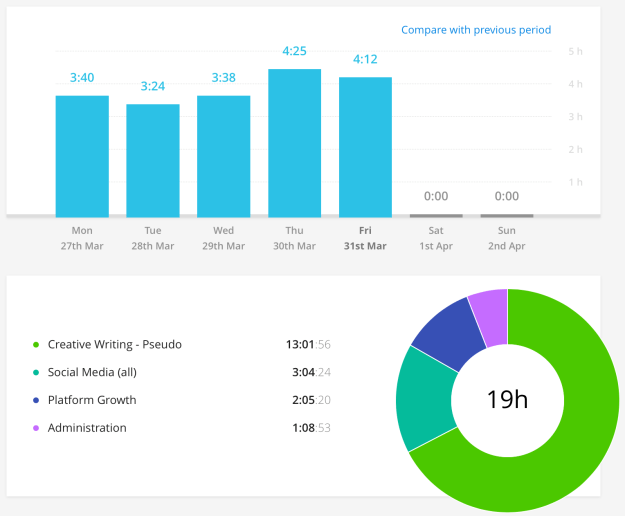
As you can guess from the title, this has not been a four hour work week. My life hasn’t been fully automated with a bunch of virtual assistants running businesses for me while I sip cocktails in Bali. How do I know this? For the first time in years, I did proper time tracking.

I didn’t spend hours looking at all the different options for doing this. Instead I picked toggl, as Mike and Grey were talking about it so much on the recent episodes of Cortex. Have I gone all in? Nope, I won’t be taking advantage of that extensive API to play with. I just want to know how much time I am spending on the key areas that now constitute my day.

The results? I might not be working a four hour week, but I’m not doing a forty hour one either:

This is actual work. This is not ‘killing time’ work. This is not timesheet submission busy-work. When the tasks for the day are done, then I am done. I focus on them completely and make them as efficient as they can be. This is just the first week of data, but it is fascinating. I’ve always believed that quality of work is more important than hours spent and this is re-enforcing that in a big way.

Time scheduling – a combination of digital and analogue
In a less time efficient move, I have lost countless hours since January looking at digital project and time management tools. None of them seem to be just what I was looking for. Many were far too time intensive to set up projects and tasks for my small, single-person projects. Secondly, I’m still reliant on the GTD way of thinking, meaning that many have critical pieces missing. Thirdly, none would emphasise calendaring in a way that works for me. I’m a deadline driven person, so without a ‘real’ due date, my default action will be to happily defer.

Rather than continuing this frustration, right now I am managing things in an analog and digital combo. The first is a paper planner (the Moleskine Weekly Planner that I reviewed here) and a separate ‘work’ calendar that chunks times of the day into very high level categories (for example, editing time vs ‘line edit of x book’).

Putting the two together has allowed me to focus on the bigger picture, whilst still getting into the detail of the day. Whether it will continue to work in the long term remains to be seen, but for this first focused week, just about everything went according to plan, with enough flexibility to allow for one or two unscheduled events.

Free time and the sensation of guilt (‘I should be doing…’)
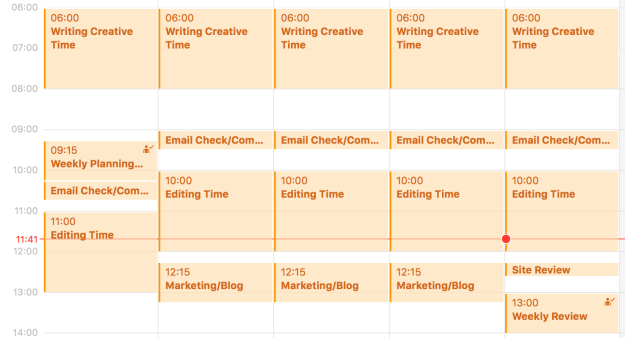
I’ve been sticking to my usual routine of starting my workday at 6am. Doing around 4 hours means I have a lot of day left at the end of my day. Whilst this sounds like a dream – and it is – the thing that I have noticed at times is an overwhelming sense of guilt. Even on the day I used all my brainpower writing 7,500 words, it was an obvious nagging sensation at the back of my brain. The quest for something ‘productive’ to do. It has made me realise how much we are compelled to fill our hours with work, when sometimes the thing to do is just relax.

I hope this is something that disappears quickly. It feels like a hangover from the 9-5 life and it serves no purpose as far as I can tell.

Walking and thinking is a valid use of time

Conclusion – scary, at times overwhelming, but eye-opening and utterly rewarding

Would I class this first proper full time writing week as a success? Yes, I would. I’ve eaten well, I’ve rested well and I’ve spent time creating new products and learning new things.

Has it been difficult and crazy ass scary at times? Of course it has. Any big change always does (and anyone who tells you otherwise has got caught up in their own lies and bravado). But I’ve also loved the freedom and the self-reliance. I’ve loved a semi-traditional work week, with all of the benefits and very few downsides.

I already can’t wait to see what next week brings when reality sets in.