Tag Archives: david allen

GTD – Mastering Workflow, Mastering Life

This post is the first in my series about mastering productivity from the perspective of a full time working mom of a toddler with a side business. That’s me with the side business, not the toddler. 

If you’re looking to be more productive, more effective and grow as a person, then there is a bewildering world of self-help business books out there to choose from. Some are fashionable for a year, others stand the test of time. David Allen’s Getting Things Done has been successful enough to warrant a brand new edition in 2015.
It’s always the book I recommend that people start out with. Not because it is a literary masterpiece, but because the methodology he describes allows you to sort out the little things so you then have the mental clarity and space to then deal with the bigger life questions. Books such as The 7 Habits of Highly Effective People start with life purpose and other lofty aspirations. I really don’t recommend that as a starter for anyone. Ever.

Despite saying the GTD method is for everyone (and it really is), the book is nevertheless aimed at business executives, with the secondary motivator of selling consulting services. I’ve never had to worry about forgetting to get flowers for my secretary’s birthday (although in the 2015 version I noted that’s been changed to a less culturally charged ‘assistant’). With that in mind, I want to show you over this series of posts how I’ve implemented it in my work, personal life and side business as a writer, without the requirement for a corner office.

Since 2009, I’ve probably read Getting Things Done at least once a year. That’s what I’ve always believed anyway. When I decided to write this series, it forced me not to just choose the bits I was most interested in, or needed a refresher on, but really read what he was saying like it was the first time I’d come across it. I’m not going to lie: the chapter on Mastering Workflow took effort.

I’ve heard so many people say they found the material ‘dry’ and ‘hard-going’. I’d never really thought that to be the case, but re-reading a chapter like this, so early on, I can see why people got stuck here. In a single chapter, he gives you the entire methodology. The remainder of the book is the detailed ‘how to’. I’m a fan of the big picture, but this is intense stuff.

Luckily, it can all be summed up in a handy flowchart. Get a copy. Put it where you’ll see it. It will be more helpful than constantly going back to this chapter while you’re starting out.

© David Allen

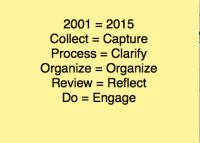
I find it interesting that the flowchart remains unchanged, but the titles for the stages have been updated between the two books.
What next?

“Every decision to act is an intuitive one. The challenge is to migrate from hoping it’s the right choice to trusting it’s the right choice.” – David Allen, 2001 Edition

Instead of being overwhelmed by this chapter, I’d suggest doing a quick assessment of where you are now. Some simple things to consider:

  1. Do you already have an existing tech or analogue system you need to use? There are some great ones out there that are designed with GTD specifically in mind, but learning the methodology can be hard enough without being distracted by a new tool as well.
  2. Are there some things you can do straight away? The 2 minute rule (see flowchart) is easy and doesn’t require any further support structures.
  3. Which area of your life is causing you the most stress? Ignore the work-life balance for now. If you’ve got a single project causing you problems, then decide if you could implement a GTD strategy just for that. If it works, you’ll find the momentum to expand out into other areas.
  4. If you’re like me, you don’t naturally trust other people to do what they’re supposed to. As a result, doing work that isn’t technically yours to complete can be the source of many feelings of overwhelm. Make a master list of things you are waiting for and then hand off those tasks. The list will allow you to control what you’ve delegated and you can check back in with people at any time.

“Basically, everything potentially meaningful to you is already being collected, in the larger sense. If it’s not being directly managed in a trusted external system of yours, then it’s resident somewhere in your mental space.” – David Allen, 2015 Edition

David Allen sets us up in this chapter for doing hard work. Getting through it separates the wheat from the chaff. He wants you to go all in on the method and promises a life of ‘stress free productivity’ and ‘mind like water’ as the end result. He’s also been quoted as expecting it to take the average person two years to really master the system. That’s a lot to ask of anyone, but I believe you can implement an effective enough strategy in a few months or even weeks. If you want to take it further then that solid foundation is one you can build on when you’re ready.
7 books that changed my life

I’ve been thinking a lot lately about how I just haven’t been reading enough. It is one of my goals for the year, but in amongst everything else it just seems to keep slipping. I find myself really struggling to get into anything new.

Which led me to pondering the question of which books have really touched my life. Perhaps if I can understand the things I’ve loved in the past, it will help me better choose what I want to read now. Once I started thinking about, it was tougher than I thought it was going to be. After all, how do you define such an impact? In the end, everything I selected met the following criteria: I have read them multiple times; they led to me doing something new or different and when I think about them, I instinctively feel they are comforting and familiar.

Only one on the list is non-fiction, so I’ll start with that.

David Allen, Getting Things Done

Perhaps this is the book that has had a direct impact on my daily life more than any other. I read it at least twice a year. I fall off the waggon about as often. But since I first read it, I have been able to organise my life and achieve way more than I would have otherwise. It allows my brain to feel less frantic in the work world, which is a gift in itself. Mind like water is still the goal.

Aiden Chambers, Dance On My Grave

I remember getting this book from the library when I was about thirteen or fourteen, venturing into the teen section. I didn’t really spend much time in the teen section as I moved straight to adult fiction fairly quickly. Yet this book about crazy, unpredictable, teenage love and the lengths it will make you go to when you lose it, opened my eyes. It also gave me the defining moment of what I wanted to have done after my own death, because I thought how useful:

“popped into the burning fiery furnace and reduced to manageable proportions, to whit: five ozs of fine grey ash, suitable for the making of egg timers”

Sir Arthur Conan Doyle, The Complete Adventures of Sherlock Holmes

Perfect writing, and memories of eating mint matchmakers at Christmas while reading story after story. I still do it most years. I’ve always been a little bit in love with the Holmes of the books, rather than the caricature of TV and film (Jeremy Brett excluded, obviously).

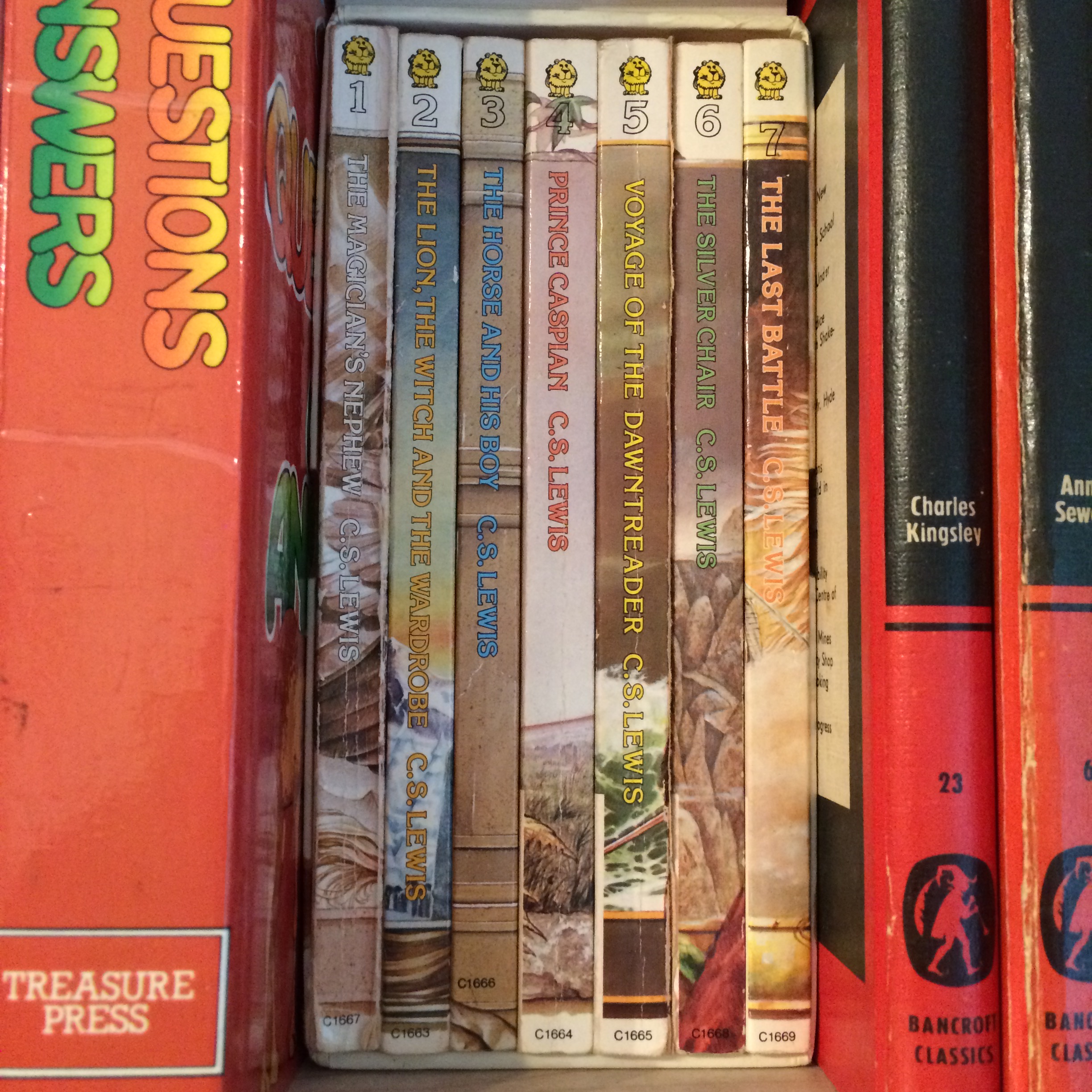
C.S Lewis, The Chronicles of Narnia

I am forever grateful to my parents for buying me the complete Chronicles of Narnia as a box set.

Still right here on my bookshelf

Still right here on my bookshelf

Mainly I’m grateful because I read The Magician’s Nephew first rather than The Lion, The Witch and The Wardrobe, so the magical wardrobe made entire sense to me. I’ve been getting annoyed with people who haven’t ever since. It was probably this that gave me my first love of fantasy and the concept that reading could make you escape into another world. Probably still couldn’t read the scene where Aslan is killed without crying, either.

Anne Rice, Interview With A Vampire

A quick jump into much darker elements of fantasy. My Dad had a copy of this on the bookcase and it was probably the first of many things I read when I was too young. There were pretty strict controls over age appropriate TV in my house growing up, but books were (mostly) fair game. If anything, this book taught me the importance of voice; the narration throughout this book feels so authentic, you feel like you are there.

Barbara Vine, A Fatal Inversion

Interestingly, I think I watched the TV series of this before the book. Certainly whenever I read it, I picture the actors, even though they don’t really resemble the descriptions in the book. That being said, I have honestly lost count of the times I have read this. There is no doubt it influenced my dreams for impossibly long, hot summers and aspirations of freedom. Not murder though.

Mostly.

Michael Connelly, The Poet

Finally, this book was a gift for my 21st birthday. By then I was neck deep in an English degree and books had been sucked of all joy. I really didn’t enjoy reading at all. I couldn’t just read any more, I had to analyse. It was a bloody awful time. Then my Mom & Dad got me this book (have you got the sense yet of how big a thing reading was in my house growing up?) and it had nothing at all to do with anything that could be related to a course. It was a modern thriller and a way back into enjoying crime. I read it in more or less one sitting. It made me remember why I loved reading for reading’s sake, not just to pass an exam. It also got me back into enjoying crime fiction and mystery after a time away.

So, I’ve just taken that trip down memory lane and I’m not sure if it helps or not. It certainly doesn’t narrow things down to author or genre. I suppose I’m just looking for characters I can engage with, voices that are authentic and plots that I can’t predict. I’ve also realised I’m in much the same slump as I was back at university. I spend so much time editing these days (both work and personal) that I feel like I’m just seeing the words, never the story itself. It’s probably going to take a really good book to shock my brain out of that state again.

I just hope I find it soon.

Anyway, I can obviously recommend all of the books above if you haven’t read them already. If you have anything that you think can break through the ice in my brain, then leave a rec in the comments and I’ll gratefully take a look.


My Top 5 Books of 2014

These are my top 5 books that I have read in 2014, not necessarily that were published in 2014. Sometimes I’m late to the game, but just because something isn’t brand new, doesn’t mean it isn’t worth mentioning. Every year I intend to read more than I actually do, but this is the first time since I was at University that I have taken advantage of the library on a regular basis. It’s the perfect way to try something you’re not sure about, which has led me to some complete gems over the past twelve months.

So, without further ado…

General Fiction

The Girl Who Saved The King of Sweden by Jonas Jonasson

The Girl

This book was immensely enjoyable, but hard to describe. Larger than life characters and even bigger plot, this book was so carefully crafted that the suspension of disbelief – even in the face of insurmountable odds – never wavered. I dare anyone not to root for the main character from beginning to end. From Soweto to Sweden, the comedy is punctured by some dark moments, but a reminder to never, ever underestimate someone because of who you believe they are.

Fantasy

Mistborn by Brandon Sanderson

final-empire-2

My sister is a huge fan of Brandon Sanderson and she’s been trying to get me to read his books for years. I finally got round to doing so earlier in the year, and I’m glad I did. I think Mistborn is a perfect entry point into his writing, and you can read my original review here. For any would-be writers of fantasy, it is also a great tool for understanding the importance of world-building and how to get the balance right between background and plot.

Self Help / Personal Development

The Happiness Advantage by Shawn Achor


I found this book by way of his Ted Talk, via the Productivity Book Group podcast. As a person not naturally given to positivity (I tend to think of myself as a hardened realist), I’ve been trying very seriously over this past year to work on my mindset as much as anything else. Insightful without being patronising, this book has delightful anecdotes, interesting research and some basic, simple tips to help people take the steps towards the benefits of being more mindful.

Biography

My Spiritual Journey by Dalai Lama

Spiritual Journey

This falls into the category of random library find. I gave a brief review of it earlier this year. It was humorous, insightful and gave a picture of the man I had heard of (who hasn’t?), but didn’t really understand. Spiritual without being preachy, there was no attempt to hard convert to Buddhism here, as there so often is with books containing religious figures. It was simply a fascinating window into the life of a man who has travelled a very different road to most of us.

Business

The Seven Habits of Highly Effective People by Stephen Covey

7 habits

In the interests of honesty, this was not the first time I had read this book. It was probably one of the first books I had read on business/personal development, probably a decade or so ago. Back then, I just didn’t get it. I found it too dense, too remote, too hard to plough through. The only thing I remember taking away was the concept of mission statements. I opened it again this year and it was a completely different experience. I was finally ready for it, I think. I’m a big fan of organisation and productivity – both personal and business – and I try to follow the principles of Getting Things Done by David Allen. Now that is engrained in my life (six years and counting), I think the maturity of my own process allowed me to understand the bigger picture approach that Covey prescribes. Proof that sometimes, you have to go back to something twice to get a true understanding of the content.

Now I’m starting to plan my reading for 2015 – if anyone has any contenders then feel free to pop them in the comments below. I’m always up for a challenge!