Category Archives: Better Living

Health, personal development and productivity tips

How I Did It: The Realist’s Guide to Sugar Free

After almost a year of being sugar-free, I’ve finally written a book about it. You see, despite being stubborn and competitive (mostly with myself), living a life without sugar was hard. Really hard. Despite understanding all the associated health risks, I still struggled to give it up and then remain virtuous in the face of temptation.

Let me tell you something about myself: I don’t like failing.

Every self help book will tell you failure is necessary. Trying and failing is how you learn what works and what does’t. That doesn’t mean I have to like it. So despite several epic failures that resulted in a large tub of ice and a spoon, I have been determined to find a way to remove sugar from my diet, yet still live in the real world. Along the way I’ve been keeping track and it is the results of my journey that I’ve put into this book.

therealistsguidetosugarfree-2

This is not a cook book. It is not a detox plan. It is a step by step programme of strategies to help you eliminate sugar in the face of the temptations life will throw at you. Knowing how to cook a delicious four course sugar-free meal won’t help you at all if you don’t actually find the motivation to do it on a daily basis. Most people I know are too busy working or chasing after small children to be able to put that kind of time into planning and prepping a meal. It’s a nice idea, but it just doesn’t work for most of us.

So if you want a humorous and honest guide to eliminating sugar from your life, then this is the book for you. Even if you’re not sure you want to quit sugar completely, the easy to understand information will still help you make better choices when faced with the temptation and sweet food marketing you’ll encounter every day.

Blurb:

A humorous and honest guide to eliminating sugar from your diet. For good.

Quitting sugar in the real world is hard. Sugar is everywhere and your friends think you’re mad for not eating cake. You’ve done the 8 week detox plan and part of you still craves chocolate so much that you develop a mild twitch when you see a brightly coloured wrapper on the shelves in front of you.

Deeply addictive, sugar is everywhere. Even added to the most unlikely foods, the majority of us exceed the recommended daily intake without even realising it. Instead of teaching you how to cook fake cake, or pretending that quinoa really is an exciting grain that will revolutionise your view on salads, this book guides you through the myths about sugar in our food and through the realities of addiction. The 9 step action plan then helps you make the change and really stick to it.
Even if you’re not quite ready to eliminate all sugar from your life, this book contains practical tips to help you shop wisely, create good habits and sustain better lifestyle choices.

Available at amazon.com and amazon.co.uk

A Thought on Politics

More than ever, I think the world is dividing not into left and right, as we in the modern world have come to identify it, but something that can span either.

Britain voting to leave the EU is one indication. The rise of Trump as an unqualified (in all ways that matter) candidate now worryingly close to be elected as president of the United States is another.

The divide to me is simple: those who fear the ‘other’, lack empathy and do not like change line up on one side. They can traditionally have voted one way or the other, it doesn’t matter. Their core beliefs are those. Then, on the other side, there are those who see a bigger world, who understand that without change there cannot be growth, who can empathise with an experience that is not their own easily.

When political commentators have been breaking down into old versus young, educated versus uneducated, this is the core of what lies beneath. This is the world we are on the cusp of shaping. This is not politics at all; it is where society is failing to address fear at its root and now – like fear always does – it is spreading like a cancer.

It’s easy to despair if you’re not on the side of anger and rage against the world. Instead, we all have our bit to work towards being kinder to each other and not turning a blind eye to bigotry and injustice because it is not *our* issue directly.

Climbing back on the wagon

I can’t believe it’s been four months since I last sat and wrote a post. The time just slips away when you’re not looking.

I’ve also been keeping a paper journal more rigorously, which reduces the need to blurt out my thoughts and feelings online. Which is a good thing for everyone really. Plus I’ve been away. Plus I’ve been ill. Stack it all up and I’ve had many excuses for being away from the blog space for awhile. Today, however, marks the return to climbing back on the wagon in almost every area of my life.

I’m lucky enough to have recently spent nearly two weeks in Mexico, with nothing to do but lie on the beach, read, eat nice food and have cocktails brought to me on whim. Not a bad way to live. But in all seriousness, it was a much needed break. As I wrote in my last post, I’d become overwhelmed and lost in my side projects, whilst maintaining a full time job and doing a gruelling weekly commute.

Then there’s Brexit. Don’t even get me started on this act of self-sabotage and insanity that Britain seems to thing is a good idea. It’s utter madness, but it has had the curious effect of solidifying a few things for me as I attempt to get back into a more productive routine:

  • Post holiday, it’s definitely time to get back on the sugar-free lifestyle. I feel rubbish off it, and there won’t be any money for the NHS to look after me and my sugar-related illnesses twenty years down the line the way things are going
  • Writing should be something I love, not a chore. If I don’t enjoy it, then I shouldn’t do it
  • I should possibly become less dependent on European travel. Which is fine, because Cornwall is lovely, assuming someone does something about the weather. (Also, it’s not fine really. Less freedom of movement and a spiralling pound suck)
  • Side projects can spiral out of control and suddenly become the cause of burnout. It’s not too late to think about doing less for 2016, whilst still being productive and having fun. This was an aha! moment I had whilst listening to one of my new favourite podcasts, Cortex.
  • Comfortable is easy. But at a time when the risks are at their highest, the rewards are also at their greatest. Somebody out there has to get them and it won’t be me if I flop at the end of the workday into three hours of mindless TV. Something I’ve never done until this year, I might add.

Independent of me, the remainder of 2016 will be a year of change. That genie is not going back in his bottle. So I might as well do what I can to influence the outcome I want, rather than just sit back and let stuff happen to me.

I think that’s all quite spirited and positive for the end of a Monday, even if I do say so myself.

Burnout comes in many forms

For most of this week, I have been off work sick. This is an unusual occurrence for me. Given that I work from home a lot and have done for years, being sick doesn’t necessarily mean not working. I can’t even remember the last time I took a sick day.

But this week I got hit by something that wiped me out. Over the years, I’ve got pretty good at spotting and managing signs of work stress. I have tools and techniques in place to make sure I spot burnout before it arrives. My ‘no work phone on vacation’ has been a rule for a decade. I stopped checking emails after 7pm or at weekends years ago. All of these things stop me from arriving at a place I swore to myself long ago that I would never get to. I’ve watched too many friends crumble because of stress. I know that the journey back is a long and painful one. If you ever properly make it back at all, that is.

But as I lay in bed this week, my brain was chattering to me. Why wasn’t I reading? Why wasn’t I using the time to write? Why wasn’t I using my sick time effectively?

Wait? What? That was the warning sign I had failed to see. My life is busy, but no more so than anyone else’s right? Perhaps not, but clearly the pressure I put on myself to try to get everything done had taken it’s toll. For an introvert like me, even going out with people socially, no matter how much fun I have, is exhausting. Combine that with a three hour plus commute a couple of days a week and my body clearly had enough.

This week has been ECGs and blood tests and more blood tests. At some point I shut my brain up and allowed myself to just lie there while my joints ached like they belonged to a ninety year old. Even typing this now, I hurt.

Burnout comes in many forms. But my body has sent me a clear signal that I can’t keep juggling everything. For once, I am going to listen to it. That doesn’t mean giving up on goals and dreams. I’m going to just have to get better at taking time for mental and physical relaxation. I’m going to have to cut the busywork from my life where it doesn’t have significant benefits. I need to be intentional. When I feel better, it will be time to hide away somewhere and really think how this will all play out for the rest of the year.

Now though, I am going to rest again and not feel guilty about it. I’m sick and tired of feeling guilty all the time. No more.

Life hacking my year

I set myself some pretty big goals in 2015 and intend to make 2016 my most successful year ever. Of course, we’re still in January, so making bold statements like that before the grudging reality of the daily grind kicks in is still possible. Even so, I picked up a few life hacks last year that I’m going to carry over into this year. They apply to daily life, so they cover off all my goal types: writing, financial, spiritual, physical etc.

Top tip number 1 – the standing desk.

Several personal development pros I follow have recommended this, but the biggest influencers for me were Jeff Sanders and Michael Hyatt’s blogpost and podcasts on the topic:

7 Amazing Benefits of a Standing Desk

4 Reasons you should buy a standup desk – right now

Previously I would spend 6-8am sitting writing, 9-6 sitting for my job, then often 7-9 sitting doing more writing. That is a lot of sitting. Now I still do the writing stints sitting down, but the day is spent standing, unless I physically need to be at head office. That persistent twinge in my left shoulder has gone, along with general back pain. I’ve recently added a balance plate to keep myself moving too, rather than just standing still.

Top tip number 2 – a really good morning routine.

I’ve had a morning writing routine for at least 5 years now. Time flies, so I can’t really be sure. Over 2015 I really upped my game on this. My morning routine now includes more than just knocking out 1000 words on my latest writing project each day. It includes affirmations and journalling (my form of meditative practice). It all felt very American at first, but once I got over being all British and reserved, it’s had huge benefits. It’s a real mental health compliment to the physical health tip above. For an idea of how to start setting it up, Hal Elrod’s Miracle Morning is a great place to start (he has a pretty full on personal story to check out too).

Top tip number 3 – carry a notebook and pen EVERYWHERE

The more I did the above top tips, the more my brain seemed to become able to throw out ideas and see potential everywhere. As I wrote in my last post, I made a habit of capturing them straight away, rather than lose them or have to waste a ton of mental energy trying to remember them for later. It could be that sudden strategic insight that you needed to get a result on that big project, or it could be that you need to add cheese to the weekly shopping list – it doesn’t matter. Getting it down on paper means that your brain can then carry on being the awesome beast that it was designed to be. Field Notes have become my pocket notebook of choice, but it’s all personal preference.

Top tip number 4 – track it

Digital or analogue, tracking what you’re doing is the easiest way of making sure you’re doing what you need to do. I use coach.me and have a few habits that I’ve done so many days in a row that I will now go out of my way to complete them so that I don’t break my streak. I’ve done 10 pushups (upgraded to 20 nearly a year ago) each morning now for over 500 consecutive days. There is no way I’d do that without the app.

These all work for me, but if anyone else has any suggestions then feel free to comment. I’m always looking for ways to up my game…

Sugar sugar everywhere and not a drop to, um, eat…

Since I came back from holidays (food and alcohol fest) I have been living the sugar free diet. Now that I’m in week three and can write about it calmly and objectively, rather than from a cravings hole of despair, I thought I’d give it a go.

Firstly, the motivations. A dear friend is on her second go round with cancer, and diet has become a significant thing she can positively influence, in amongst the traditional treatments. Cutting out sugar is the key thing. Which sent me down a huge rabbit hole of how it all works.

For those of you who know me, the fact that it is the latest diet espoused by a TV personality is more likely to make me disbelieve than anything else. But I’ve been looking at a ketogenic diet in relation to other serious diseases, so I knew there was some significant merit in reducing carbs. Cue me reading books and scientific papers about human biochemistry and the way our body uses and responds to sugar. Fascinating stuff, even if I have become a conversational bore.

So, after two weeks, here is my experience:

  • For those not on the diet for medical, disease fighting reasons, you don’t have to eliminate all sugars, just fructose
  • Good luck doing that, because everything is packaged by the title ‘sugars’
  • Fructose makes up half of sugar as we know it (the good ole white stuff) so the easiest way is to avoid anything with added sugar
  • Good luck with that too, because sugar has been added as a cheap filler to just about every product that gets made, even the savoury ones and especially the ‘low fat’ versions of things
  • Unlike other energies, fructose isn’t recognised by our self-regulating mechanisms, so it goes straight into the liver where any excess (which happens after a surprisingly small amount) gets pumped straight into your blood supply as fatty acids (nice)
  • The headache was worse for me than the cravings – three days of constant dull thumping until I came through to the other side
  • The promised bright side: resetting my body so I eat when I’m hungry and stop when I’m full (no more calorie counting) and no need to go to the gym to attempt to burn off fat – yay!
  • The downsides – restaurants are a pain, but I’m a good old fashioned meat eater, so a plain steak and jacket potato are easily allowed for a nice night out

Christmas is coming, so there will be a few treats in the coming weeks. I’m not foolish enough to think there won’t be. But the reality of reading the latest research (and the horrendous flaws that made up the current guidelines) has made me want to give it a shot long term, rather than doing it just because of Davina grinning from the front of her latest cookbook.

The importance of finding peace

Saying things have been crazy lately is an understatement. I know everyone in today’s world feels overwhelmingly busy most of the time. I’ve spent years putting systems in place to allow me to manage multiple products and still be uber-productive, but even I have had several moments of complete overload. I already know my yearly review of 2015 will be quite something.

Even my morning journalling, a time solely dedicated for quiet reflection, has been interrupted by a compulsion to check my phone, having random ideas that need capturing elsewhere and, quite frankly, the fidgetiness of a five year old.

It kind of defeats the point.

But the absence of peace and stillness has made me realise how important it has become to me. Not to sound like some hippy white person trying to be an eastern self-styled guru, but there is so much to be said for the practices of mindfulness and gratitude. Of just being in the moment and being part of the world around you. Of being able to appreciate an autumn sunset, rather than just whizzing past it on your way to somewhere else.

Lake Windermere

It has been manic, and there is more to come. Nanowrimo is coming up and I have six days to complete it in. This is not one of my crazy, self-imposed deadlines and I’m certainly not going to try and beat last year’s three day completion, but I won’t actually have access to my computer from day seven. So it’s either type or fail and I’m not the kind of person who relishes failure.

But it seems to me that in order to keep moving forwards, one needs to be intentional about standing still. About appreciating where you are and where you are going rather than just charging forward blindly. Life is about progress, but not necessarily about speed.

It will be over before you want it to be anyway, so don’t rush to a final location that may not really be where you ever dreamed you would go.

Putting the wheels back on the wagon

This isn’t my first blog about Getting Things Done (GTD for short) and it probably won’t be the last. Also, I always want to spell waggon with those two gs, but apparently that’s been classed as archaic now for a century. Clearly I really might be as old as I feel some days.

Anyway, I’ve had my GTD system set up for so long now that I’ve forgotten how to live without it. Or, at least, I thought I had. Then it became abundantly clear that I’ve been slowly sliding towards chaos in both work and personal areas. Luckily for me, my version of chaos is most people’s version of normal, so nothing slipped or became a problem. The only problem as such was in the way I felt. Like I was always on the edge of forgetting something important. It was horrible.

So on Friday I completely got things sorted on the work front: projects identified, next actions defined, emails and tasks list all up to date. It gave me a wonderful sense of freedom. One which was also, unfortunately, a false sense of security in how easy it was.

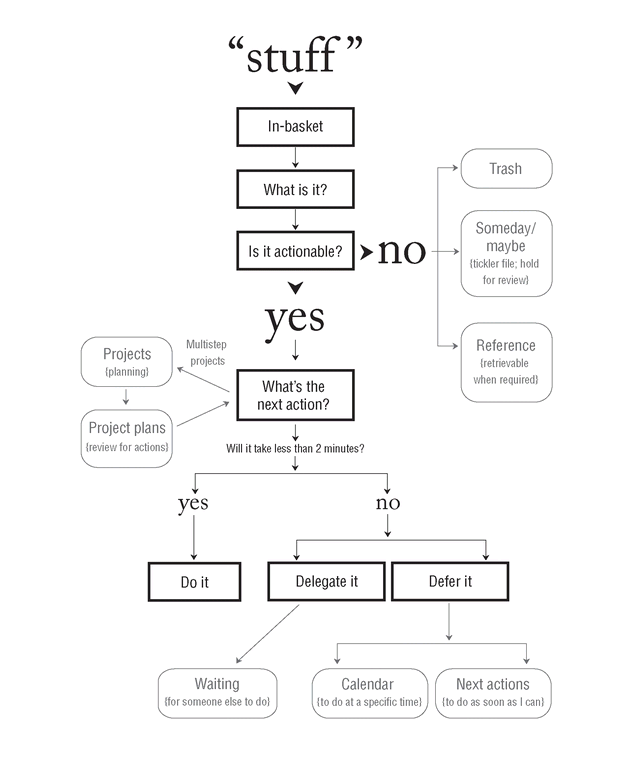
On Sunday, I then spent my day working through this:

GTD+workflow+diagram

By the end of the day, you know where I was at?

Step 1: Stuff to in (or collect, for those of you who prefer the term).

All of those things that had been lying around, pieces of paperwork, random receipts, half held thoughts in my head, were actually at least captured all in one place. For most people who pick up Getting Things Done, I think they fall at this hurdle. Don’t get me wrong, it is massively overwhelming. I burst into tears at one point and I am not a person prone to random crying. Well, not at this stuff anyway.

So why keep going? Because I do know what it feels like at the other end. To be able to be mysteriously more productive and still have time for creative thinking. Having this system will essentially allow me to have two jobs: employee and writer. The bills still need paying and without a system, the one I love the most would be the one I have to sacrifice.

That’s how you put the wheels back on. You remember that the two days of 100% overwhelm will be followed by many more days when you know exactly what has to be done and how you are going to do it. I’d rather do that than run through every day at 25% stress and go to bed each night kicking myself for making progress on everything other than the things that matter to me most.

Holiday Guilt (don’t worry, I don’t have any)

Anyone who knows me, or has read this blog fairly often will know holidays are pretty much my favourite thing. Coffee probably just about pips them to the post, but it’s a close run contest.

So why do many people feel holiday guilt? I’m not setting that up as a question I’m going to answer by delving into the depths of the human psyche. It is a genuine question on my part. Why do people look forward to, plan for, then go on holiday and take with them all the things they’ve been talking about escaping from?

I guarantee there are people here who’ve made a work call today, despite saying they weren’t going to. Or checked their emails, despite promising their significant others that this time they really wouldn’t.

I’m not talking people who own their own businesses and are the last say when it comes to making an emergency decision that could make or break the company. I’m not talking about people who are doing their dream job (such as writers or artists or crazy code writers) for whom a holiday is just a different way of experiencing the thing they love. I’m talking about middle management and mainly routine emails and calls.

My rule has always been that I will not take my work phone with me. From the moment my out of office goes on, all communication with my day job ceases. For the past 7 years, since the concept of being available 24 hours a day became something of a thing, it has been the one compromise I refuse to make. When I say that my employers can’t pay me enough, I mean it. The value of that time away is beyond monetary value for me.

So, no guilt. The world will go on without you. The job will actually be better if you return refreshed and capable, rather than only marginally less worn out, but with a tan. Research shows that taking a break will be of benefit in just about every way.

Ask yourself, if you can’t let go of the phone, what is really making you check your emails. Micro-management? Lack of faith in other people? Lack of faith that you’ve done what you were supposed to before you left and a ball has dropped? Or are you just addicted to the rush of getting email notifications, which is some bizarre chemical response the human brain has for some reason. Evolution needs to fix that one pretty damn quickly.

Whatever it is, give it up. Look around you. Take into account the things that matter most. Your family. Your friends. Your health, both physical and mental.

And for those of you getting all judgemental on me for taking the time out of my break to write this post, of course I scheduled it. Fingers crossed I’m actually lying in the sun now having a cocktail, watching the world go by.

Finding my inner calm

One of my goals for this year was being able to meditate for 30 minutes. I am nothing if not ambitious. I think the most I achieved was 4 before getting completely frustrated and distracted. Oh, and really, really uptight and anxious.

I’m pretty sure that’s not what’s meant to happen. It was certainly not what I was hoping to get out of it.

Then I had an interesting conversation with someone at work who pointed out that feeling the state people (other than me) achieve while meditating is more to do with being in the state of flow, rather than specifically being able to put your ankles on your hips and say ohhhmmmmmm.

A lot of people get this state from running. That’s never worked for me either. The only thing I get from running is aching hips and a weird heart rhythm for the next three hours. Again, not relaxing.

That’s when I heard that people were using Julia Cameron’s Morning Pages principles to not only become creatively unstuck, but also to get that sense of peaceful personal insight that comes from meditation. I took one look and realised I had the four things needed to make this engaging for me:

  1. Plenty of attractive notebooks
  2. Even more pens
  3. Even more inks
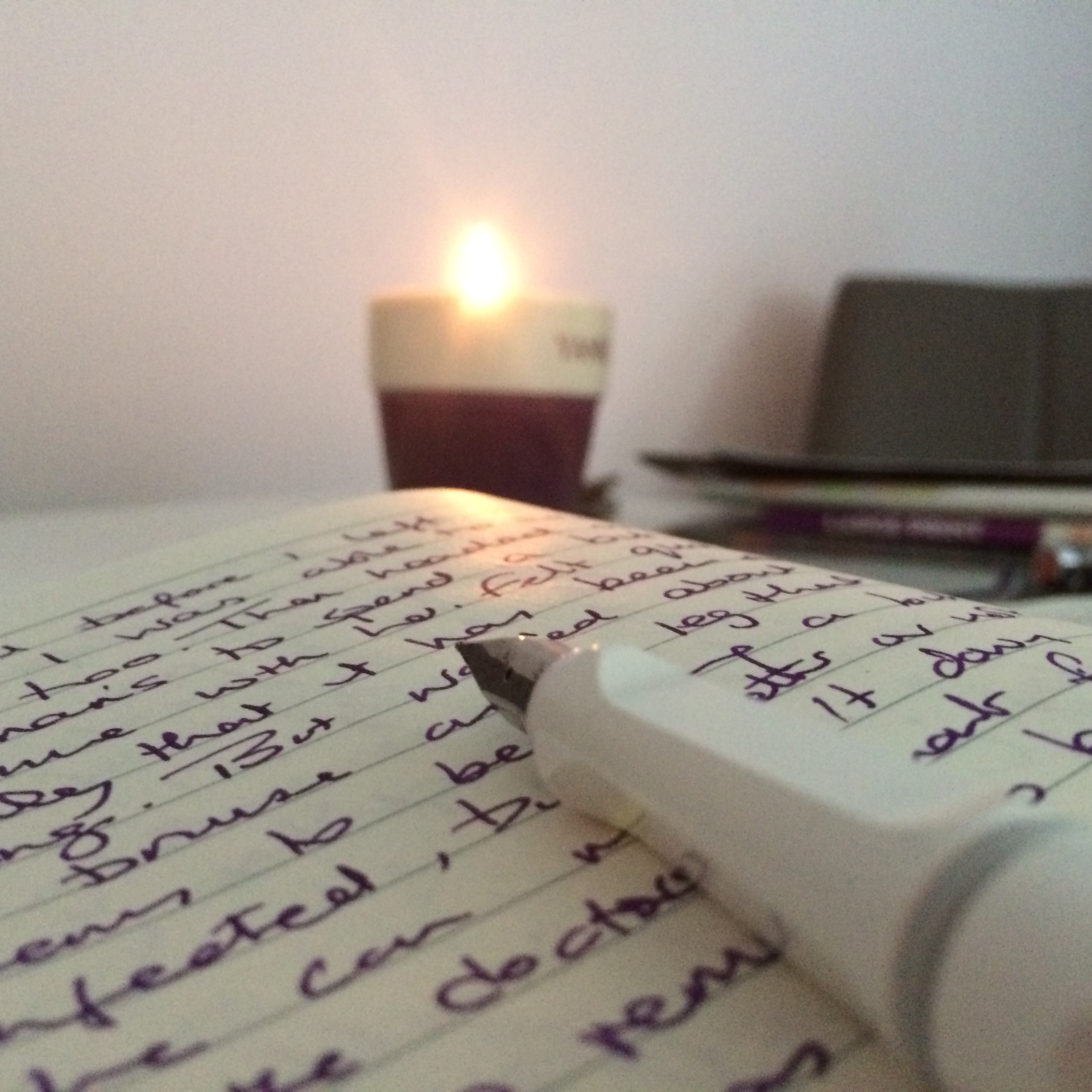
  4. Also some coffee and candles to create a bit of ambience and a sense of ritual.

IMG_9141

So I decided to give it a go.

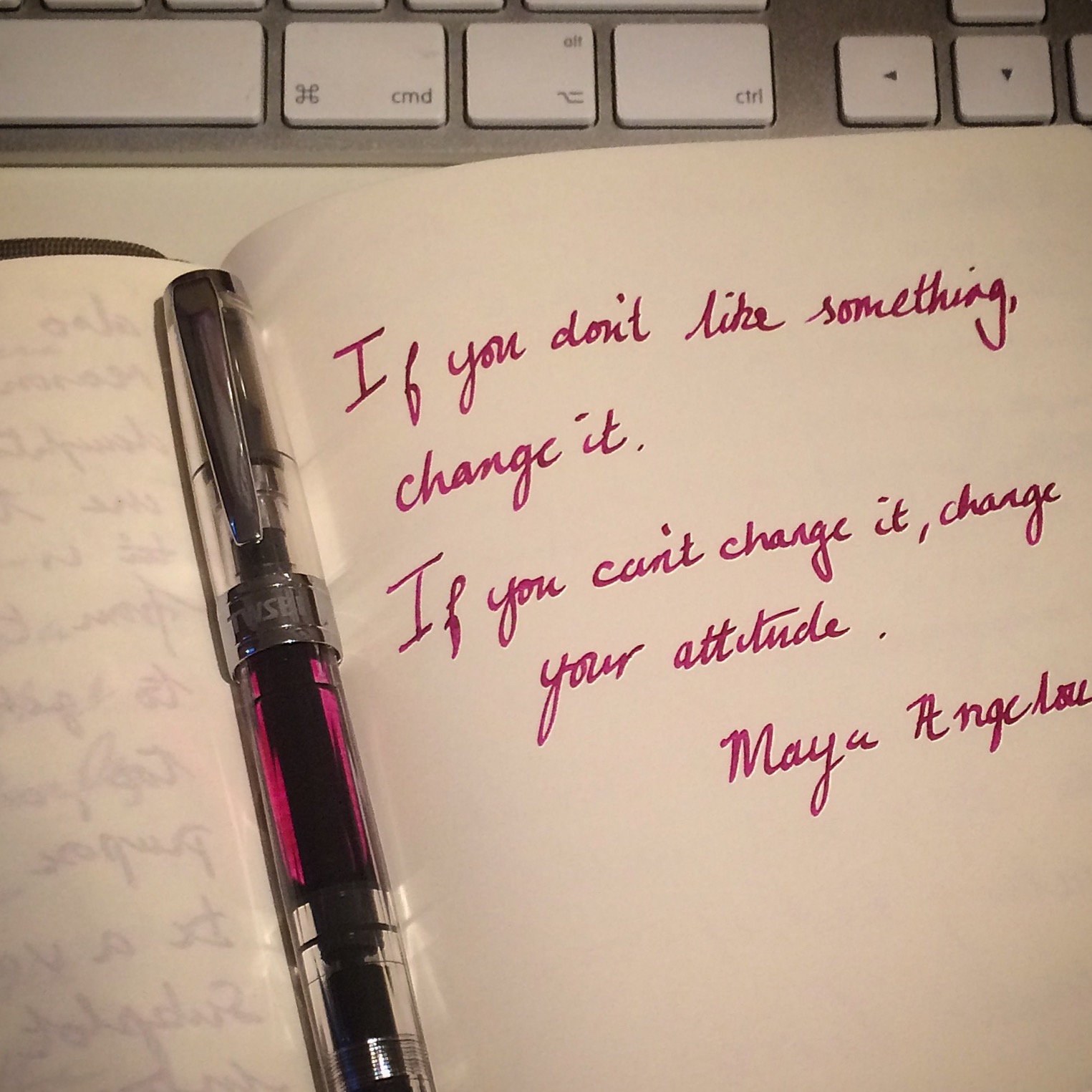
I started on the 6th July. Since then I’ve got through nearly three A5 lined notebooks (think moleskine, although I’ve discovered that a Leuchtturm 1917 is much better in terms of paper quality and features. Especially when using my current favourite fountain pen and ink combo, the TWSBI 580 1.1 Stub nib with Iroshizuku yama-budo). Turns out I’ve got a lot of thoughts going on.

FullSizeRender-14

The benefits have been pretty significant. I make sure that I start each set with three gratitudes. Not just in a list form, but really describing what I’m grateful for and why. After that, it’s whatever springs to mind. It can be positive, negative or just really, really boring.

Even though I’ve only been doing it for just over a month, I’ve already found I’m calmer and less responsive to external stress when it happens. I’ve become better at creative problem solving, both at work and play. I’ve become more willing to trust the universe, or whatever it is out there. Slowly, I’m becoming more accepting of myself. With that, comes a growing confidence too. Those last two points are a much gentler curve, but there is progress now where there used to be none.

So I’ve redefined my goal. It is no longer meditate for 30 minutes, but instead 30 minutes of daily meditative practices.

Sometimes, it’s about walking the road that’s right for you, not the one most travelled.