Category Archives: Better Living

Health, personal development and productivity tips

Not The 4-Hour Workweek: lessons in scheduling, time tracking and an abundance of hours

This is the first full work week completely under my own control. I set the tasks, the hours, the goals and overall strategy. Anyone who knows me will agree I love to have that kind of control. It has been a steep learning curve, but years of practicing in my free time outside of the 9-5, as well as the lessons in project management I’ve learned over the years working in companies, has made it much easier than it could have been.

Towards the end of 2016, I listened to The 4-Hour Workweek by Tim Ferris. For anyone who has ever considered location independent living or being a digital nomad, then this is often the springboard book. Besides, with a title like that, who wouldn’t want to work just four hours?

Of course, is that really what the book is saying? ‘Do nothing and get rich’ is the answer a lot of people hope to get from it. But at it’s heart, it’s about doing the things that matter in the most effective way possible. It is a bible for lifestyle design. People who can automate their business to the point that they only spend four hours on them are the kinds of people who don’t then retire. They start another business. The ‘be effective’ and commitment to living big is the message they take away, not do as little as you can.

Four hours sounds nice on the surface. But if you work doing the things you enjoy, which I suspect most of Ferris’ disciples do, then four hours is never the goal.

Time tracking

As you can guess from the title, this has not been a four hour work week. My life hasn’t been fully automated with a bunch of virtual assistants running businesses for me while I sip cocktails in Bali. How do I know this? For the first time in years, I did proper time tracking.

I didn’t spend hours looking at all the different options for doing this. Instead I picked toggl, as Mike and Grey were talking about it so much on the recent episodes of Cortex. Have I gone all in? Nope, I won’t be taking advantage of that extensive API to play with. I just want to know how much time I am spending on the key areas that now constitute my day.

The results? I might not be working a four hour week, but I’m not doing a forty hour one either:
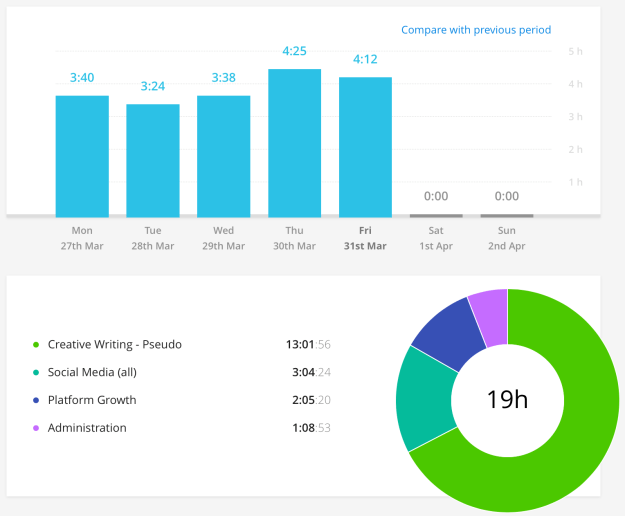
This is actual work. This is not ‘killing time’ work. This is not timesheet submission busy-work. When the tasks for the day are done, then I am done. I focus on them completely and make them as efficient as they can be. This is just the first week of data, but it is fascinating. I’ve always believed that quality of work is more important than hours spent and this is re-enforcing that in a big way.

Time scheduling – a combination of digital and analogue

In a less time efficient move, I have lost countless hours since January looking at digital project and time management tools. None of them seem to be just what I was looking for. Many were far too time intensive to set up projects and tasks for my small, single-person projects. Secondly, I’m still reliant on the GTD way of thinking, meaning that many have critical pieces missing. Thirdly, none would emphasise calendaring in a way that works for me. I’m a deadline driven person, so without a ‘real’ due date, my default action will be to happily defer.

Rather than continuing this frustration, right now I am managing things in an analog and digital combo. The first is a paper planner (the Moleskine Weekly Planner that I reviewed here) and a separate ‘work’ calendar that chunks times of the day into very high level categories (for example, editing time vs ‘line edit of x book’).
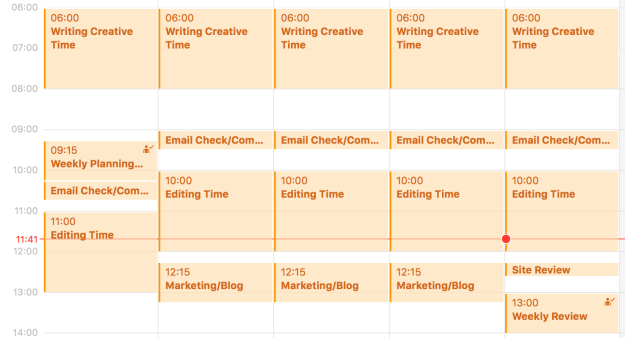
Putting the two together has allowed me to focus on the bigger picture, whilst still getting into the detail of the day. Whether it will continue to work in the long term remains to be seen, but for this first focused week, just about everything went according to plan, with enough flexibility to allow for one or two unscheduled events.

Free time and the sensation of guilt (‘I should be doing…’)

I’ve been sticking to my usual routine of starting my workday at 6am. Doing around 4 hours means I have a lot of day left at the end of my day. Whilst this sounds like a dream – and it is – the thing that I have noticed at times is an overwhelming sense of guilt. Even on the day I used all my brainpower writing 7,500 words, it was an obvious nagging sensation at the back of my brain. The quest for something ‘productive’ to do. It has made me realise how much we are compelled to fill our hours with work, when sometimes the thing to do is just relax.

I hope this is something that disappears quickly. It feels like a hangover from the 9-5 life and it serves no purpose as far as I can tell.
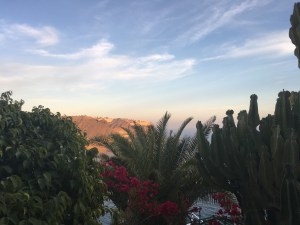
Walking and thinking is a valid use of time

Conclusion – scary, at times overwhelming, but eye-opening and utterly rewarding

Would I class this first proper full time writing week as a success? Yes, I would. I’ve eaten well, I’ve rested well and I’ve spent time creating new products and learning new things.

Has it been difficult and crazy ass scary at times? Of course it has. Any big change always does (and anyone who tells you otherwise has got caught up in their own lies and bravado). But I’ve also loved the freedom and the self-reliance. I’ve loved a semi-traditional work week, with all of the benefits and very few downsides.

I already can’t wait to see what next week brings when reality sets in.

The first week of my location independent experiment

I first heard the term digital nomad just over six months ago. It resonated straight away, as it fit with the lifestyle I’d been working towards for a long time. However, it definitely seemed populated by a younger demographic. Many of the articles and YouTube videos made me think of my time backpacking over a decade ago (and I was already in my late twenties then), rather than where I currently am in my life. The movement was also concentrated in South East Asia (Thailand, Cambodia and Indonesia), with a smaller grouping in South America (Chile, Mexico and Brazil).

So I sat down and worked out my list of requirements for an ideal work/life. I’d already made the decision to become location independent. It turned out that my requirements made a surprisingly small list:

  • Somewhere warm, near the sea
  • Preferably a balcony overlooking aforementioned sea
  • Good wifi
  • Affordable

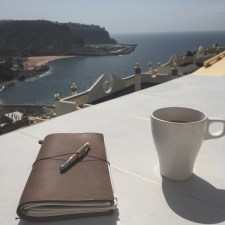
    Writing with a view

Digital Nomad: Asia or Europe?

All of this was possible without travelling halfway around the world from England. I did that when I spent six months in New Zealand three years ago and it always felt just a little too distant for a long term base. Over time various Canary Island locations started to be mentioned by seasoned nomads who wanted to try somewhere different. Given that it was a location I’d visited a dozen times, it felt comfortable and right to make the move.

Virtually a private pool – awesome!

Know Thyself

The list I’d made certainly didn’t include city living. As most of my work is writing, I didn’t need to be in a coworking space either. So I could rule out any of the big (relatively speaking) cities such as Las Palmas. I want to be able to cook for myself, so I didn’t need a plethora of tasty but unhealthy restaurants to tempt me. I also wanted a view that would compel me to exercise…

The reward at the end of the running track

What I am saying is this: when asking yourself which location is right for you, don’t feel like you have to choose from the ones everyone else is talking about. Make your list of requirements and find what feels right for you. Chang Mai may be a digital nomad mecca, but if that’s not what you need, then it’s really not a problem to be somewhere else.

Freedom comes from constraint

I have spent my first week out here testing the lifestyle. I started with a mini-break because I was exhausted. In the two weeks leading up to the flight, I saw lots and lots of people. As an introvert, it left me with nothing in the tank. A few days of reading at the beach was just what I needed.

Next week the work gets serious. I set up a separate calendar in iCal just for work scheduling. I got the idea from Michael Hyatt about planning an ideal week to help constrain and focus your work life. It’ll be exciting to try that out in a full implementation now I am a master of my own schedule.

I’ve also had time to test what food is available and what works with the limited cooking facilities. Constraint is great here because it means I have to think about my food. Many studies have shown that planning meals removes the weakness that leads to junk being the quick and easy option if you’re making a decision when already hungry.

Time to explore (it’s not all work!)

For me, being location and lifestyle independent isn’t actually about ultimate flexibility. After a few years of business travel, I’m looking for structure more than anything else. But I get to determine that structure to allow for maximum effectiveness and happiness.

Hopefully I’ll be just as content after my first full work week as an independent author and freelancer!

Death of a salesman: The (not so) sweet truth about hotel breakfasts

Hopefully today was my last hotel breakfast for a long time. For nearly three years, I have spent at least one night each week in a hotel. I’ve stayed in some good places and some bad places. I have tried a lot of hotel breakfasts and at some point I might look forward to one again, but right now that seems impossible.

This kind of temptation each week? Exhausting!

So how do you stay healthy while traveling? It’s not easy at all. In unfamiliar surroundings, the default setting is to take the easiest option. Sticking to a healthy lifestyle – food or exercise – is a challenge of monumental proportions.

Most UK hotels offer a simple choice: cooked or continental. Cooked is usually more expensive as you have to pay for the privilege of someone heating your bacon until it is at least tepid (or the other option, so black and crispy you’re waiting for a CSI unit to come in and identify it). However, if you’re keeping your unhealthy fats low during the rest of the week, it is a low sugar option if you forgo the beans and ketchup. The same cannot be said for the continental option, with it’s all-you-can-eat high sugar cereal options, pastries and jams in every variety.

So, if you are trying to be healthy and wholesome, why not forgo the temptation and get a healthy breakfast to go instead? It’s quick, it’s easy, it has limited portions and it is marketed as a great start to your busy work day.

Quick, easy and healthy marketing? Alarm bells are ringing…

So, what do these packs typically contain and how much sugar does that translate into? I’ve researched a couple and below is a pretty accurate representation:

Cereal and milk (19g) OR fruit yoghurt (15g)
Muffin (25g)
Breakfast bar (12g)
Juice (20g)

This equals between 70-75g of sugar before you even start your day (that’s more than double the NHS recommended daily intake of 30g!). When you’ve got an early meeting, this can seem like a sensible choice, but it isn’t. Not to mention that it virtually guarantees a mid-morning slump that will have you reaching for another quick pick me up.

This persistent set of poor options is one of the reasons why I’ve decided to transition into a lifestyle where I can have more control not only of my work, but also my health. Research shows that health is one of the consistently de-prioritised areas of modern life, despite us understanding more than ever about exercise and nutrition benefits.

The healthy ‘to go’ breakfast, whether at a hotel or your favourite coffee chain, is just another marketing trap, so heed the warning and don’t be fooled!

therealistsguidetosugarfree-2

The Realist’s Guide To Sugar Free is available at Amazon (UK) and Amazon (US) in both ebook and paperback.

Love the book? Then please leave a review on Amazon. Reviews help keep the book visible, which means I can help more people make the change to a happier and healthier life.

Still struggling to lose excess holiday weight? A workbook to help cut dangerous sugars from your diet

When I first published The Realist’s Guide To Sugar Free, lots of people asked for a paperback version of the book. I resisted for a while, as only offering the the book in electronic form meant I could keep the price low and get the message out there.

Over time, the requests for a paperback version have continued to grow. So I decided to take the plunge and create one.

food-dinner-grilled-shashlik

The physical copy of the book not only contains the important tips, tricks and psychology of the ebook version, but also contains a greater degree of interactivity. The Realist’s Guide To Sugar Free is not a cookbook. It is not a diet book. It is about serious lifestyle change and kicking a powerful addiction. I’ve built the paperback version to contain space for you to make notes and answer the questions I ask you in real time.

sugar free workbook

Countless studies have shown that the act of writing down your goals vastly improves your chances of reaching them. The same goes for your habits and routines. It empowers people to take conscious, positive decisions rather than make unhelpful unconscious choices.

This has turned the guide into a workbook of sorts. It can be your personal journal on the road to eliminating processed sugars from your life for good. The 9 step action plan includes the space you need to analyse your behaviour, face up to your bad habits and document your journey to a sugar-free lifestyle.

I know how difficult it can be to rely on willpower alone, so there is real value to be found in writing down your motivations and weaknesses. When the craving for a sugary snack strikes, having a tangible reminder of why you’re changing your life helps you to resist. I know I struggled to stay sugar free over the holidays and then had to kick the addiction again, so I’ve returned to this basic guide to get myself back on track. If it works for me, then it can work for you.

therealistsguidetosugarfree-2

The Realist’s Guide To Sugar Free is available at Amazon (UK) and Amazon (US) in both formats.

Love the book? Then please leave a review on Amazon. Reviews help keep the book visible, which means I can help more people make the change to a happier and healthier life.


It’s quitting time: How Jon Acuff’s Quitter changed my life

I first read Jon Acuff’s Quitter 3 years ago on vacation. I even wrote a review on it.

I loved the book. It had many useful insights. So, did I come home from that sunny beachside view, walk into the office and hand in my notice?

pexels-photo-104750

No, I did not.

Why? Not because I didn’t want to. At the end of the book, when you feel the glimmering possibility of quitting your day job for your dream job, there is a pop quiz. One that gives you an idea of whether or not you’d make it in the real world.

I answered the questions and, despite knowing doing so wouldn’t give me the answer I wanted, I answered them honestly. The result? I was putting in some work, but not in enough areas to enable me to quit. I was annoyed with the outcome, but only because it was telling me what I already knew. It wasn’t giving me a quick out. It wasn’t giving me any kind of false hope.

The false hope is a common flaw of many business / self-help books. Their purpose is to sell you a concept. The promise that the book will change your life forever if you just follow their new approach or idea. Life isn’t that simple. Especially when it comes to quitting a stable, good job in a tough economy.

So I went back to work, but I also looked seriously at my side projects. My passion projects. Instead of keeping them as hobbies, I made them into real, practical things. Hobbies are great, but they don’t come with obligations and deadlines. You don’t hustle on a hobby. Writing for fun is the best thing ever, but I had to understand the difference between that and writing things that would allow me to follow my dreams.

pexels-photo-62471

Every year since that first experience, during my two weeks looking out over the ocean, I read the book and took the quiz again. Each year, my score got a little higher. It was slow, but it was progress.

Then one day, without that sunny view, I could feel the change in the air. It was a normal Tuesday morning, but something tickled the back of my mind. I grabbed the book and before work, I took the survey. I got a score of 65. That seemed pretty good. Higher than ever before. I flicked to the scorecard to double check.

The answer: it’s quitting time.

Still, felt like I had some work commitments and loose ends to tie up. It seemed like the decent thing to do. I also see there was a little bit of fear involved with quitting. A reason to put it off for a little while longer.

Now, after so many years of wishing it was time to quit, I finally have.

In four weeks, it will be my last day with my present company before going it alone for a while. It will be tough, but it is the most exciting thing I have ever done. Persistence has paid off and Quitter gave me the framework to create my best chance of success, rather than an impulsive leap into the unknown.

Thanks Jon!

You can find my original Jon Acuff’s Quitter review here.

4 reasons why it’s not too late to start a profitable side project

Some people love having side projects. Other people love the idea of having side projects. The dream that one day, you’ll find the magic bullet that will let you escape the 9-5 grind.

With the internet’s ability to peer into the carefully curated lives of others, we get a false sense of what success is and how young you need to be to achieve it. There is a sense that if you haven’t changed the world by the time you are twenty-five, you probably never will.

Which is, for the record, bullshit.

Billion dollar tech startups created in some fourteen year old whizz kid’s bedroom are always going to make you feel inferior. Yet most people don’t really make something of themselves until their late thirties or forties. You don’t really know who you are when you are a teenager. You may have some technical skills, advanced ones at that, but you haven’t lived yet.

You don’t have a multitude of people and experiences to shape you. These come later in life. Much of the dissatisfaction we experience is because we’re expected to set a course in our mid-teens and then stay on that hard earned (and often still paying for with student loans) trajectory.

man-coffee-cup-pen

So let’s bust some myths about why it’s not too late. These are all from my personal experience too, so I’m not just spinning someone else’s yarn here.

1. It won’t take as long as you think

It will probably feel like it, but it won’t. For most entrepreneurs, the skills that make them successful and competitive are not ones they learned through formal education. Yet for most people who think about changing income sources, the education route is the only way they know. It takes a lot of cash and time to retrain when you have existing responsibilities, like a job, a family and a mortgage. For most people, that scenario feels impossible.

But the three years of expensive qualifications and then on the job training won’t be the route for many successful side projects.

2. You can use the Pareto Principle to speed things up

The Pareto Principle is broadly that 80% of the results come from 20% of the tasks/effort. Once you can establish this as a defining life principle, you can really make things move. In life, work and all the grey areas in between, we see it in action all of the time.

Let’s apply the Pareto Principle to the time/cost retraining fear above. 80% is a high enough level of competency to succeed at most things. If our three year degree course teaches us 80% of the skills during just 20% of the time, then by working out what those key skills are and ignoring the rest, then three years quickly becomes less than one.

If we can find out what those things are, we probably won’t even need to pay for the course anyway.

There are obviously exceptions of course, but I’m assuming your side project isn’t to become an astronaut or a brain surgeon.

3. If you’re reading this, you probably already have the skills you need

Again, see the caveats about brain surgeons and astronauts. If you’re poking around in my skull then I expect you to have more than an ability to use google effectively. For anyone else, then if you’ve found me, you’re already on the right track. Even if your side projects have nothing to do with the internet, in our current world, you’ll still need to master it in order to sell your products and services. Side projects can become businesses very quickly. They might not become ‘jobs’ in the traditional sense, but they can if you want them to.

Everything you need to know these days is buried on the internet somewhere. You just have to find it, learn it, be brave enough to do it. Which brings us to…

4. Consistency is more important over the next year than where you are now

This is actually the hardest step. When you’re starting out, the rewards are non-existent at worst, infrequent at best. There is nothing so dispiriting as a first iteration flop, whether it’s a book, product or YouTube video. Casey Neistat makes it look so easy, right?

You burn bright with enthusiasm at first, but then it all fizzles out. The excuses come thick and fast. Before you know it, a month has rolled by before you remember your side project and dust it off.

The lesson here is that you don’t just pick up where you left off. The clock resets to zero, or close enough. You’re rusty. Those three strangers who actually found your new YouTube channel have moved on, forgotten about you. Frustration and overwhelm sets in.

The good news? If you can be consistent and you have something of value, in a year you can experience exponential change. It can take as little as six months to grow your idea into a sustainable, life changing source of income. Not a billion dollar startup, but enough to quit the 9-5 and focus on it full time.

pexels-photo-297755

Your side project can work for you at home or secretly inside your laptop, even if you are on a sun-drenched beach in Bali or walking around the streets of New York. It can do it if you are turning 30, or 40, or 50.

Location independence matters to me. So does having the time to prioritise my health. So does having time to spend with my friends and family. If you’re reading this, then I suspect they might matter to you too.

So stop reading. Start doing.

Now.

Sugar Free Farm: A noble but flawed attempt at mixing entertainment with a serious message

I’m not usually a fan of reality TV. As a genre it is filled with vacuous, fame hungry idiots and adds no real meaning or value to my life, or to that of many others.

sugar_free_farm

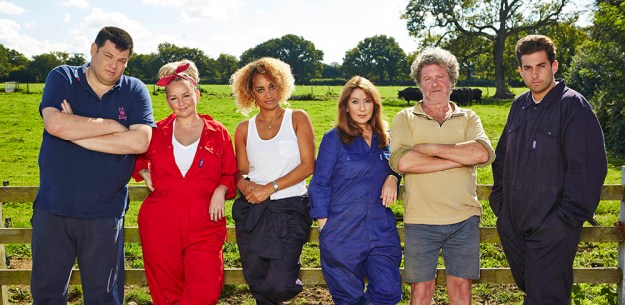
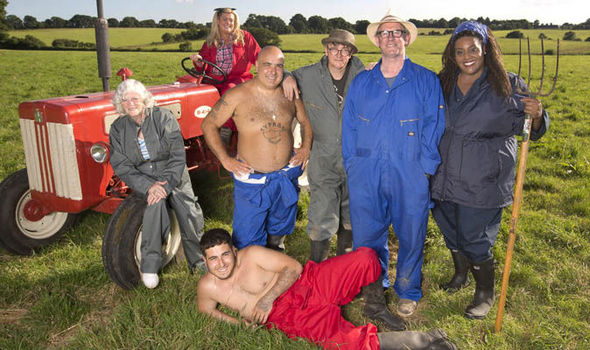
The cast from season one. At least they look clean.

However, I watched the first series of Sugar Free Farm (Tuesday, ITV) with interest.  I have developed an interest in living a sugar-free lifestyle over the past year and half. One of the problems with this is that the media is only now coming to terms with questioning historically inaccurate scientific research. As a result the information about sugar is entering the ‘mixed messages’ phase.

As with any change and any new way of thinking, education is key.  Unfortunately, statistics show that highest incidences of obesity tend to occur in areas where income and education are the lowest.

So how do we reach this particular demographic? Quite simply, it is through the medium with which they are often most comfortable: entertainment. People like Tony Robbins have used this  effectively over the years by creating an almost rock concert-like atmosphere in which he is able to get his message across.

Reviews of the show have not been overwhelmingly positive. Despite its good intentions, when trying to put an educational message across, it needs to be either shocking or completely hidden behind something more engaging. Failure to do that results in something that isn’t very entertaining and, dare I say it, just a little bit preachy.

The quality of the celebs is a huge factor as well. The fact I only know the one who used to be a politician says more about me than it does about the intended audience, but even I can realise a Z-list when I see one. Sorry, old Dr. Who, but it’s the truth.

sugar-free-farm-cast

But most importantly, the message gets lost because it is simply not relatable. I realise the show needs a central concept (getting back to the land and living unprocessed lives) but who has time to grind their own flour? Or shake up their own butter?

No one, that’s who.

I live a sugar-free life already and I rolled my eyes and switched off. It would be far better to provide the contestants with a store cupboard that was limited but contained readily available items. That way people could begin to imagine how it would look in their own homes. Instead, the message becomes that to quit sugar you need to quit life and never have fun again.

Watching a few random other people lose a bit of weight and play with pigs isn’t going to motivate you to those extremes.

I mean, does this make you want to change your life?

sugar_free_farm


Want to quit sugar anyway? Buy the book that’s more about making it work in real life than baking fake cake. 

therealistsguidetosugarfree-2

2017: New Year, New Goals, New Dreams

I’m not going to lie. During November and December I fell off so many wagons I couldn’t work out which one I wanted to get back on first. So I drank another glass of wine, enough cheese and crackers to sink a small boat and opened a box of chocolates instead.

But now that has all changed! By the mystical power of the calendar year flicking over, my willpower has returned and I am wholesome and virtuous again!

I wish.

I’m not sure I’ve ever been wholesome and virtuous. But I have begun to steadily correct course this week to get back on track. But where did it all go wrong in the first place?

I suspect much of it came down to illness and exhaustion. I failed to achieve a lot of things in 2016 because I felt worn out or ill most of the time. Listening to the Creative Penn podcast, it was great to hear another writer making health a priority in 2017. It is very easy to set ‘business’ type goals only. We’re taught how to focus on finance and career, but not necessarily spiritual or health goals. Last year was a harsh reminder of how if I don’t sleep and maintain a healthy lifestyle, eventually I’ll fail in other areas as well. I had two (because I’m a slow learner) fairly serious burnouts last year. I’m determined not to make the same mistakes again.

I’m tracking my sleep on my Fitbit and have once again begun the process of detoxing from sugar. I got a huge morale boost from seeing my book, The Realist’s Guide To Sugar Free at #2 in the kindle personal health charts in the first days of January. Hopefully I’ve been able to help a few people on their journey towards making the change too. Throw in a daily journaling and gratitudes practice and I can keep moving towards a physically and emotionally better me.

I’ve also challenged myself to read a book a week in 2017. With an English degree, I find it easy to read quickly, so the only excuse I have for not doing it is that I simply haven’t made it a priority. I have to hold myself accountable for that.

Mainly, I want to work on more exciting and challenging writing projects in 2017. I won’t give the numbers, but I have set myself a pretty hardcore stretch goal for increasing my writing income compared to 2016. Like health and reading, it will come down to prioritising and commitment. I’m good with that. When the 6am alarm sounded each day this week, I got up, got coffee and did the work. That’s how you achieve anything, right?

So those are some of my goals and plans for 2017. I want to get into a more consistent blogging schedule as well, to hold myself accountable to these things as much as anything. It also means I’ll get to share some tips and tricks I find along the way.

2016 was a terrible year generally, but with some major personal highs. I want 2017 to be the year to give back. To use my voice to make a change in the world when I can. That sounds lofty and ambitious. But if you haven’t been happy with the way things went politically in 2016 then you have to raise your voice. You have to do something. As Shonda Rhimes said, a hashtag is not a movement. Do something.

Subtle discomforts

I haven’t posted here for a while. As well as being very busy, there was a strange discomfort that I couldn’t quite put my finger on.

This morning, I realised what it was. I’d probably known all along, but I finally acknowledged it.

When I published my Sugar Free book, I decided to give Facebook a go, despite disliking it as a concept for years. Obviously, if you’re going to use it for marketing purposes, then it made sense to link my blogposts to it.

I still hated it. More importantly, its open door policy and spooky algorithm meant that everyone I may have ever known was being suggested to me in other places, such as my Instagram. Even people who I don’t want to be part of my life. It was like a sledgehammer of suggestions that kept poking sore spots.

So this morning I deleted my Facebook account. I’m under no illusions that it will make all the problems instantly go away. But I realised I don’t want the downsides it brings, no matter what the upsides might be.

It feels good. If something bothers you, then get rid of it, even if other people tell you it’s a ‘must have’ item. Trust your own instincts. They’re probably right about things more times than you realise.

Floating: why it is beneficial to my physical and mental health

Everyone who knows me understands that I inhabit a strange place between logical efficiency and unconstrained creativity. Essentially, this:

venn

In reality, I try to be efficient so I can get the things I must do out of the way as quickly as possible, so that I can enjoy the things I want to do. Like a lot of people, I frequently seem to slide down the slippery slope towards getting more done, rather than getting the right things done.

Luckily for me, just under a year ago, Time To Float opened up nearby. Before, I had travelled to London to float, but for anyone in the centre of the England, this is infinitely more convenient. So, why did I try it and why do I keep doing it?

1. Sleep

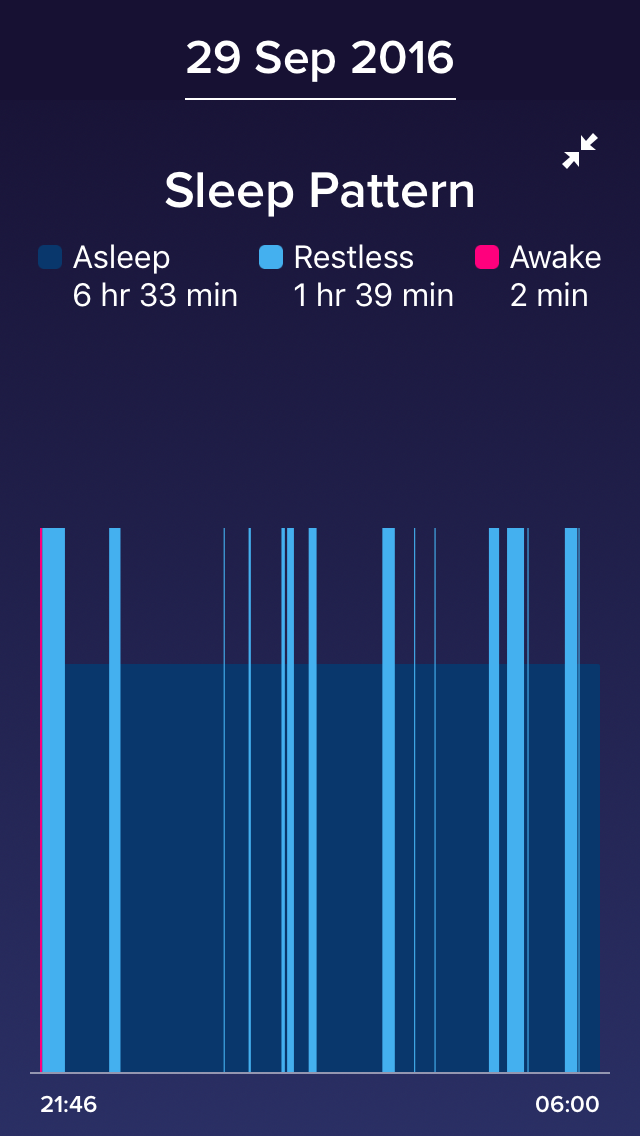
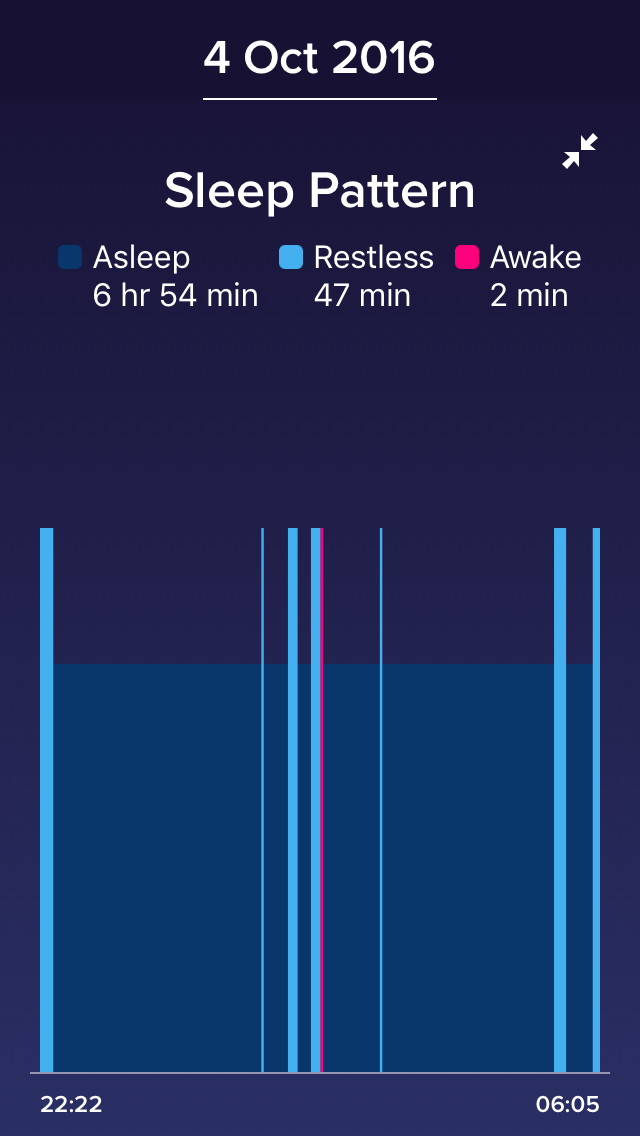
I’ve put this first, because it is the one I can actively measure. I’ve always ‘felt’ like I slept better after floating, but having recently started wearing a fitbit, I was interested to see if my gut feel actually resembled reality.

Apparently, it does:

img_1531  img_1530
I selected two nights, one from the week before floating and the second from the week after. Both had a similar amount of ‘total’ sleep. But you can see the quality of that sleep was markedly different. After floating I had prolonged periods of sleep without restlessness (the light blue bars that make the first picture look more like a barcode). This was really interesting to see and I’m glad it’s not just all in my head.

2. Physical Relaxation

The physical effect of floating is a strange one. At first, I find that it is like lying down on a really comfortable bed. Then I start to become aware of areas such as my neck and shoulders relaxing, letting go of a tension that I’ve simply become used to feeling. I try to use a standing desk at home, because prolonged periods of sitting during my workday makes the problem so much worse. Even doing that, I still find my shoulders tensing in response to any stressful scenario. Feeling that tension disappear is amazing.

Finally, when the session is over, trying to stand is almost hilarious. My body gets used to being weightless very quickly, so when my feet get back on the earth it feels like my limbs are made of lead. For a few moments you are aware of gravity in a way that can be achieved by little else. I tend to be a little zoned out for a while after and have to take advantage of the chill out area.

3. Creative/Strategic Thinking

Unlike sleep, this can’t be quantified with a chart. But I notice it every time, depending on what phase of life I am in. If I’ve been juggling multiple projects and can feel the beginnings of burnout and poor decision making, then floating allows me the clarity to get to the higher levels. Most people don’t apply strategic thinking to their daily lives, but I have no intention of getting to 80 and wondering how I ended up in a place I never wanted to be. The sensory deprivation may be a part of it. But it certainly works.

Alternatively, there are times when I just want to come up with new ideas. They may be for my writing, or they may be for other side projects. Sometimes I go into the session with a problem already in mind, giving myself a chance to really think about it in the silence. The aha! moment usually comes a few hours later, seemingly out of nowhere, but really from the freed up depths of my subconscious. Other times I am open to whatever my brain comes up with when it is allowed to do nothing but think. I’ve recently been reading Greg McKeown’s Essentialism and I can see how floating provides me with a fast track to getting that clarity. Although it is easy to understand the physical effects, the psychological ones are as profound.

So those are the key benefits of floating for me. There are many more that are important for other people, but these are the ones that have had a positive impact on my own life. If you think that could work for you, then definitely check it out.