Author Archives: sherrinicholds

Top 5 blogs of 2017 for creatives

I’ve got a few ‘top 5’ posts coming up to round off what has been an unusual and exciting year. One of the first subjects that came to mind was this one, the 5 blogs I have found most useful during 2017.

It was only as I started really thinking about what they were that I realised that actually, I’ve moved away from blogs as a resource. I’m not sure if this is a trend, or whether I’ve just had a change in circumstances. Instead of having favourite sites I return to time and time again, I’ve instead been more likely to search by subject and consume a variety of blogs I find. The chances of me returning to any specific site are slim.

Perhaps, unfortunately, it has something to do with how fake news (actual fake news, which is generally the polar opposite of what is being branded fake news) has got me second guessing everything. Instead of taking any one person or comapany’s view as truth anymore, I find myself always verifying sources. I suspect that 2018 will contain more of the same.

However, I did manage to find 5 blogs that I have returned to more than others. Unsurprisingly, these cover my main interests of writing, travel and how to stay productive and healthy.

 

The Creative Penn

Joanna Penn has quite the enterprise going now. There’s a lot of really useful information on the Creative Penn website and I find myself returning to it frequently. Bridging art and commerce, Joanna’s site is future thinking and always optimistic, no matter what craziness and uncertainty exists in the world. She’s making money from people wanting to be authors, but she’s up front about expecting money in exchange for valuable insights, rather than being a ‘get rich quick on kindle’ scammer.

Goins, Writer

Jeff Goins has made a career from writing about writing. When you look at his work about work it all sort of gets a bit meta, but there’s a lot of important takeaways included. The concept that actually, in today’s world we are moving away from a single-track career progression and into a varied career of diverse options, is something that has really resonated with me this year. As I look towards 2018 this site has been great at reminding me to keep my options open, embrace opportunities and ignore the imposter syndrome.

Chris The Freelancer

Admittedly I tend to watch Chris’s videos on YouTube more frequently than I visit his blog. He’s built quite the channel about working from a laptop while he travels the world. He was one of the first resources I came across while looking at the way the world is gradually turning towards a laptop, gig based economy. Unlike many digital nomad sources, he has a professional approach, steering away from the backpacker with a side-hustle content that forms much of the information out there.

Pick The Brain

The banners at the top of this site cover off all the things near and dear to my heart: motivation, productivity, health, self-improvement. It focuses on doing the things required to move you forward to a dream life, but isn’t all about the hustle. Productivity is great, but not as a way of doing even more so you can burn yourself out. Instead, a healthy momentum is the name of the game. Even when the information isn’t new to me, it always acts as a good reminder to stop and think.

Brain Pickings

Although it has a very similar title to the one above, it’s very different. With much longer pieces, it’s not full of snappy soundbites. There are no quick wins to take away here. Instead, the posts are more critical and philosophical. More academic, if you don’t mind me using that word. The insights are numerous, but you have to work for them. Honestly, in today’s world of short attention spans and instant gratification, I don’t think that’s a bad thing.
Moleskine vs Leuchtturm1917 Weekly Planner Review

For years, the Moleskine Planner in its various formats has been the ‘go to’ product for those wanting an analogue calendar/organiser. It was the brand I picked for 2017, because the layout worked great for me. The trade off, of course, came with the paper quality. You can check out the original review of the Moleskine Weekly Planner I did back at the beginning of the year.

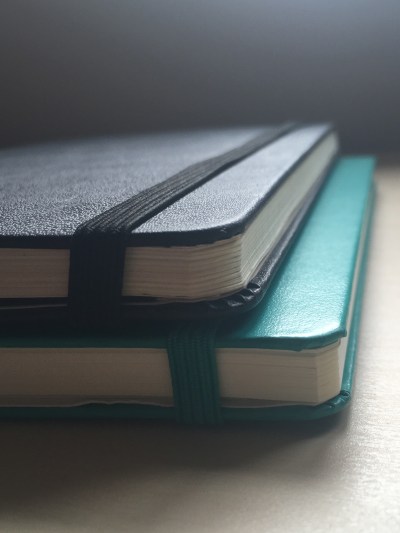
Molekine top, Leuchtturm bottom

For 2018 I have chosen to go with the Leuchtturm1917 Weekly Planner instead. As the two are very similar, I thought it would be useful to do a direct comparison for those people who are interested in trying a different brand.*

Paper Quality

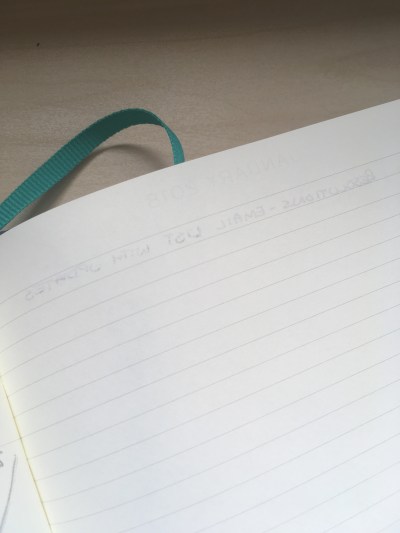
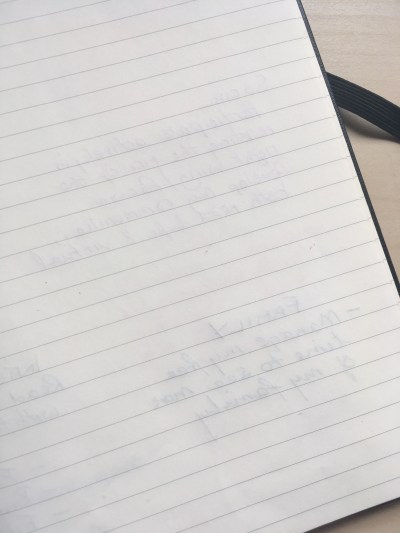
There’s no point avoiding the elephant in the room. If you want to write with fountain pens, the battle of Moleskine vs Leuchtturm in the planner selection is no different to the regular notebooks. Leuchtturm1917 paper wins hand down. Even gel pens show through worse on the Moleskine paper:

Moleskine paper

Leuchtturm1917 paper

Year Overview Sections

Moleskine bottom, Leuchtturm top

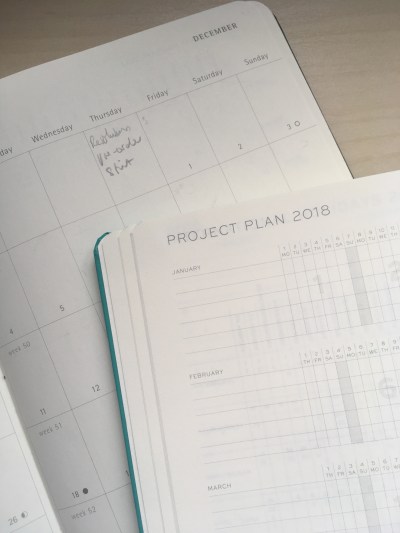
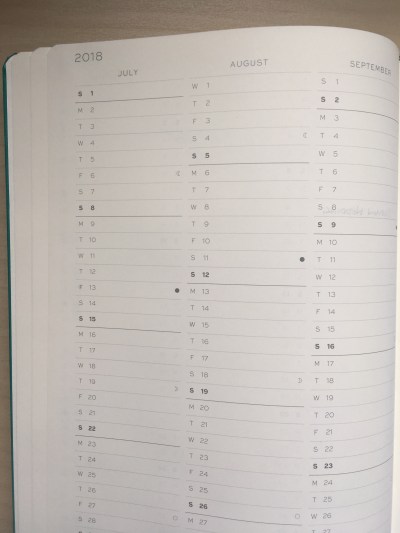
There is a difference in approach here. The Moleskine overview is closer to the project planner section in the Leuchtturm (more on that below). The ‘by day’ view in the Leuchtturm probably offers similar space, but is visually less useful to me:

Leuchtturm day overview

Weekly View

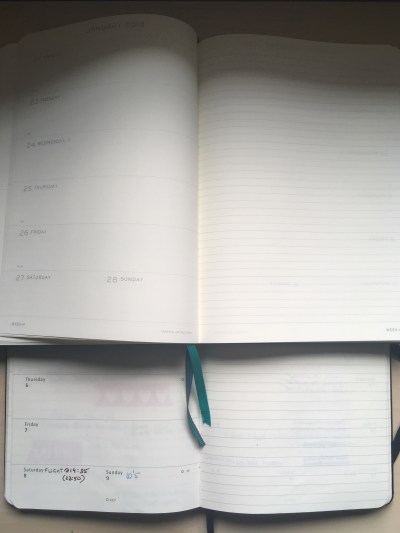
Both have the same format: days on the week on the left hand side, lined page for notes on the right hand size. Because of the extra width of the Leuchtturm, you get more writing space for both.

Leuchtturm top, Moleskine bottom

Blank Pages

Last year it really annoyed me that my Moleskine planner had four blank pages at the back. For a whole year? Impractical. Leuchtturm, by comparison, has ten. Still not a great number, but much more useful.

Bonus features

Leuchtturm has a project planner view of the month. For high level use, this is something I’m really looking forward to trying out.

My Moleskine planner is from 2017, but it no longer came with an address book. The Leuchtturm1917 planner for 2018 came with a separate address book (with a section at the front for listing birthdays perhaps?), as well as some stickers and a grid guide.

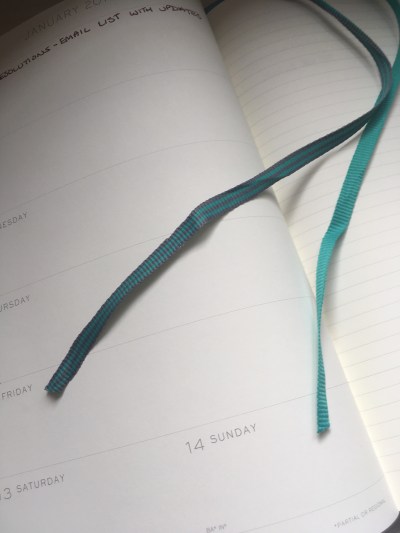
Leuchtturm – 2 bookmarks!

Bookmarks – Moleskine has one, Leuchtturm have two. I think two is significantly more useful, given the project plan feature. However, they are both a good length, rather than being less than an inch longer than the length of the book. Small thing, but it really bugs a lot of people when the bookmark is too short.

Moleskine comes with more information at the front. Flight durations, time zones, measurements and conversions. Useful in their own way perhaps, but I’ve not used them once, even when planning travel for the year.

On balance, I think the Leuchtturm1917 wins as a more functional planner. Better paper, more of it, two bookmarks and a project planner. However, you can’t downplay the form factor and brand recognition that comes with Moleskine.


*Not an affiliate link. As I’m in the UK I can get Leuchtturm1917 notebooks from Amazon, but in the US it seems harder. I’ve used Goulet for fountain pens though and they’re a great company to order from.

NaNoWriMo Prep: 30 days of staying healthy

As a significant number of people are about to launch into the writing insanity of National Novel Writing Month, I thought I would do a post not on writing, but on health.

As someone who has been doing NaNoWriMo for a long time (over fifteen years!), I’ve learnt some hard lessons along the way. So I thought I’d wrap them up into a single post so you can learn from my mistakes rather than making them yourselves.

Preparation


The best way to have a comfortable and healthy month is to prepare for it. Take the time to plan your novel (if you’re a planner rather than a pantser) but also take the time to prepare your writing environment. Your wrists and neck are going to be under some strain during November, so make your set up as ergonomic as possible. If you’ve only ever written 300 words a day before, then don’t expect to write 3000 and not feel a twinge or two the following day.

Clear your calendar of other events if you can, so you don’t end up with too many competing priorities.

Diet

Writing can be an absorbing pastime. You get lost in the world you’re creating. It can be fun to get to know your characters. So much fun that you look up and it’s a lot later than you realised. Time to grab a coffee and a quick snack and keep going, right?

Wrong.

Eating a proper diet and avoiding quick and easy junk food will give you enough energy to keep going long term. Don’t make November the month of sugar highs and carb crashes. Simple, healthy meals can be planned for in advance so they don’t cut into you writing time.

Hydration

No, I don’t mean drinking endless pots of coffee. Much as I love the stuff, don’t chug it to get you through that all night writing session. Drink plenty of water and other uncaffeinated, sugar-free beverages to stay sufficiently hydrated. I’ve found this is especially important if you’re doing an early morning session as it clears the fog of sleepiness very effectively.

Sleep

Talking of sleep, make sure you get some. Finding the time to write 50,000 words means finding a lot more hours during your day. Sacrifice TV and Facebook time, not sleep. Tiredness will make the whole process of writing slower and begin a vicious cycle of struggling to hit your daily word count. Try not to deviate too much from your existing pattern and if you know that’s currently a terrible one, then don’t allow NaNo to make it worse.

Exercise and rest breaks

As well as sleep, make sure to build in some exercise time and rest breaks. Not only will your wrists appreciate it, but your eyes will too. There have also been several studies highlighting the dangers of prolonged sitting, so make sure you get up and walk around. Set a timer or alarm if you have to. It might not seem easy to stop mid-flow, but it’s better than sitting for an extended period and risking blood clots and heart attacks in later life (a bit dramatic, I know).

Mental health

Doing NaNo can be hard on your physical health, but it’s not a walk in the park for your mental health either. The pressure to finish (often self-inflicted) can lead to some serious burn out. This is often exacerbated if you haven’t done the things above to work on your physical well-being. Remember, at the end of the day, NaNoWriMo is meant to be a fun and inspiring writing experience. It’s not meant to be soul destroying. Don’t win the month, only to never want to write again.

If you start to feel upset, frustrated or unhappy, then step away from the computer. Take a break. You can come back tomorrow, the next day or not at all. It doesn’t matter. Life is too short to be made miserable by an internet competition where the only prize is to be able to say you’ve done it…

Books for writers: Shadows Beneath (Writing Excuses Anthology) review

With NaNoWriMo only a week away, instead of my usual ‘book for entrepreneurs’ review, I thought I would focus specifically on a book for writers.

Most writers (aspiring and published) have read Stephen King’s On Writing. I love that book, but most of the engaging content is the autobiographical stuff, rather than the writing parts. So I thought I would take a look at a much more hands on, practical book: Shadows Beneath: The Writing Excuses Anthology.

The book was released in 2014 and often gets overlooked as being a short story anthology, rather than a practical guide to writing. It follows the writing process of the four main Writing Excuses hosts from story concept to finished work. Side note, if you’re a writer and haven’t checked out the Writing Excuses Podcast then go there now. It’s one of the best ‘craft’ podcasts out there in a realm of marketing ones.

The first part of the book contains the completed short stories. This means that those who aren’t interested in the writing process can just enjoy reading some quality fiction. For writers, it is the second part that is interesting: the ‘making of’ section.

For each of the stories, we can read a transcript of the Writing Excuses episode where they brainstormed ideas. For people who wonder where ideas come from, this is gold in itself. Then there is the first draft of the story, transcripts of workshopping discussions and intermittent drafts and commentaries from the authors. Finally, there is a version showing all the edits from the first draft to the published edition, full of cuts and additions.

So why read this book?

During NaNoWriMo, the idea is to take an idea and write. Write each day and get 50,000 words down by the end of the month. Editing has no place here. Often at the end, we are left with 50,000 words that need some pretty serious work. Shadows Beneath is a great way to see that even without these crazy time pressures, the first draft is never perfect. It can be hard to imagine that our favourite, successful authors struggle to write a first draft and that it often doesn’t work. It can be hard to believe they reach out to others and say ‘hey, I’m struggling with this and could use some help’. This book will teach lessons in craft and development, but it also shows the spirit of community and encouragement.

Which, when you think about it, has always been at the heart of NaNoWriMo.

You can buy Shadows Beneath: The Writing Excuses Anthology here. If you can, I’d recommend getting the print edition, as it allows you to flip back and forth much easier when following the revision process.

Writer Tools: Field Notes Dime Edition Review

One of the most difficult parts of being self-employed is constant self-motivation. As a writer, the easiest way for me to do this is to use tools that inspire me to pick them up. I’ve done some of my best work when I’m having the most fun just playing with my toys.

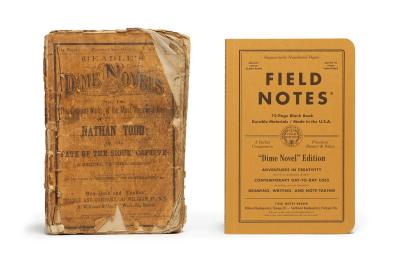
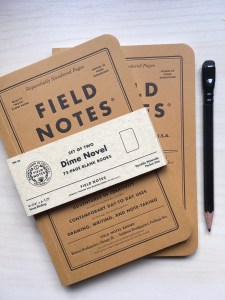
Field Notes Dime Novel Edition

The Field Notes Dime Novel Edition is a perfect, quirky writer’s tool. Inspired by the American Dime Novel (much like the British Penny Dreadfuls back in the day), it is a departure from the standard pocket notebook Field Notes is known for. I love that, despite being iconic in the notebook world, they continue to mix it up with their quarterly releases and not play it safe.

Instead of the usual 48 pages, there are 72 plain pages bound as three signatures. This creates a completely different look and feel to the standard ones, as well as giving more space to write:

Interestingly, the Dime Novel Edition has numbered pages, another departure from the usual Field Notes functionality:

Given the explosion of Bullet Journaling, more and more companies are incorporating the numbered pages into their notebooks. Even though I’ve been using a modified bullet journal method for years and would normally be super excited about this feature, for once it isn’t important because…

What will I be doing with mine?

I’ll be doing exactly what it says on the tin. There’s not quite enough space for a novel, but I intend to write out a short story in each of them. In one, I intend to use my coveted Blackwing 24 (The Steinbeck Edition). In the other, I plan to use one of my fountain pens loaded with J. Herbin Lie De Thé – a beautiful sepia toned ink that fits the aged theme perfectly.

As much as I appreciate the opportunities that the world of self-publishing has given me, it’s nice to be reminded that writing doesn’t always need to have an audience. It doesn’t have to be a book churn efficiency. Writing can be – and should be – fun first. I can’t wait to pen these stories for myself, written by hand in the cold winter mornings.

Main images in the post are courtesy of Field Notes Brand. Check them out.

You’ve got 12 weeks to complete your 2017 goals

12 weeks? Is that all?

I know, 2017 has sped by in a bit of a blur. However, there are still 12 weeks left to make progress on those goals you’ve spent the majority of the year procrastinating on. The good news is, with a bit of planning and forethought, that’s plenty of time.

Learn to think in 12 week years

If you’ve not read The 12 Week Year by Brian P. Moran then go and read it now. You can also check out my 12 Week Year Book Review post if you want to know more.

Prioritise

Okay, so 12 weeks is plenty of time to get things done, but it’s not enough time to get everything done. Work out which goals will give you the biggest impact and leverage then discard the rest. If you’ve not done anything about them so far, they can probably wait another few months anyway.

Engage

Don’t do anything you don’t care about deep down. If you want to make 2017 your best year ever, then do the things that will give you satisfaction and a sense of pride. Obligation and guilt are not the motivators here.

Plan, plan, plan

I don’t care if you do it in an app or on paper, but you need to write down a plan. Between now and the end of the year, social and family obligations shoot through the roof, there are holidays and for many of us, lots of shopping. Don’t pretend this won’t zap your time and energy. Open the calendar and plan the work.

Get specific. Plan the tasks that get you to the goal, not just vague references that make you feel like you’ve written without really having to think about it.

Execute

The hardest part of all. Now you have to act on those tasks you’ve defined. Each day, make sure that you’re working towards the goal, rather than getting distracted by lesser tasks that feel like work, but don’t actually get you anywhere.

Finish strong

Although the end of the year is approaching at break neck speed, it really isn’t too late to make it a great year for your productivity. There may be the temptation to put everything off until the New Year, but if you do, then you’ll find reasons not to start then either. Take the first few, small steps and the rest will follow. Plan the work, work the plan.

5 lessons learned since The Realist’s Guide to Sugar Free

It has been one year since I published The Realist’s Guide to Sugar Free. So much has happened since it’s almost hard to believe.

My goal in writing the book was to help people understand the dangers and extent of processed sugars being added to our lifestyle. So what have I learned in the year since?

As I’m a compulsive reviewer and improver, I sat down and came up with 5 key things.

1. Falling off the wagon is inevitable

Sugar free living is hard. Really hard. If it wasn’t, then I wouldn’t have written the book. Even with the knowledge and experience I have, in the time since I have fallen off the wagon more than once. So what do you do when this happens? You forgive yourself and learn from the experience.

There are two ways sugar creeps back in. External circumstances beyond your control make things difficult. Then there is personal choice/poor impulse control. The first often leads to a prolonged period of the second.

Unless you have total control over your food, then it is likely that you will encounter a processed meal or two. On its own, it can be fine. A few days of extended travel and it’s back to square one. Your body wants to continue eating the delicious food and the pull is irresistible. Sugar addiction is back in full swing and it takes dedicated effort to get back to healthy eating and stick with it.

So, you will slip up and you need to forgive yourself. Don’t beat yourself up, but put a plan in place to start again. Don’t keep listening to the voice that justifies one more cupcake.

2. Discipline begets discipline

The times when I have been most rigorous about being sugar free are the times when I have been on top of things in plenty of other areas too. Sloppy behaviour has a way of spilling over and the opposite is true.

I’m not saying that going sugar free is the key to solving life’s problems. However, if you want to begin a cycle of self-improvement, pick one cornerstone habit and allow yourself to build from there. For me, that is the physical health that I have always found easier to put on the back burner.

3. ‘Big Food’ is already taking advantage of us

Several well known personalities, especially in the UK, have begun to promote the benefits of a reduced sugar lifestyle. Governments are discussing sugar taxes and health providers are finally coming round to the dangers of sugar, rather than a blanket ban on fats. With increased awareness, you might think that we’re getting closer to an easier shopping experience.

You’d be wrong.

Processed, cheap food is about making profit, and marketing is about making more profit for the same experience and calling it a lifestyle. Big Food marketing to undermine consumer’s attempts at sugar free that I’ve already seen includes:

  • X% less sugar than before! Yes, you’ve made it X% smaller and are still charging me the same price (or more, blaming Brexit). Nice try.
  • Only natural sugars! Yes, you’ve started using fruit sugars instead, but your sugar content is just the same. A particular favourite when it comes to children’s snacks.
  • Sugar free/zero sugar! This takes advantage of the increased desire for sugar-free food, whilst still containing a tonne of the worst kinds of artificial sweeteners. 

4. I want to help people, even though I’m an antisocial introvert

More of a personal one, but worth mentioning. A huge surprise has been the enjoyment I’ve had from people reaching out to me for help. I don’t always have the answers, but I love to point people in the right direction. So if you want to help people, don’t think the only way is to become a keynote speaker or ‘in person’ counsellor. The world always needs more positivity and compassion and this can be done in a million tiny ways.

5. Education is key

I’ve been contacted by people all over the world and it is clear that understanding the ingredients of your food is hard. Food labelling still has a long way to go. Manufacturers will not make it easy.

‘Serving size’ is frequently misleading and makes it hard to calculate % sugar (a particular problem in America, although much easier in Europe). ‘Added sugars’ can refer only to the white stuff, rather than fruit sugar syrups. The phrases ‘healthy’ and ‘low sugar’ are poorly defined and frequently unregulated, making it easy to mislead the consumer.

I’m not going to lie, constant vigilance is exhausting. It’s a long road ahead, but we’ll get there.

Several people have asked for the book to be updated to include recipes. The reasons there aren’t any there already are quite simple. Firstly, I’m no chef. Secondly, people want recipes in cookbooks to be interesting and beautiful. Going sugar free is mainly about mastering the mundane, everyday foods. However, if there is an updated revision, then I will consider including some.

Until then, you can of course sign up to get the first week meal plan I’ve followed to get back on the wagon when I’ve fallen off. It’s basic, but it works for me.

Seasons – Planning Life Alongside Nature

For us in the northern hemisphere, there is no denying the change in the air. Summer is giving way to autumn (or fall, if you want to be all American about it). The kids are back at school. All the upcoming holidays now have an ‘end of year’ feel to them. For those in the southern hemisphere, the reverse is true. Spring is coming and summer will be here before you know it. Time to hit the beach and get outdoors.

It was whilst living in New Zealand that I realised for the first time how productivity and personal development have seasons of their own, often very much inline with nature. Perhaps it was because all my online inputs were largely presenting an experience that was the reverse of the one I was living through. What I did realise was that as the rains came (I was living in Christchurch, there was lots of rain), it became harder to stay motivated and geared up for new projects all the time.

Any productivity guru worth their salt will tell you that you don’t need to wait for the New Year to make a change. Or that every day is a fresh start. It’s all very true. I just think it becomes harder if you try to do it out of sync with the world around you.

Many people live online so much that it makes it easier, in a strange sort of way. When you never leave the house, it’s easy to forget what is going on outside. I know the temptation of the laptop as much as anyone else. Nevertheless, it can contribute to a feeling of burnout when there is no variation, just the non-stop hustle and grind of daily life.

Right now, I am taking a mini-break to plan the remainder of the year. I wanted to be somewhere different, somewhere much closer to nature, to remind myself of this idea. As the days get shorter, it will become harder to get out of bed each morning. The evenings will seem made for curling up under blankets with a good book, not hitting the gym or high intensity projects. I need to remember this so that I don’t fill my days with things I won’t achieve. I don’t like breaking promises to anyone, least of all myself.

So, over the next few weeks when you begin to see articles and blogs reminding you that ‘It’s not too late to win the year!’ and ‘make that final quarter count!’, remember that life is meant to have periods of recovery and renewal. If you’ve left it until nature begins to shut down, then it might be time to consider a different approach next year.

Of course, for those of you in the southern hemisphere, it’s time to get up and at ‘em.

Books for entrepreneurs: Tools of Titans review

Tim Ferriss does not know how to write short books. Don’t let the fact his paperback versions could be used to bludgeon someone to death put you off. He’s a master of the soundbite.

He’s just collected more of them than anyone else.

Tools of Titans is a fantastic book for anyone who wants to try life-hacking. It works because it doesn’t expound a single point of view. Instead, Tim has interviewed hundreds of top performers and asked them what they do. As he says, it’s all in asking the right questions:

“What do these people do in the first sixty minutes of each morning? What do their workout routines look like, and why? What books have they gifted most to other people? What are the biggest wastes of time for novices in their field? What supplements do they take on a daily basis?”

Of course, this results in some contradictory approaches. But it never seems like he is doing this to cover all bases and therefore always be right. Instead, it’s clear how certain techniques suit different personality types, or specific sets of circumstances. This allows you to cherry pick the ones that work for you. And if they don’t work, a quick flick through the book and you’re sure to come up with a Plan B.

The book itself is divided into three broad sections: healthy, wealthy and wise. There is fluidity between them all, as certain tips and tricks can be applied effectively in all three life areas. It gives the book a sense of structure though that allows you to start where you need the most help. Tim’s writing voice is quite distinctive, so if you don’t gel with his podcast style, you might struggle with reading. I find him to be a highly engaging speaker, so I went through all 674 pages in a week. Most sections contain direct quotes from his interviewees, so there is plenty of variety to keep your brain engaged.

This is one of those books I would recommend without hesitation to anyone who wanted to level up their life. If you’re looking for productivity tips, diet and exercise hacks, habits and routines, meditation and yes, even raw and candid advice for those who are depressed to the point of suicidal, then this is the book for you.

You might even find the thing you didn’t know you really needed along the way.

You can buy Tools of Titans on Amazon and all other good retailers. For more information about Tim and his work, check out toolsoftitans.com

Why the 45,000 pound sugar mountain wasn’t what it seemed

In today’s post-fact society, always read the label

Last week, a huge mound of sugar appeared in Times Square. This piece of educational art was installed to drive home the point that in America, every five minutes children consume 45,485 pounds of added sugar.

That’s a lot of sugar.

I’m all for promoting the dangers of sugars added to and hidden in food. But it did raise the question: who exactly were they trying to educate? What was really the message here?

I’ve been to Times Square. I love it. It’s hustle and bustle and, dare I say it, prime marketing real estate. This installation highlighting the dangers of added sugar comes not from any educational or government body. Nope, it comes from a food manufacturer.

KIND have a message that’s hard not to get behind. From their website:

“We believe if you can’t pronounce an ingredient, it shouldn’t go into your body. Actually, it shouldn’t even go into your pantry. KIND® products are made from nutritionally-dense ingredients like whole nuts, fruits and whole grains – no secret ingredients and no artificial flavors, preservatives or sweeteners.”

However, this is where I get really frustrated with food companies being disingenuous when it comes to promoting healthy food. It’s true that the added sugar consumed by children is way above where it should be and where most parents probably believe it to be. But for many people, it is precisely the types of snacks made by KIND that cause the confusion. They’ve just launched a new range of snacking products, Fruit Bites. Let’s look at the description for the Mango Pineapple Apple version:

Our Mango Pineapple Apple Fruit Bites are made from only 3 simple ingredients and give you a delicious tropical fruit snack in every bite. We don’t use fruit juices, purees, concentrates or preservatives – so you can enjoy a fruit snack that’s actually made from real fruit. And with no sugar added and 1 full serving of fruit per pouch, it’s the perfect lunchbox snack.

Real fruit! That elusive serving! Perfect for the lunchbox! What parent trying to do the right thing wouldn’t go for that? However, let’s look at the nutrition label. Again, from their website:

Whilst it contains no added sugars, it still contains 11g per pouch of natural sugars. Which are, make no mistake about it, still sugar. At an 18g serving, that’s around 60% sugar.

Always be suspicious of marketing, especially when the message is wholesome and healthy. Even more so when that message is aimed at your kids.