Evolution is, perhaps, the wrong way to describe it. The phenomenon that is the bullet journal method is slowly coming full circle, leading us all right back to where it started.
As I’ve discussed before, I was a relatively early adopter of the system. I know I was using it at a job that ended in December 2013. Given that Ryder Carrol launched the Bullet Journal website in August 2013, I must’ve been one of the first people climbing aboard that waggon. Plus, it led me to the Pen Addict podcast, which allowed me to rekindle my love affair with all things analogue.

Above all, I found it because it was a productivity tool. A system to better manage my To Do list. Although I’d been using a digital task manager for my personal life and a GTD style spreadsheet for my work tasks, when the proverbial hit the fan, I always grabbed a pen and made a paper list. Five years later, things are still the same. A handwritten list allows me to focus on what is truly important, rather than scrolling through lists of next actions throughout the day and wearing myself down with decision fatigue.
Then, at some point, bullet journaling and Instagram collided. The emphasis on actual productivity became muddied. Yes, there were things to do on people’s lists, but no growth once things got under control. People who had come to the system because they needed to manage their overwhelm had everything in one place at last, but the twins of effectiveness and efficiency were nowhere to be seen. This is, of course, a gross simplification and uses broad brush strokes, but when your productivity system becomes an art portfolio with token tasks, then it’s missing the point (unless you’re an actual artist). Underneath the bujo hashtag is a mind-blowing array of beautiful images.

No one’s bujo looked like mine. Four things to do each day and space for a beautiful sketch? You’re living the dream then. A day with only four things for me to do is a lazy weekend day. And with it the bitter, mostly envious thought of well if you spent less time drawing perfect layouts, you’d actually get more done. This is not necessarily true, but the images of weekly spreads across the various social media sites made it difficult for anyone new who didn’t want that element to feel like they could do it. It can be demoralising as much as it can be inspiring.
Not to mention that all those pretty accounts led to a wrongly perceived gendering of ‘how’ to bullet journal. I couldn’t imagine someone going into a boardroom meeting with all those pastel shades and flowers and being taken seriously. The culture we live in would, sadly, make one of two assumptions. Firstly, if it was a man, he would be mocked endlessly for his girliness. If it was a women, then she clearly isn’t as focused and capable as a man. I’m not saying it’s right, but it’s the world we live in until we make progress in making it better.

Yet the system is perfect for that environment. Writing by hand removes the perception that you’re secretly checking your email, which happens when you take notes on a laptop. A well-organised and maintained system allows you to easily flip through to previous meetings and related collections. Your actions and waiting fors are captured quickly so nothing gets lost. The act of capturing the notes themselves stops you from zoning out when that powerpoint presentation hits slide twenty.
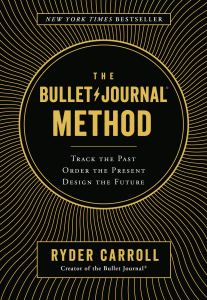
So the bullet journal is at a point of reckoning. Ryder is an astute businessman and creative, so was prepared for this moment already. His book, The Bullet Journal Method, takes it gently back to where it began – a productivity tool. The emphasis is what made it attractive in the first place: it’s not about getting more in your system, it’s about focus on what matters.
So, the bullet journal breaks down to this:
- As long as your notebook is something you want to engage with, it doesn’t need to be a work of art
- A notebook that comes with an Index and numbered pages does half the work for you
- You don’t need to do everything – keep the parts of the system that work for you
- You can use a bullet journal in conjunction with digital tools – it’s not sacrilege to use an online calendar
- The bullet journal is a methodology that plays well with others – you don’t have to abandon GTD or personal Kanban to use it
- You don’t need an expensive notebook and pen (although I prefer them)
- It doesn’t have to be a specific, larger size format that you see most often depicted – I apply the same principles to my pocket notebooks

 Sherri Nicholds